
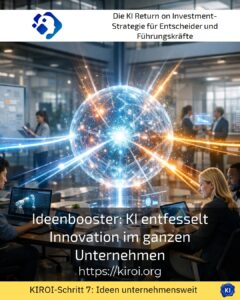
Imagine your team developing groundbreaking concepts within just a few hours that could sustainably change your company. The Leadership Ideation Workshop: Unleashing Team Innovation This space offers just the right environment for creative development and strategic thinking. Many leaders report that their best ideas didn’t emerge in a quiet corner, but in the dynamic exchange with their team. But how do you activate and sustain this creative energy in a sustainable way? This question concerns decision-makers in almost all sectors of the economy, and the answers are more diverse than you might think. In this article, you will learn which methods have proven themselves in practice and how you, as a leader, can become the catalyst for innovation.
Why creative thinking spaces have become indispensable
The working world is changing rapidly. Companies are under considerable pressure to adapt. Traditional hierarchies alone no longer provide sufficient impetus. Employees today expect to be included and to actively participate in shaping the future. This development makes new formats for structured idea exchange necessary.
For example, a medium-sized machine engineering company from southern Germany realized that its product development was stagnating. The engineers were working very efficiently, but radical innovations were lacking. Only the introduction of regular creative meetings brought fresh wind into the department. A similar experience was made by a logistics service provider, whose managers suddenly brought in optimization proposals through moderated workshops that no one had expected. Similar effects are also being seen in the financial sector, where teams from the day-to-day business step out and consciously get time for strategic thinking.
The Leadership Ideation Workshop: Unleashing Team Innovation It does not function as a one-time event, but as a continuous process. Clients often report that the first sessions are initially bumpy. Participants must learn to abandon habitual patterns of thinking and become open to unconventional approaches. This learning process requires time, patience, and professional guidance.
Methods that let the creative spark flow through
Various techniques have proven particularly effective in practice. Design Thinking, for example, enables a structured approach to complex problems. Teams go through several phases, from needs analysis to prototyping. This method is used by technology companies as well as by craft businesses that want to rethink their services.
Brainstorming sessions often serve as the starting point for initial brainstorming sessions. However, simply gathering ideas indiscriminately is not enough. The subsequent structuring and evaluation determine the actual benefits of such sessions. One pharmaceutical company combined classic brainstorming with the Six Thinking Hats method and achieved remarkable results in developing new sales strategies. Similarly, a retail conglomerate used the Walt Disney method, in which dreamers, realists, and critics successively contributed their perspectives. In the restaurant industry, on the other hand, World Café formats proved effective, in which employees in different constellations develop ideas.
Best practice with a AIROI customer
An international automotive supplier company turned to transruptional coaching because its internal creative processes were not delivering the desired results. The management felt overwhelmed, while at the same time they had to ensure operational excellence and create room for new developments. Together, we first analyzed the existing structures and identified several bottlenecks that hindered the creative flow. Subsequently, we developed a customized workshop concept that was specifically tailored to the company culture and took into account the specifics of the industry. The management learned how to act as moderators themselves and encourage their team to think more freely. After six months of intensive coaching, the company recorded a significant increase in the number of actionable improvement suggestions from the workforce. What was particularly remarkable was that even reticent employees began to get actively involved and contributed valuable perspectives that had previously remained untapped.
The role of the leader in the idea workshop for leaders: Unleashing innovation in the team
Leaders play a crucial role in shaping the success of creative processes. Their attitude determines whether employees are willing to express unusual ideas. An open mindset is essential. At the same time, leaders must learn to take a step back and create space for others.
In an insurance company, it became clear how strongly the presence of the management influenced the discussion atmosphere. Initially, the employees held back from making critical remarks. Only when the executives consciously assumed an observer role did the doors open. We observed similar dynamics in a media house where younger editors initially hesitated to challenge established formats. We also frequently observe in the construction industry that supervisors and construction managers hold back valuable practical experience when they sense dominant hierarchies.
Transruptions coaching helps leaders understand and manage these sensitive processes. We provide guidance on how to structure meetings without stifling creative energy. It’s not about patent recipes; it’s about individual solutions that suit the specific organization.
Overcoming obstacles and using resistance productively
Not everyone welcomes new working formats enthusiastically. Skeptics are present in every team. However, labeling these people as obstacles would be a mistake. Often, critical voices possess valuable experiences and realistic assessments that can protect against missteps.
One energy provider experienced that long-standing employees initially reacted skeptically to workshops. They had already experienced several change initiatives that failed. Only when management could present concrete examples of implementation, the mistrust subsided. In the textile industry, we observed similar patterns among experienced production managers who initially clung to proven procedures. The telecommunications industry, in turn, often struggles with the phenomenon that technical experts perceive abstract creative exercises as a waste of time.
The key lies in transparent communication. People need to understand why changes are necessary and what personal benefits they can derive from them. Transruptive coaching helps organizations communicate these connections in a comprehensible way and turn resistance into constructive energy.
Optimizing spatial and temporal frameworks
The environment influences creative processes more than is often assumed. Sterile conference rooms with long tables and fluorescent lighting rarely encourage innovative ideas. On the other hand, unusual places can generate surprising impulses and break through established patterns of thinking.
A business advisory firm moved its strategy meetings to a historic factory hall and immediately saw better results. The unfamiliar atmosphere encouraged associative thinking. A software developer, meanwhile, used walks in the green for brainstorming and found that movement stimulated thought flow. Even in the rather conservative legal sector, progressive law firms are now experimenting with creative space concepts to redesign client meetings and internal discussions.
The time frame is equally important. Creativity cannot be forced between two deadlines. Sufficiently long timeframes without interruptions are essential. Many companies underestimate this aspect and are surprised by meager results.
Best practice with a AIROI customer
A long-established family business in the food sector faced the challenge of modernizing its product range without alienating its loyal customers. The management realized that fresh perspectives were necessary and asked transruptions-coaching for support in designing a multi-day creative workshop. Together, we developed a format that brought together experienced product developers with young talents from marketing and deliberately created space for unconventional ideas. The event took place outside the company premises to create mental distance from the day-to-day business and to break the participants out of their habitual surroundings. The results exceeded all expectations, as several product concepts emerged within three days, which have now been successfully launched on the market. What was particularly pleasing was the positive response from the workforce, who felt valued and included by the new format. The company has since held comparable events half-yearly and has firmly established creative collaboration as part of its culture.
Sustainable embedding of creative processes in the daily work of the company
Unique workshops often fail to have an impact. Real change requires continuous effort. Companies must create structures that allow and promote ongoing creative exchange. This starts with regular meetings and extends to adapting evaluation systems.
For example, a chemical company integrated innovation time into the job descriptions of its researchers [1]. Each employee is allowed to spend a fixed percentage of their working time on self-initiated projects. Similar models exist in the IT industry, where hackathons and innovation labs have become the norm. Even in the traditional craft industry, there are now companies that allow apprentices to dedicate time to experimental work, achieving remarkable improvements in the process.
The Leadership Ideation Workshop: Unleashing Team Innovation It has to become part of the company’s DNA. For that, role models are needed at all levels of the hierarchy. Leaders who remain curious themselves and see mistakes as learning opportunities inspire their teams far more than any motivational speech.
My AIROI Analysis
Systematic promotion of creative processes presents a significant challenge for many organizations, but at the same time offers enormous potential for sustainable growth and competitive advantages. From my consulting practice, I know that successful companies are not innovative by chance; they have consciously created structures that favor and reward creative thinking. The role of the leader is fundamentally changing from decision-maker to facilitator, which for many managers represents an unfamiliar position. Transruptive coaching accompanies leadership personalities in this transformation and provides insights on how to achieve change without jeopardizing the operational business. Clients often come to us with the topic of cultural change because they feel that technical solutions alone are not enough and that the human factor is crucial. The investment in creative spaces pays off in the long run, as numerous examples from a wide variety of industries prove, and in an increasingly volatile economic world it becomes an indispensable factor of success. Organizations that set the right course today will reap the fruits of their efforts tomorrow and emerge strengthened from the change processes. The time to act is now.
Further links from the text above:
[1] Harvard Business Review – Innovation Management
For more information and if you have any questions, please contact Contact us or read more blog posts on the topic Artificial intelligence here.









 Deutsch
 English (UK)