
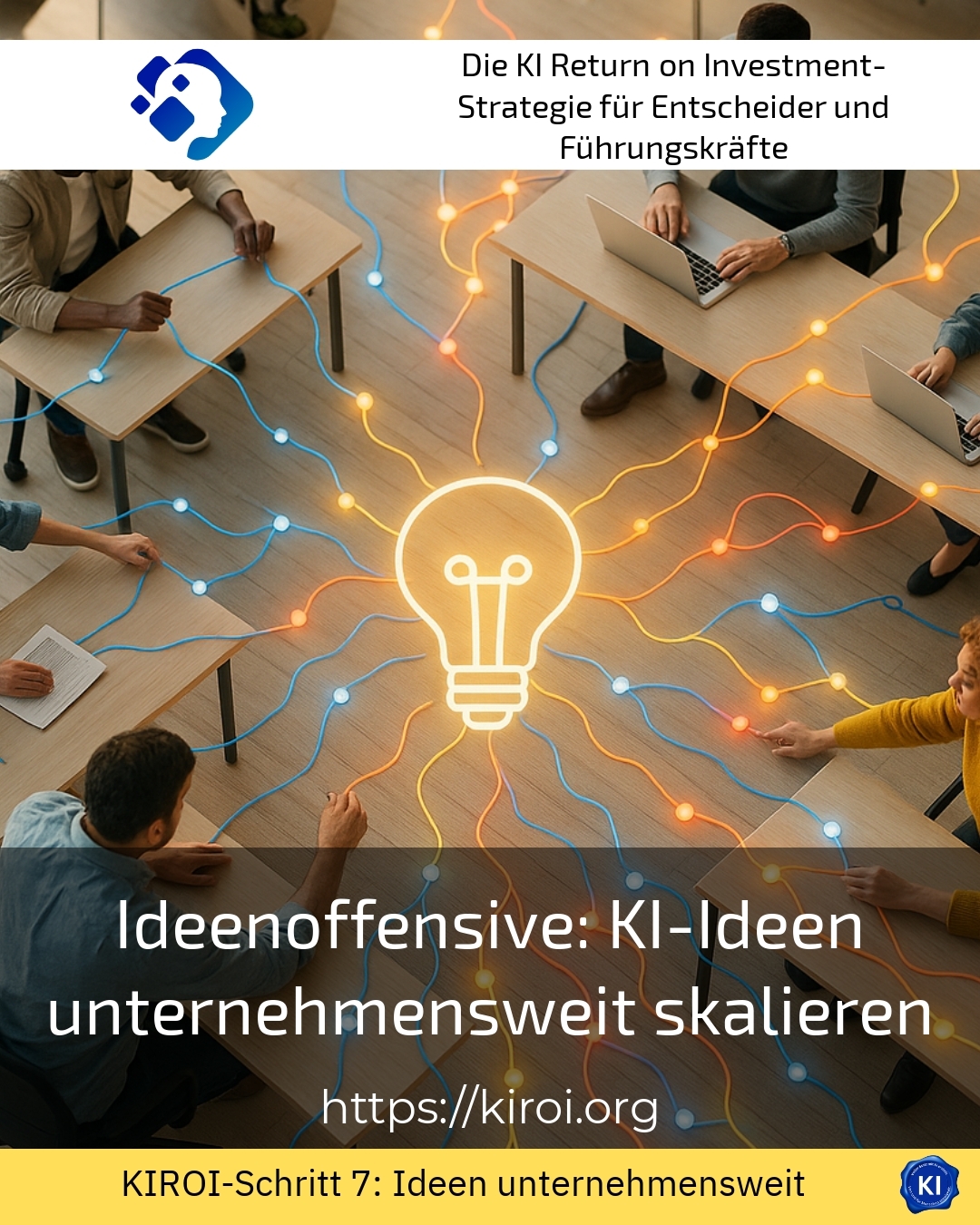
Imagine hundreds of brilliant minds exist within your company, yet their innovative thoughts never see the light of day. These hidden treasures lie dormant across departments, locations, and hierarchical levels, while competitors have long since harnessed the power of collective intelligence. Ideas Offensive: Scaling AI Ideas Company-Wide represents a paradigm shift that unleashes precisely this potential. Companies that systematically collect and intelligently evaluate suggestions gain a decisive advantage. But how can the leap from individual lighthouse projects to comprehensive transformation be achieved?
Why traditional innovation processes are reaching their limits
Many organisations still rely on traditional innovation workshops and rigid suggestion schemes. While these methods may appear tried and tested at first glance, they suffer from fundamental weaknesses. Employees often feel unheard because their submissions get lost in bureaucratic processes. Furthermore, there is often a lack of transparency regarding what happens to submitted concepts. The result is declining motivation and missed opportunities. The digital age demands more agile and intelligent approaches. Artificial intelligence can act as a catalyst, systematically capturing, evaluating, and prioritising ideas [1]. This creates dynamic ecosystems instead of static idea graveyards.
This problem is particularly evident in manufacturing companies. Plant managers report improvement suggestions that remain unprocessed for months. Engineers develop optimisations for production lines without them ever being evaluated. Quality assurance teams identify process weaknesses that nobody systematically addresses. This situation frustrates dedicated specialists and costs hard cash.
The Ideas Offensive: Scaling AI Ideas Company-Wide as a Strategic Imperative
A well-thought-out strategy for scaling algorithmically supported innovation processes begins with a clear commitment from senior management. Management teams that view such initiatives as mere IT projects regularly fail. Instead, a cultural integration is needed that understands every single employee as a source of innovation. Transruption coaching supports companies in shaping this transformation holistically. This creates spaces for experimentation where mistakes are considered learning opportunities. The technological component merely forms the backbone of a much broader change.
For example, mechanical engineering companies use intelligent platforms to capture maintenance optimisations from the field. Chemical corporations collect suggestions for improving laboratory processes via digital channels. Logistics providers aggregate route optimisations from drivers in real time. These examples illustrate the enormous range of applications for cross-industry innovation platforms.
Best practice with a AIROI customer
A medium-sized company in the precision manufacturing sector faced the challenge of preserving the knowledge of its experienced workforce while simultaneously generating new ideas. Management recognised that valuable optimisation ideas lay dormant in the minds of machine operators, but were never documented. Together, we developed a digital ecosystem that captures suggestions via mobile devices and categorises them using algorithmic analysis. The platform automatically assesses submitted concepts based on feasibility, cost reduction potential, and strategic relevance. Within six months, the company recorded over four hundred submitted improvement suggestions, more than sixty of which were directly implemented. Particularly noteworthy was the participation of long-serving employees, who were able to contribute their experience in a structured manner for the first time. The annual savings from implemented ideas exceeded the investment costs sevenfold. This project illustrates how systematic approaches can unlock hidden potential.
Technological bases for the ideas offensive
The technical implementation of a company-wide innovation initiative requires careful planning. Central platforms must be intuitive to operate to ensure acceptance. At the same time, they need powerful analytical functions in the background. Natural Language Processing enables the automatic categorisation of submitted text contributions. Machine Learning algorithms identify patterns and connections between different suggestions. Predictive Analytics forecast the potential impact of individual initiatives [2]. These tools support decision-makers in prioritisation without replacing human judgment.
Manufacturing companies often integrate such systems with existing Manufacturing Execution Systems. Process industries link innovation platforms with quality management software. Automotive suppliers create interfaces to product development databases. This integration avoids isolated solutions and maximises added value.
Cultural prerequisites for successful scaling
Technology alone does not guarantee success when scaling innovative concepts. Rather, it is the company culture that determines whether such projects succeed or fail. Psychological safety forms the foundation for all creative development. Employees must be able to trust that unconventional suggestions will also be valued. Leaders play a crucial role-model function in this regard. They must themselves contribute ideas and deal constructively with criticism. Transruption coaching sustainably supports precisely these cultural transformation processes.
Workshops frequently report initial scepticism among their commercial employees. Shift workers fear jeopardising their own jobs through automation suggestions. Quality inspectors hesitate to question established testing procedures. Maintenance teams are reluctant to challenge tried-and-tested maintenance routines. Taking these concerns seriously proves to be a decisive success factor.
Ideas offensive: Scaling AI ideas company-wide through incentive systems
Effective incentive systems intelligently combine material and intangible components. Financial bonuses for implemented improvement suggestions show short-term effects. However, recognition and opportunities for creative input are more sustainably motivating in the long term. Innovators should be involved in the implementation of their own ideas. This involvement strengthens ownership and promotes continuous engagement [3]. Gamification elements can provide additional impetus without overemphasising the competitive aspect.
Manufacturing companies are experimenting with innovation budgets for individual departments. Engineering firms are establishing hackathons for focused idea development. Assembly plants are introducing monthly innovation awards. These diverse approaches demonstrate that no universal recipe for success exists.
Best practice with a AIROI customer
An internationally active group in the field of industrial automation wanted to systematically increase its innovative strength. Until now, the various sites had been working largely in isolation on similar challenges. Synergies remained unexploited, and duplication of work wasted valuable resources. Together, we developed a cross-site platform for exchanging technical improvement ideas. Algorithms automatically identify thematic overlaps between submissions from different sites. The system suggests collaborations between employees working on related issues. The multilingual functionality proved particularly valuable, automatically translating and making suggestions comparable. Within a year, over twenty cross-site improvement projects were initiated that would have been unthinkable before. Employee satisfaction in relevant survey dimensions increased measurably. This example impressively illustrates the potential of networked innovation approaches.
Implementation strategies for sustainable scaling
Introducing a company-wide innovation initiative requires a phased approach. Pilot projects in selected areas enable valuable learning before the rollout. Both technology-savvy and sceptical departments should be involved. This mix provides realistic insights into adoption hurdles and success factors. Change management accompanies the entire process and proactively addresses resistance. Transruption coaching supports leaders in guiding their teams through the change.
Manufacturing companies often start with pilots in the work preparation department. Process industries frequently choose laboratory environments for initial tests. Logistics operations typically begin in the planning department. These starting points offer manageable complexity with high demonstration potential.
Measurability and continuous improvement
Successful scaling requires clear metrics and regular measurement of success. Quantitative metrics include the number of submissions, implementation rates, and measurable savings. Qualitative indicators capture employee engagement, innovation culture, and knowledge sharing. This data allows for evidence-based adjustments to the strategy. Feedback loops close the circle between idea generators and decision-makers. Transparency about successes and failures strengthens trust in the entire process [4].
For example, toolmakers track saved setup times through implemented suggestions. Chemical companies measure reduced scrap rates after process optimisations. Machine manufacturers quantify shortened development times through collective intelligence. These metrics create visibility for the initiative's value contribution.
The Innovation Offensive: Scaling AI Ideas Company-Wide as a Competitive Advantage
Companies that systematically leverage collective intelligence are positioning themselves for the future. They react faster to market changes and make more effective use of internal knowledge. Employee retention increases because people experience themselves as creators rather than implementers. At the same time, a continuous stream of improvements is generated, creating cumulative competitive advantages. The ability for organisational self-renewal becomes a core competency. This transformation requires patience, investment, and consistent leadership.
Manufacturing companies use aggregated improvement suggestions for strategic technology planning. Engineering firms develop new service offerings from employee ideas. Manufacturing companies discover new business areas through internal innovation. These examples demonstrate the transformative potential of systematic innovation approaches.
My AIROI Analysis
The systematic scaling of algorithm-supported innovation processes represents a fundamental shift in corporate management. My experience from numerous advisory engagements shows that technological excellence accounts for only about thirty percent of success. The remaining seventy percent are attributable to cultural factors, leadership behaviour, and change management. Companies regularly underestimate the effort required for the human side of transformation. At the same time, they often overestimate the complexity of the technical implementation. Organisations that address both dimensions equally and think long-term achieve the greatest successes.
The authentic involvement of management in such initiatives seems particularly important to me. Managing directors who submit ideas themselves and communicate transparently about their evaluation send powerful signals. This role model function cannot be delegated or replaced by communication campaigns. Furthermore, I observe that successful companies invest in the qualification of their employees early on. People not only need platforms but also the skills for structured idea development. Transruption coaching supports these multi-layered transformation processes with a holistic approach. Ultimately, it is about enabling organisations to permanently unlock their own potential.
Further links from the text above:
[1] McKinsey: The Economic Potential of Generative AI
[2] Harvard Business Review: Artificial Intelligence Insights
[3] Gartner: AI Research and Insights
[4] Forbes: Artificial Intelligence Coverage
For more information and if you have any questions, please contact Contact us or read more blog posts on the topic Artificial intelligence here.











 Deutsch
  English (UK)