
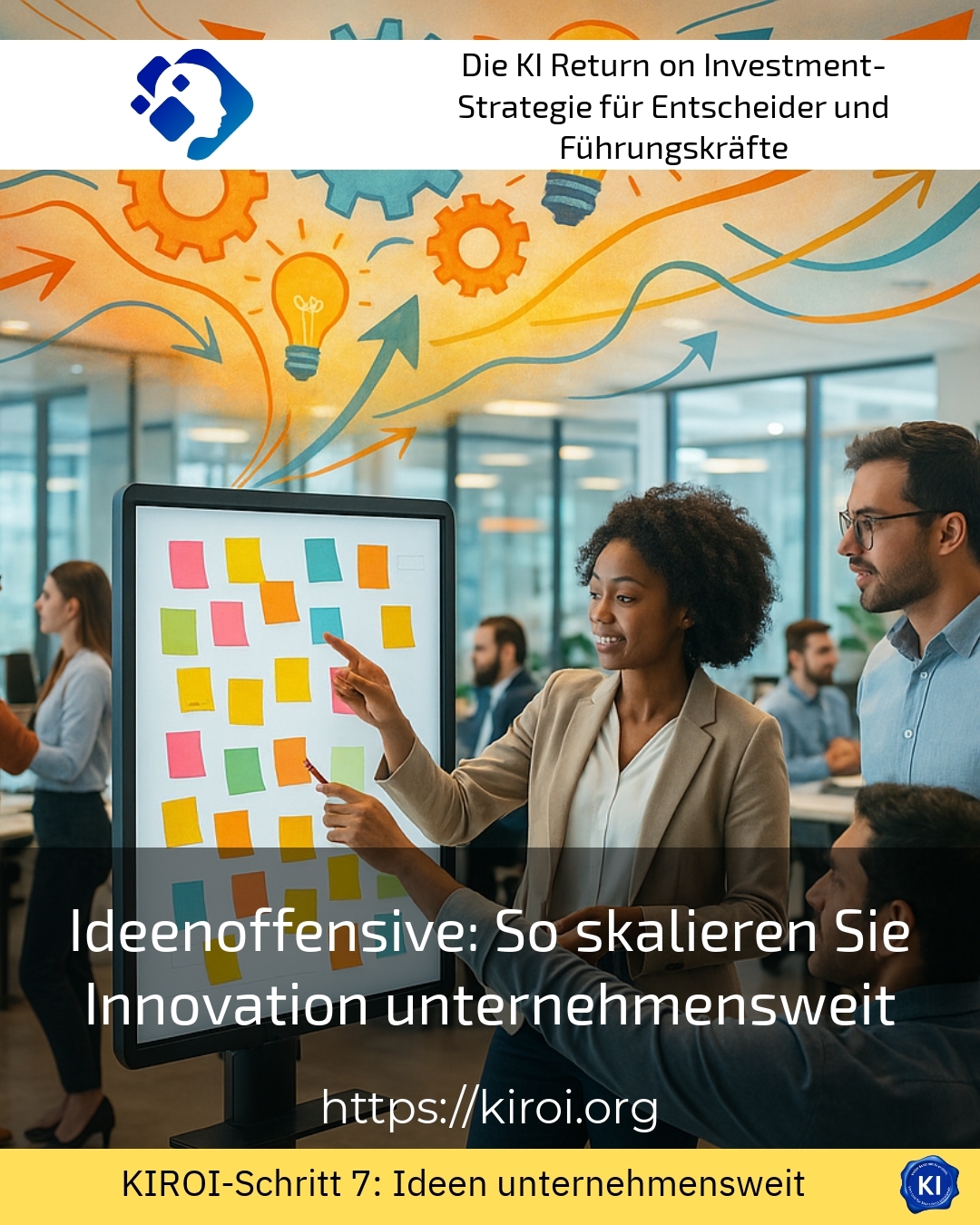
Imagine your company transforming into a vibrant ideas hub, where every employee becomes a driver of innovation. The Innovation Offensive: How to Scale Innovation Company-Wide begins precisely where traditional structures reach their limits. Many organisations today struggle with the same dilemma: individual brilliant minds develop great concepts, but these get lost in bureaucratic processes. The key lies not in more resources, but in systematic approaches that unleash creative potential at all levels. This is exactly where a well-thought-out transformation strategy comes in, offering both support and structure.
Understanding the fundamentals of a company-wide idea generation campaign
Innovation rarely arises in a vacuum; instead, it requires fertile ground of trust, openness, and clear processes that enable employees to contribute their ideas. Clients often report that their best ideas emerge from informal conversations. However, these spontaneous flashes of insight are lost because there are no structures in place to capture and develop them. For instance, a manufacturing company in the automotive supply sector recognised that production workers often had the most practical suggestions for improvement, but these never made their way to decision-making bodies [1]. A mechanical engineering company introduced digital idea boards where technicians could post their optimisation suggestions for manufacturing processes. A medium-sized component manufacturer established weekly innovation circles where apprentices and master craftsmen discussed ideas as equals.
The challenge lies in creating a culture where failure is understood as a learning opportunity and not a career risk. Transruptive coaching can provide valuable impetus here by supporting leaders in establishing psychological safety within their teams. Guiding such projects requires tact and a clear methodology. A supplier of electronic components created a protected space where even unrefined suggestions could be discussed without judgment. A machine tool manufacturer introduced "failure celebrations" where failed projects were analysed and the lessons learned were acknowledged. A precision parts manufacturer established anonymous submission options to give even introverted employees a voice.
Best practice with a AIROI customer
A medium-sized metal processing company with approximately 450 employees faced the challenge that innovations were solely originating from the design department. Management recognised that valuable knowledge within production, purchasing, and sales was lying dormant. As part of an AIROI project, we jointly developed a multi-stage strategy to activate the entire company. Initially, we conducted workshops where employees of all hierarchical levels could contribute their perspectives. It became apparent that many improvement ideas already existed but had never been heard. We implemented a digital platform that enabled low-threshold submissions and guaranteed transparent feedback. Additionally, we established a mentorship programme where experienced managers supported promising idea generators. After eighteen months, the company recorded an increase in submitted suggestions of over three hundred percent. It was particularly noteworthy that several significant process improvements came from employees in the logistics department, who had previously never been involved in innovation processes.
Ideas Offensive: How to Scale Innovation Company-Wide Through Systematic Structures
Scaling doesn't mean simply doing more of the same, but rather establishing smart systems that can grow organically. Many companies fail because they want to centrally control innovation programmes, which stifles initiative. A successful approach combines clear frameworks with decentralised execution and local adaptability [2]. A supplier of plastic parts decentralised its innovation circles and gave site managers budget responsibility for local experiments. A foundry established cross-departmental teams that rotated quarterly, thereby promoting knowledge transfer. A manufacturer of hydraulic components created internal incubators where promising ideas could be developed further with dedicated resources.
Digital transformation offers enormous opportunities here, but also pitfalls to be avoided. Idea management platforms can create transparency, but also become bureaucratic monsters if implemented incorrectly. Transruption coaching supports companies in finding the right balance between structure and flexibility. A precision tool manufacturer implemented a lean app that enabled idea submission in under two minutes. A drive technology specialist used gamification elements to promote engagement without undermining the seriousness of the process. A sheet metal processor linked their idea management to existing suggestion schemes, thus creating synergies rather than parallel structures.
Leaders as catalysts for the idea offensive
Without convinced leaders, any initiative remains a toothless tiger, as they set the tone for the entire organisation. Many managers underestimate their role as role models and then wonder why their teams remain passive. A tool-making company trained its entire middle management in coaching techniques that encouraged creative thinking. A surface technology specialist introduced mandatory innovation time for managers, during which they worked on projects themselves. A valve manufacturer established reverse mentoring, where junior employees trained experienced managers in digital methods [3].
The biggest hurdle is often not a lack of knowledge, but the fear of losing control, which unconsciously drives many managers. Those who genuinely want to foster ideas must be willing to delegate decision-making authority and tolerate mistakes. An electric motor manufacturer introduced a principle whereby team leaders were only allowed to respond to submitted ideas after three weeks, in order to prevent hasty rejections. A valve manufacturer established peer reviews, where equals rather than superiors provided initial feedback. A sealing specialist set up an ombudsman's office that employees could turn to if they felt their ideas were being blocked.
Best practice with a AIROI customer
A family-run manufacturer of industrial pumps with three production sites approached us with a specific concern: the rate of innovation had stagnated for years despite high investment in research and development. Our analysis revealed that an invisible hierarchy was blocking creative impulses. Employees outside the development department did not feel empowered to make suggestions. Within the AIROI process, we worked closely with the management team to dismantle these cultural barriers. We conducted innovation workshops where managing directors worked alongside machine operators on specific challenges. This symbolic parity had a profound effect on the company culture. Additionally, we established a reward system that recognised not only implemented ideas but also high-quality suggestions that could not be realised for other reasons. After one year, the HR department reported significantly increased employee satisfaction, and the number of patent applications doubled. Particularly pleasing was that three of the five most important process innovations came from employees who had never previously been involved in development processes.
Cultural change as the foundation for sustainable innovation
Processes and tools are important, but they remain ineffective if the underlying culture doesn't play along and hinders change. True Innovation Offensive: How to Scale Innovation Company-Wide requires a profound change in mentality at all levels. This does not happen overnight but requires continuous nurturing and authentic role-modelling by company leadership [4]. A spring specialist launched a company-wide campaign that celebrated and publicly recognised failures as learning opportunities. A fastener manufacturer introduced monthly innovation breakfasts where employees presented ideas in a relaxed atmosphere. A heat exchanger producer established job rotation programmes that brought fresh perspectives to established departments.
Measuring innovation culture presents many companies with challenges, as qualitative changes are difficult to quantify. Nevertheless, there are indicators that can provide valuable insights and make progress visible. A transmission specialist conducted regular culture pulse surveys that specifically asked about psychological safety and openness to new ideas. A grinding machine manufacturer tracked the number of cross-departmental collaborations as an indicator of silo busting. A filter technology company analysed the time ideas spent in the system to identify blockages early on.
Overcoming resistance and engaging sceptics
Every change initiative faces resistance, and an innovation culture is no exception, as people defend familiar structures. Smart companies don't ignore skeptics but actively involve them and use their critical perspective constructively. A materials handling company deliberately invited known critics into pilot projects where their concerns could be addressed early. A compressor manufacturer established devil's advocate roles within innovation teams to uncover blind spots. A clutch specialist created a forum for constructive criticism that distinguished between destructive nagging and valuable objections [5].
Communication about successes and failures plays a central role in building trust and creating momentum. Transparency signals that innovation work is taken seriously and is not just another management buzzword. A paint technology specialist published monthly innovation reports that documented both successes and failed experiments. A turned parts producer used internal social media channels to highlight idea generators and tell their stories. A stamping plant manufacturer organised annual innovation days where all employees could experience the results of the past year.
My AIROI Analysis
After years of supporting companies of various sizes and industries, clear patterns of success have emerged, which I would like to share here. The successful scaling of innovation capability is based on three pillars: culture, structure, and consistent leadership, all three of which must be developed simultaneously. Companies that only invest in tools without creating the cultural prerequisites are highly likely to fail due to the realities of day-to-day business. At the same time, an open culture alone is not enough if there are no processes in place to systematically capture ideas and lead them to implementation.
In my AIROI methodology, I always emphasise the importance of patience and perseverance, as cultural change takes time and consistent action. Most initiatives fail not due to a lack of ideas, but a lack of stamina and a relapse into old patterns at the first sign of difficulty. Leaders often underestimate how long it takes for new behaviours to become habit and become embedded in the organisation. Support from external coaching can be crucial here because it holds up an objective mirror and reveals blind spots.
What seems particularly important to me is the realisation that innovation is not an end in itself, but must serve value creation and company success. The best idea offensives combine creative freedom with clear strategic direction and transparent decision-making criteria. Employees need both room to experiment and guidance on the direction in which the company wants to develop. Finding and maintaining this balance is the real art of company-wide innovation scaling, and this is precisely where we start with Transruption Coaching.
Further links from the text above:
[1] Harvard Business Review – Innovation Management
[2] McKinsey – Innovation Insights
[3] Forbes Innovation
[4] MIT Sloan Management Review – Innovation
[5] Boston Consulting Group – Innovation Strategy
For more information and if you have any questions, please contact Contact us or read more blog posts on the topic Artificial intelligence here.











 Deutsch
  English (UK)