
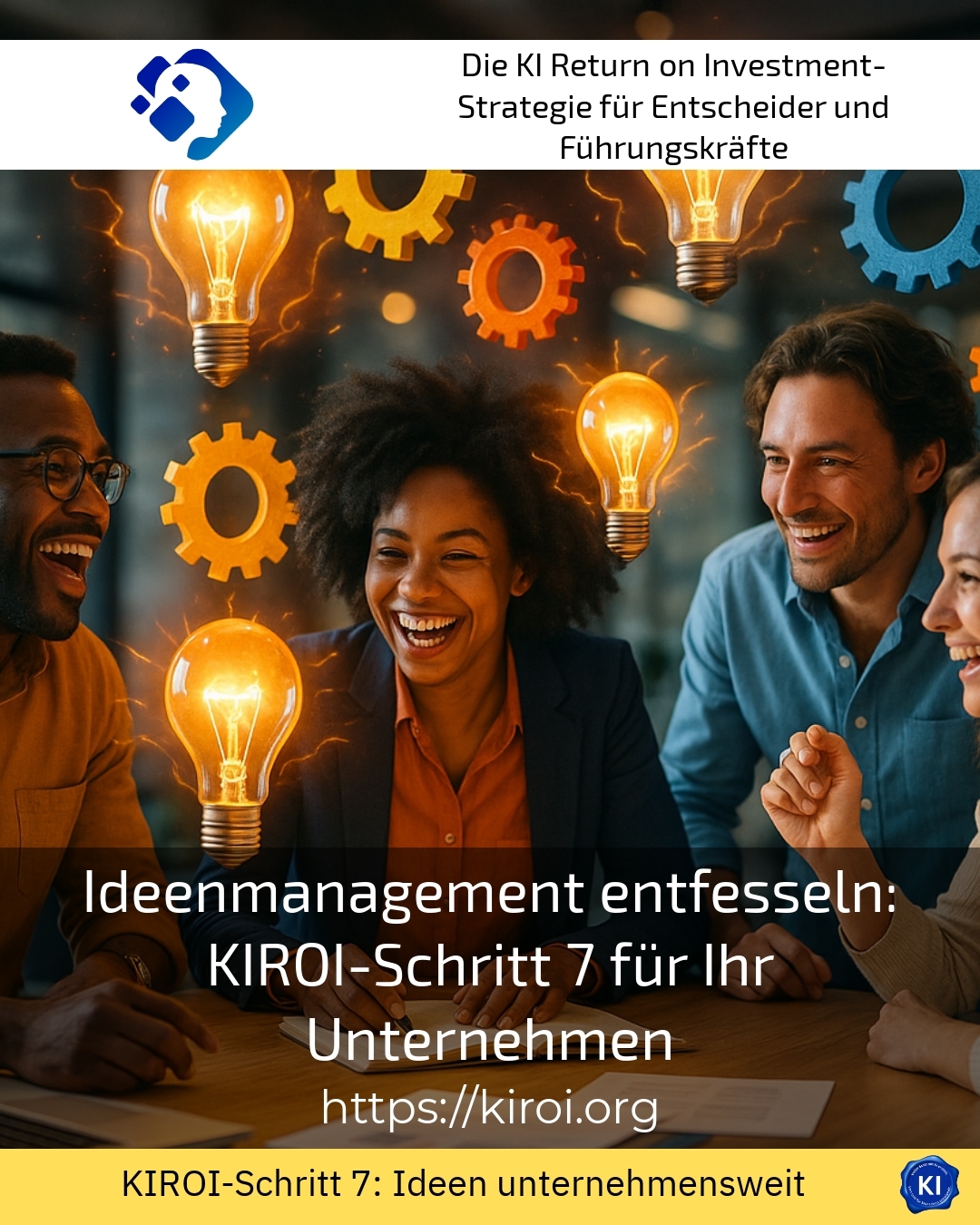
In today's competitive environment, idea management plays a crucial role in the sustainable success of companies. The KIROI step 7, in particular, shows how to unleash idea management company-wide to systematically foster innovation and efficiently implement optimisation processes. This provides companies with the opportunity to specifically leverage the creative potential of all employees and remove obstacles to implementation.
Ideas management as a driving force for modern business development
Ideenmanagement encompasses far more than just collecting suggestions. It is a structured and continuous process that promotes the capture, evaluation, and implementation of ideas. The KIROI Step 7 assists companies in not only embedding this process organisationally but also in bringing about genuine cultural changes. This creates an open environment in which all employees are encouraged to contribute their creative impulses.
In the automotive industry, for example, idea management within the framework of KIROI Step 7 has shortened development cycles by introducing moderated innovation workshops. This has not only led to faster product innovations but also to better cross-departmental collaboration. In retail, companies are increasingly using digital platforms to capture ideas transparently and thus strengthen communication between branches. Positive effects are also evident in the IT sector when development teams are actively involved in feedback processes, which accelerates adjustments and optimisations.
Practical implementation and benefit of the KIROI step 7
The seventh step in the KIROI concept promotes knowledge transfer through structured workshops and targeted feedback cycles. This not only encourages the implementation of promising ideas but also strengthens interdepartmental exchange. Particular focus is placed on continuous support and transruption coaching, which assists teams in overcoming blockades and developing new perspectives.
In the field of industrial manufacturing, a significant acceleration in the realisation of innovation projects has been achieved through the systematic application of KIROI Step 7. Moderated working groups made it possible to identify and remove obstacles early on. This led to a sustainable strengthening of innovation potential throughout the entire company.
In healthcare, coaching measures supported the creation of an inclusive culture. This motivated employees to actively contribute their suggestions for improvement, which noticeably improved process quality. In retail, too, digital idea management systems demonstrated that transparent feedback processes can significantly enhance collaboration between teams.
BEST PRACTICE with one customer (name hidden due to NDA contract) In an industrial manufacturing company, the use of KIROI Step 7 led to a structured approach that systematically identified implementation hurdles and helped overcome them through targeted workshops. This resulted in faster implementation of innovations and more intensive interdepartmental exchange, which improved long-term competitiveness.
Key impulses for successful idea management
Successful idea management requires companies to react flexibly to suggestions and actively encourage exchange. Digital tools play a key role in this. They help to systematically capture, categorise and transfer ideas into the implementation process. This ensures that no valuable suggestions are lost.
Furthermore, transparent feedback is crucial. Employees must feel that their ideas are taken seriously and receive feedback. This increases motivation and engagement. To achieve this, companies can establish targeted communication channels and regular innovation workshops that promote dialogue across departmental boundaries.
Equally important is a culture that permits mistakes and understands them as learning opportunities, as not every idea can be implemented directly. Ideas management supports the valuable insights gained from experiments and the continuous development of the innovation process.
Examples of practical measures
A software company introduced a weekly brainstorming meeting where employees from different departments develop creative solution proposals. In parallel, a major mechanical engineering company used a digital platform to keep all ideas documented and accessible. This promotes transparency and facilitates prioritisation. A trading company also organised an ideas competition, which had visible awards and sustainably strengthened the innovation culture.
My analysis
KIROI Step 7 breathes fresh life into classic idea management by viewing the process as a continuous, company-wide companion. Thus, not only is the collection of suggestions initiated, but the entire organisation is supported in consistently driving innovation. Practical examples from various industries show how flexible processes, digital tools, and targeted coaching accelerate implementation. This significantly strengthens not only innovative capacity but also collaboration and employee motivation.
Companies that recognise ideas management as a strategic success factor and implement it with modern support enhance their competitiveness sustainably. The systematic approach of KIROI Step 7 helps to overcome obstacles, unleash innovation potential and establish a vibrant innovation culture.
Further links from the text above:
What is idea management? Definition, processes and...
Unleashing Idea Management: KIROI Step 7...
What is Idea Management | Definition, Importance & …
Rethinking idea management: KIROI Step 7…
Unleashing Idea Management: KIROI Step 7...
For more information and if you have any questions, please contact Contact us or read more blog posts on the topic Artificial intelligence here.











 Deutsch
  English (UK)