
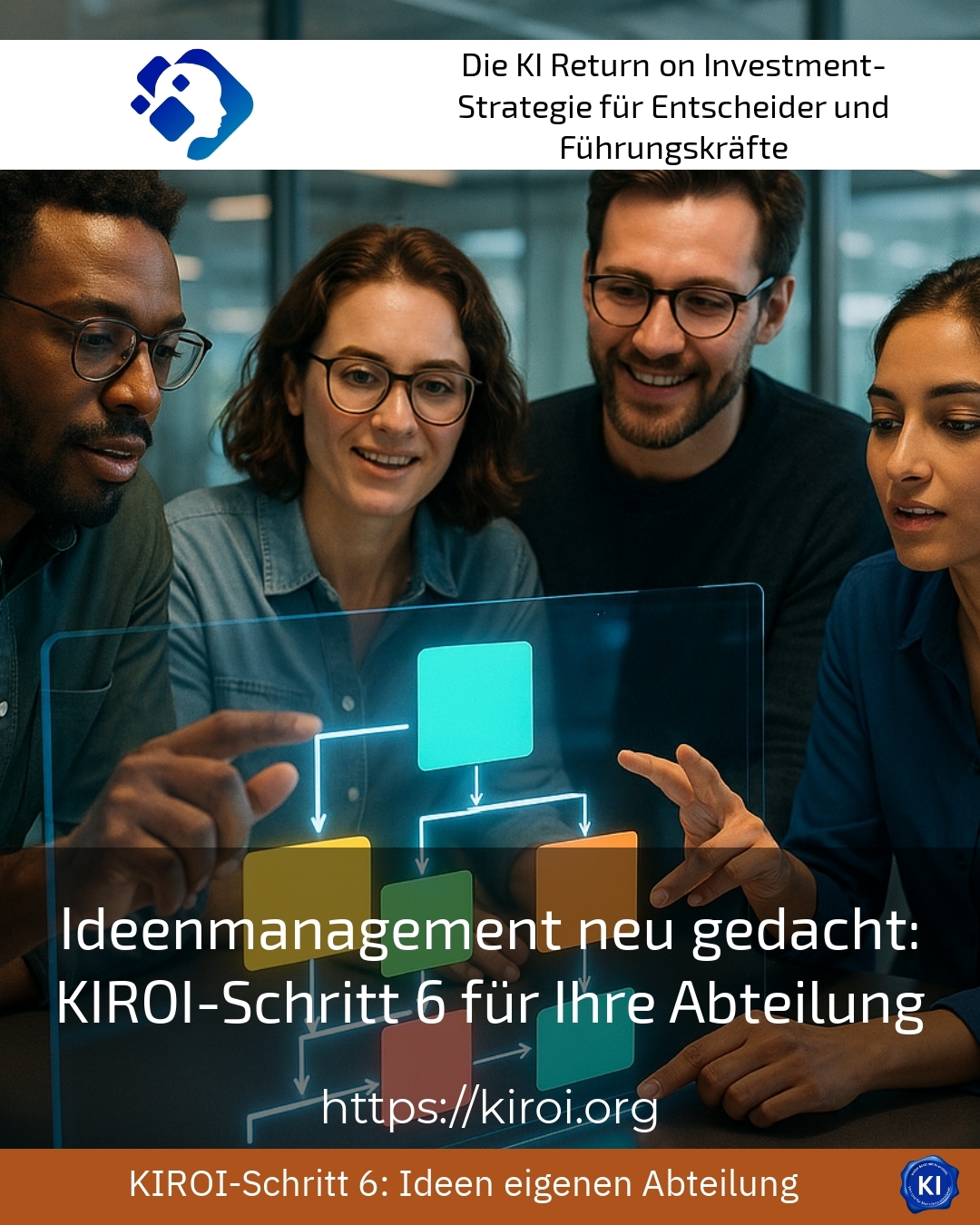
In today's company, idea management is at the heart of valuable innovation processes. The term encompasses far more than simply collecting ideas; it signifies a systematic and structured approach to suggestions for improvements and innovations. Particularly within the demanding framework of modern work environments, well-thought-out idea management helps to foster creativity while sustainably strengthening competitiveness. The focus here is on KIROI Step 6, which is specifically tailored to the needs and potential of departments and guarantees practical implementation.
Idea management as a driver for departmental innovation
The sixth step in the KIROI concept specifically supports departments in establishing idea management as an integral part of their everyday processes. This means that employees actively contribute their perspectives and expertise to develop practical solutions. In production, for example, targeted workshops as part of KIROI Step 6 led to a noticeable reduction in material waste and, at the same time, an increase in product quality. The teams used joint brainstorming sessions to make machine processes more efficient and eliminate sources of error.
The implementation of idea management was also successful in the IT department of a medium-sized company by creating an automated ticketing system. This saved the team repetitive tasks and opened up scope for strategic innovations. At the same time, employees benefited from increased motivation because their ideas were valued and promptly implemented. Another example shows its application in customer service: there, the systematic collection of suggestions for improvement led to the optimisation of communication processes and significantly shorter response times.
BEST PRACTICE with one customer (name hidden due to NDA contract) A workshop was designed in a manufacturing company using the KIROI Step 6, bringing together all department heads. They collaboratively developed new production methods. Consistent process support led to a 15 percent reduction in scrap rates and improved the working atmosphere through increased cross-departmental communication.
Structured Support in Idea Management
Successful idea management is based on two pillars: creative impulses and systematic support. KIROI step 6 provides clear process structures with which ideas can be submitted, evaluated, and further developed. Teams meet regularly in moderated idea sessions and bring different perspectives to the table. This not only fosters better solutions but also strengthens team cohesion.
In addition, it is advisable to clearly define responsibilities and simplify decision-making processes. This prevents promising ideas from being thwarted by bureaucratic hurdles. In departments that were supported during KIROI step 6, employees often reported that the new workflow led to more initiative and commitment. This not only increases satisfaction but also the efficiency of processes.
Furthermore, the introduction of digital tools can significantly support this process. Platforms for idea generation facilitate documentation and create transparency, ensuring that every idea remains traceable. If accompanying workshops are held regularly, obstacles can be identified early on and solutions can be developed collaboratively. In this way, idea management provides lasting support and motivation.
Practical examples from various industries
In healthcare, an innovative way to optimise patient admission has been developed. Staff in the admissions department introduced new concepts that significantly reduced waiting times and decreased administrative effort. In retail, meanwhile, idea management enabled more flexible assortment design, as goods were adapted more quickly to customer wishes. In a service company, the involvement of all teams led to the introduction of a new feedback system that strengthens customer loyalty and allows for targeted training.
BEST PRACTICE with one customer (name hidden due to NDA contract) An interdepartmental ideas forum was initiated by KIROI Step 6 at a medium-sized service provider. It helped to break down communication barriers and facilitated company-wide knowledge transfer. After a short period, this led to measurable process improvements and increased customer satisfaction.
Impulses for sustainable idea management with KIROI - Step 6
KIROI Step 6 can help to embed vibrant and sustainable idea management within any department. The integration of clear processes makes it easier to submit and systematically evaluate suggestions. It is important that all employees feel a sense of responsibility and that the results achieved are communicated transparently.
Through workshops, digital tools, and targeted coaching, obstacles can be identified and overcome at an early stage. This creates space for creativity and innovation. Particularly when leaders lead by example and credibly convey the importance of idea management, teams report increased motivation and a culture of innovation that is actively lived.
Companies that consistently implement these principles not only support the individual development of their employees but also secure their long-term competitiveness. Idea management thus becomes a driver for continuous improvement and growth.
My analysis
Systematic and structured idea management offers departments a clear advantage in today's corporate world. The KIROI Step 6 specifically highlights the potential of teams by combining creative stimuli with organised support. The multitude of practical examples shows how different industries can benefit from active idea management. It provides impulse, supports projects in a structured manner, and enables effective process improvements. Companies that take this step seriously thus lay the foundation for a vibrant innovation culture and sustainable success.
Further links from the text above:
REFA's Definition of Idea Management
Rethinking Idea Management: KIROI Step 7 in the Company
The Guide to Idea Management – ITONICS
KIROI Step 6: Idea Management as a Driver of Departmental Innovation
For more information and if you have any questions, please contact Contact us or read more blog posts on the topic Artificial intelligence here.











 Deutsch
  English (UK)