
Idea management today is more than just collecting good ideas. It is a structured and systematic process that specifically helps to foster innovation within departments and strengthen competitiveness. Particularly in the context of KIROI, Step 6 represents an important milestone for effectively implementing idea management at the departmental level and achieving sustainable success.
Idea management as a driver for departmental innovation
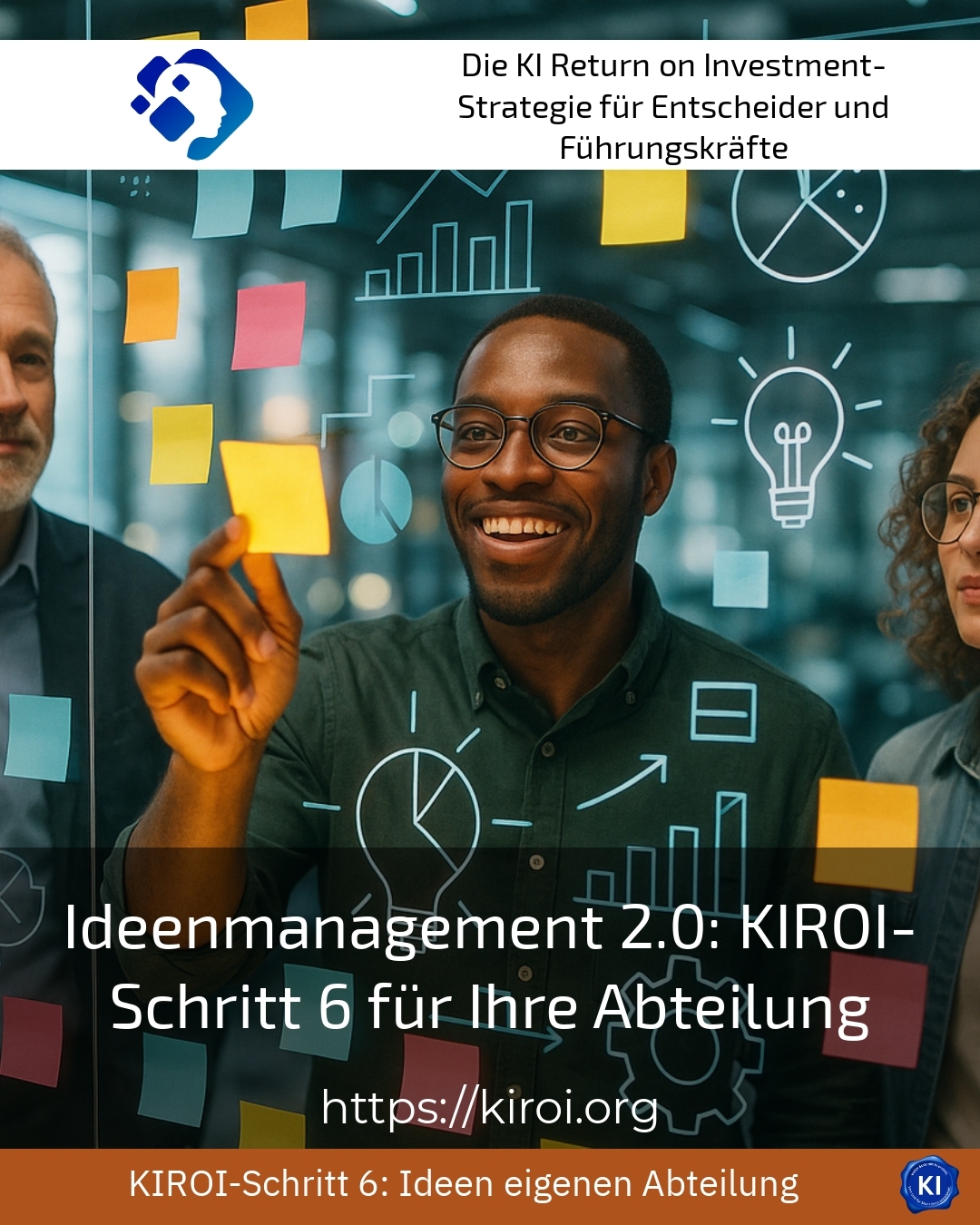
The sixth step in the KIROI process focuses on involving employees in their immediate work environment. This allows them to directly use their expertise to develop practical solutions for common challenges. An example from manufacturing shows how targeted brainstorming workshops helped to minimise material waste while simultaneously increasing product quality. Through collaborative brainstorming, an efficient adjustment of machine processes was achieved.
Likewise, in the HR department, innovative shift plans were introduced through idea management, which both reduced employee stress and sustainably boosted motivation. In the logistics sector, the analysis and optimisation of transport routes led to significant savings in time and costs. These examples show how tailored idea management can have a major impact in individual departments.
BEST PRACTICE with a client (name omitted due to NDA) In the manufacturing industry, a workshop was initiated through Step 6 of the KIROI method, which improved internal communication between the production and quality departments. This enabled faster identification of error sources and the joint development of creative solutions. This led to a noticeable reduction in scrap and increased employee satisfaction.
Practical implementation of idea management in teams
Successful idea management rests on two key pillars: creative impetus and structured support. Teams come together in moderated idea sessions to contribute different perspectives and evaluate ideas collaboratively. In the IT department of a medium-sized company, an automated ticketing system was developed in this way. This reduced repetitive tasks and gave the team more scope for strategic projects.
In the field service, the idea management also led to a concept to redesign visit intervals. This resulted in shorter travel times and higher customer satisfaction. Similarly, a team in research and development developed new methods for faster prototype testing, which significantly shortened innovation cycles.
BEST PRACTICE with a client (name withheld due to NDA) A department in logistics was able to make their supply chains more transparent through the structured implementation of an ideas management system. By jointly developing solutions with the drivers, routes were optimised and transport times reduced. The project supported team spirit and led to measurable cost savings.
Impulses for sustainable idea management with KIROI - Step 6
The KIROI approach helps departments understand idea management as an integral part of everyday work. This is achieved through clear processes that facilitate the submission, evaluation, and further development of ideas. It is important that all participants take on concrete responsibilities and that the results are communicated transparently.
Many companies report that this approach not only results in suggestions for improvement but also a stronger identification of employees with their work. For example, in a technical services company, the maintenance process was optimised with the help of idea management by directly involving technicians. Efficiency increased measurably, and employees experienced a greater sense of appreciation.
A further example from retail demonstrates how shelf layout was made more customer-friendly through continuous idea management. As a result, sales figures in individual product categories increased. In marketing too, structured idea workshops led to successful campaign concepts, which strengthened branding in the long term.
My analysis
Ideas management is an indispensable part of modern corporate leadership – and KIROI Step 6 shows how departments can benefit concretely from it. By fostering active exchange and structured support for ideas, a creative climate is created that promotes innovation while simultaneously increasing motivation and efficiency. The examples presented confirm that targeted ideas management not only solves problems, but also strengthens entire teams and sustainably improves processes. Companies that adopt these principles lay the foundation for long-term success and continuous development.
Further links from the text above:
What is idea management? Definition, processes, and best practices
Mastering idea management: KIROI step 6 for your department
What is Ideation Management 2025: Introduction + Definition
For more information and if you have any questions, please contact Contact us or read more blog posts on the topic Artificial intelligence here.











 Deutsch
  English (UK)