
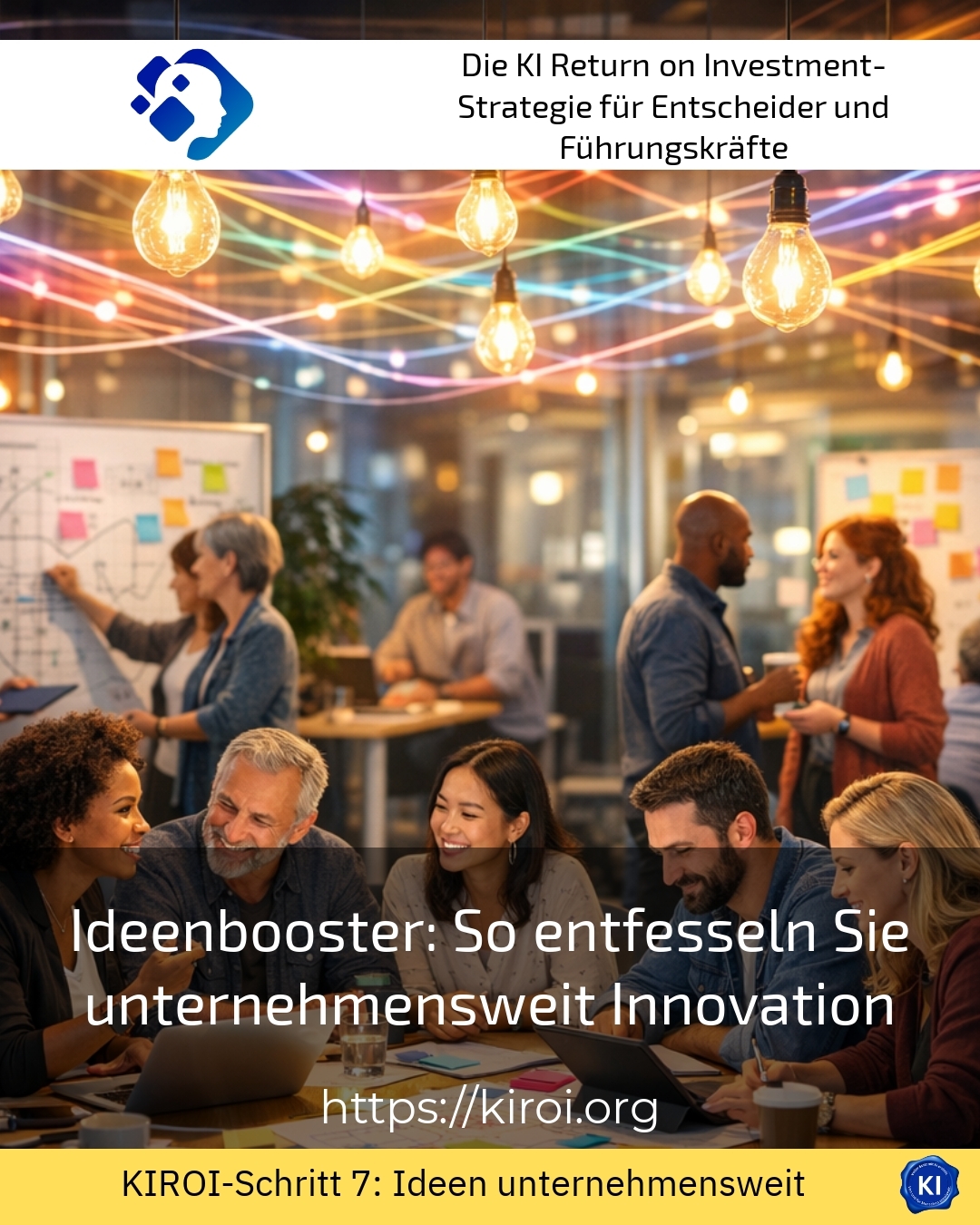
Have you ever wondered why some companies seemingly develop groundbreaking products effortlessly, while others, despite enormous efforts, remain mediocre? The answer often lies in the systematic activation of the creative potential of all employees, because an effective Idea-booster It can make the crucial difference when it comes to unleashing innovation across the enterprise and creating sustainable competitive advantages. In an economy that is transforming at an astonishing pace, it is no longer enough to rely on individual geniuses or isolated research departments. Instead, many successful organizations report how they have established a culture of continuous renewal through targeted measures that involve every single employee in the innovation process, thereby unlocking unprecedented possibilities.
The hidden power of collective creativity as an idea booster
Traditional organizational structures tend to isolate creative thinking within specialized departments. However, this approach misses out on enormous potential. Each employee possesses unique perspectives and experiences. This diversity of viewpoints forms the fertile ground for revolutionary ideas. For example, a leading automotive manufacturer recognized that the best ideas for production optimization often come from factory employees who are directly confronted with the manufacturing processes on a daily basis. A large telecommunications company uses internal idea competitions in which teams from different departments work together on solutions. An international logistics company has also achieved remarkable success by providing digital platforms for drivers and warehouse workers to submit improvement suggestions.
The key lies not only in providing technical tools. Rather, it is about creating an atmosphere of psychological safety. Employees need to feel that their contributions are valued. They need the certainty that unconventional ideas are also welcome. Only then can the full creative potential of an organization be unleashed.
Best practice with a AIROI customer
A medium-sized mechanical engineering company with approximately 800 employees turned to transruptive coaching with the challenge that, despite an established corporate proposal system, there were hardly any relevant impulses coming from the workforce. The analysis revealed that the previous structures were perceived as bureaucratic and slow, which significantly dampened motivation for participation. Together, we developed a multi-stage approach that first sensitized the management to the importance of appreciative responses to proposals. Subsequently, we implemented a digital system that created transparency about the status of submitted ideas. Additionally, we established monthly innovation circles where departmental-wide work is done on promising concepts. The results significantly exceeded expectations. Within eight months, the number of submitted proposals increased by more than three times. Several ideas led to concrete process improvements with measurable savings. Employee satisfaction in the affected areas improved significantly, which was also reflected in the annual survey.
Create structures that inspire creativity
Innovation rarely arises from nothing. It requires fertile ground. Organizations that successfully innovate have recognized that creativity requires both freedom and supportive frameworks. A renowned pharmaceutical company deliberately grants its researchers time for projects outside their regular areas of responsibility. A large retail chain has established so-called innovation labs where new concepts can be tested without the pressure of daily operations. A financial services provider organizes regular hackathons where employees from all levels of the hierarchy work together to develop digital solutions.
The combination of structure and spontaneity is particularly effective. Fixed timeframes for creative work provide orientation and signal that innovation is recognized as a legitimate activity. At the same time, flexibility is needed to respond to unexpected opportunities. Finding this balance poses challenges for many companies. Transruptions coaching helps organizations develop customized solutions. The approach takes into account both industry-specific requirements and the individual corporate culture.
The idea booster in practice: methods for sustainable success
Implementing a company-wide innovation approach requires thoughtful methods. Design Thinking has proven particularly effective because it consistently focuses on the needs of end users. A large insurance company has successfully used this method to develop customer-friendly products [1]. Agile working methods support rapid iterative cycles and promote a culture of continuous learning. An international media company also uses Scrum techniques outside the IT department to drive projects more efficiently. Open Innovation, which involves the targeted involvement of external partners, expands horizons and brings fresh ideas. A consumer goods manufacturer systematically collaborates with startups and universities to gain access to the latest developments.
These methods only achieve their full effect through consistent application. One-time workshops rarely produce lasting changes. Instead, perseverance and the willingness to learn from setbacks are required. Clients often report that the real breakthrough only comes after several attempts. Experienced coaches help maintain motivation and adapt the course as needed.
Overcoming resistance and winning over sceptics
Changes naturally encounter resistance. This is especially true for profound cultural transformations. Some executives fear a loss of control when employees develop more initiative. Long-time employees may perceive new working methods as criticism of previous practices. These concerns deserve serious attention. One chemical company has successfully used this approach by deliberately engaging skeptics in pilot projects where they could see for themselves the benefits. A trading company relies on teams of experienced and younger employees to promote mutual learning. A technology company has systematically documented success stories and communicated internally to encourage doubters.
The transparent handling of failures also plays an important role. When failed experiments are viewed as learning opportunities, the threshold for riskier projects lowers. A culture of error that constructively deals with setbacks forms the foundation for genuine innovation capability. Transruptions coaching provides the impetus for organizations to develop and embed this attitude.
Best practice with a AIROI customer
A traditional family business in the food industry faced the challenge of gently opening up its long-established corporate culture without losing the strengths of the past. The workforce initially showed reluctance towards new approaches, as previous change initiatives were perceived as less successful. In close collaboration with the management, we developed an approach that explicitly drew on positive traditions and linked them with contemporary methods. We initially identified respected personalities in various departments who could serve as multipliers. These received thorough training in creative techniques and subsequently moderated workshops within their teams. The association with familiar faces and proven values significantly facilitated acceptance. Within a year, several product ideas were developed that have now been successfully placed on the market. Particularly noteworthy was the development of a sustainable packaging concept that emerged from the collaboration between production and sales. The initiative has noticeably strengthened the company’s self-perception as an innovative player.
Using digital tools as an idea booster
Technology can significantly accelerate and simplify the innovation process. Modern platforms enable cross-location collaboration in real time. A globally operating electronics company uses digital collaboration tools to connect development teams across continents [2]. Artificial intelligence supports the analysis of large data volumes and identifies patterns that human observers might miss. An energy provider uses machine learning to more accurately predict customer needs and develop appropriate offerings. Virtual reality applications allow prototypes to be tested virtually before costly physical models are built. A furniture manufacturer uses this technology to make design concepts tangible and to gather early feedback.
However, the deployment of digital tools requires careful implementation. Technology alone does not generate innovation. It must be embedded within a coherent organizational framework. Training employees on how to use new tools deserves special attention. Only when the workforce understands and can utilize the possibilities, can digital solutions achieve their full potential.
Leadership as a catalyst for innovation culture
The role of leaders in the innovation process cannot be overstated. Through their behavior, they send signals that are perceived by the entire organization. When supervisors themselves show curiosity and a willingness to experiment, this radiates to their teams. A software company has consistently aligned its leadership development efforts with fostering innovation. A construction company explicitly encourages managers to bring their own ideas to the table and participate in projects outside their immediate sphere of responsibility. A large hotel chain has established a program in which leaders regularly intern in other departments to gain fresh perspectives.
The ability to create space for ideas without immediately evaluating them is particularly important. Many promising approaches are stifled by hasty criticism. Leaders who initially ask questions and show genuine interest foster an open atmosphere. This attitude can be developed and strengthened through targeted coaching.
My AIROI Analysis
Systematic promotion of innovation represents a central strategic task for companies in all industries, going far beyond occasional creative workshops or the establishment of a corporate suggestion system. My experience from numerous accompanying projects clearly shows that sustainable innovation capability can only be created when it is understood and lived as an integral part of the corporate culture, which requires profound changes in structures, processes, and above all in the mindset of all involved parties. The most successful transformations are characterized by a clever combination of several elements. First, there must be a sincere commitment from the company leadership that is not limited to verbal declarations but is manifested in concrete allocation of resources and structural adjustments. Furthermore, the integration of multipliers from different business areas has proven to be exceptionally effective because they can act as bridge builders between strategic vision and operational reality. Linking with digital tools accelerates the process and enables broader participation, but must always serve the human element rather than replace it. Particularly noteworthy to me is the observation that companies that perceive failure as a learning opportunity act significantly more innovative in the long run than those that sanction mistakes. The guidance provided by transruptive coaching supports organizations in finding their individual path to a vibrant innovation culture, while also helping them to: Idea-boosterThe approach is always adapted to the specific circumstances and goals of the respective company. Innovation is not a state that can be achieved and then maintained; it is a continuous process that requires attention, care, and a willingness to continuously improve.
Further links from the text above:
[1] Design Thinking Basics – Harvard Business Review
[2] Digital Collaboration Insights – McKinsey
For more information and if you have any questions, please contact Contact us or read more blog posts on the topic Artificial intelligence here.









 Deutsch
 English (UK)