
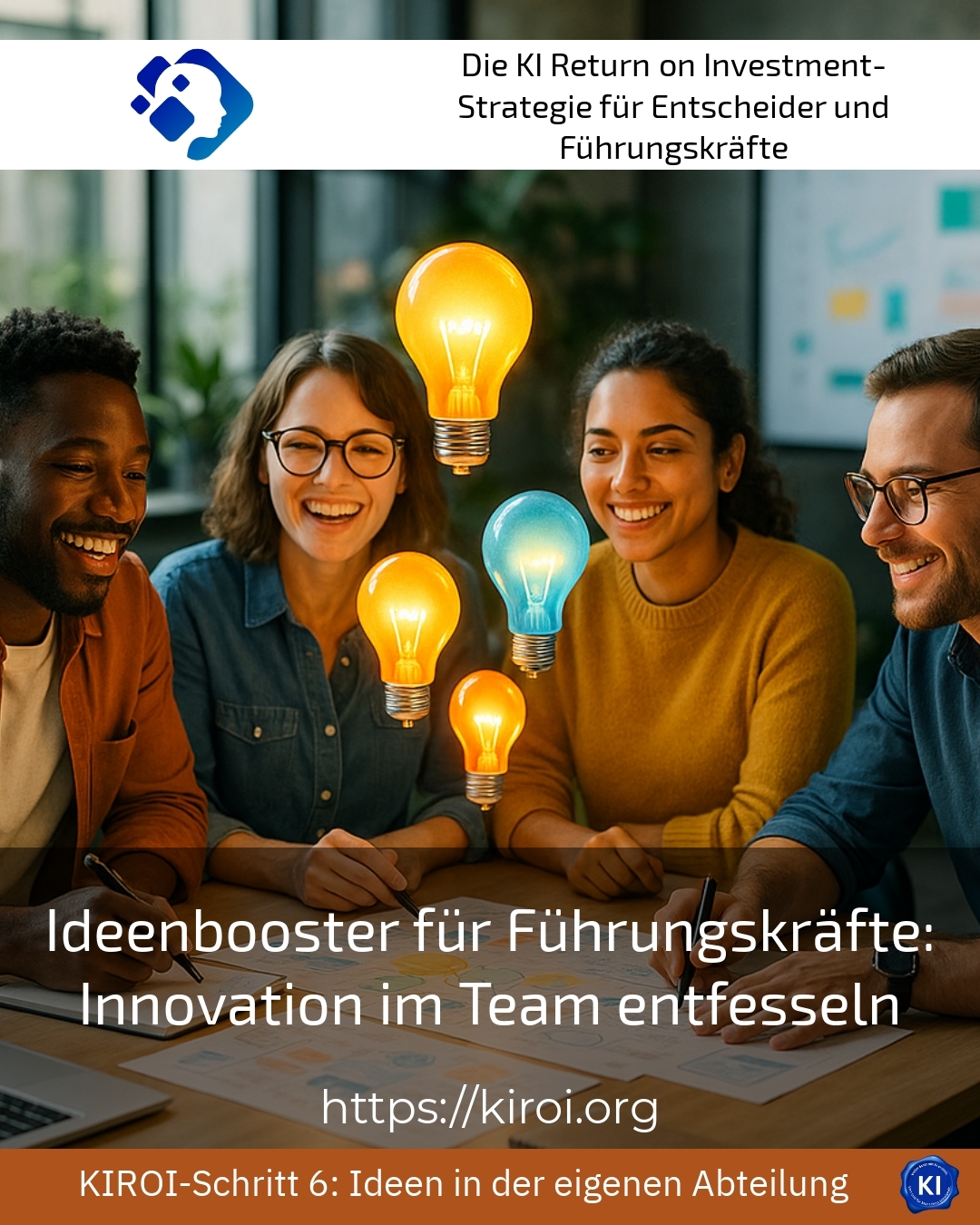
Imagine your team developing breakthrough concepts that transform your company within weeks. This vision is not a utopia, but an achievable reality. The right Ideas booster for leaders can unleash precisely this dynamic. But how can creative potential be systematically activated? How can you create an atmosphere where employees dare to think and experiment? In this post, you will learn concrete strategies that are already working in numerous companies. You will get to know methods that dissolve innovation blockages. At the same time, you will discover why classic leadership approaches often achieve the opposite.
Warum klassische Führungsmodelle kreative Prozesse oft blockieren
Traditional hierarchies are based on control and efficiency. These principles have their justification in standardised processes. However, they stifle creative impulses at the root because employees develop a fear of making mistakes. A medium-sized manufacturing company in mechanical engineering experienced exactly this phenomenon: although the workforce was highly qualified, hardly any suggestions for improvement were forthcoming. Management was surprised by the lack of initiative but did not recognise its own role in it. It was only through external support from transruption coaching that the hidden barriers became visible. The realisation was illuminating: every new idea had to go through seven levels of approval. No wonder nobody wanted to take on the effort.
Another example comes from the logistics industry. A company there had been using the same route planning for years. Younger employees had innovative suggestions for optimisation, but didn't dare to raise them. The company culture signalled: what has proven itself is not to be questioned. This pattern is found across industries and costs companies significant competitive advantages. In the retail sector, managers frequently report similar situations. Sales staff on the ground recognise customer needs earlier than management. Nevertheless, channels for passing on these valuable observations are lacking.
The Idea Booster for Leaders: Psychological Safety as the Foundation
Research findings clearly show that psychological safety is the most important factor for innovative teams [1]. People need to feel safe before they express unconventional ideas. This safety is not created through appeals, but through consistent leadership behaviour. For this reason, a car parts supplier implemented so-called "error culture" workshops. Within these protected spaces, managers initially shared their own failures. The effect was astonishing: within three months, the number of submitted improvement suggestions tripled.
Transruptions-Coaching supports leaders in creating such spaces authentically. The methodology includes reflection exercises and communication training. It's not about perfection, but about honest development. A pharmaceutical company used this approach for its research team. The scientists reported a noticeable relaxation in meetings. Suddenly, even half-finished hypotheses were discussed, accelerating the acquisition of knowledge. In the financial sector, a bank experienced something similar in product development. New investment concepts emerged faster because teams experimented more openly.
Best practice with a AIROI customer
A medium-sized company in the food industry faced a particular challenge. Product development had stagnated for several years, despite the team including highly qualified specialists. Management sought an "idea booster" for leadership staff and turned to transruptions-coaching. During the analysis phase, it became clear that two department heads were subconsciously blocking innovation. They filtered suggestions from their teams before they reached the decision-making level. This was not done with malicious intent, but out of fear of losing control themselves. The coaching intervention worked individually with both managers on their self-perception. Concurrently, we installed a direct idea channel to management. Employees could submit suggestions anonymously and were guaranteed feedback. Within six months, eight marketable product ideas were generated. Three of these are now successfully on the market. The department heads were surprised to discover that their authority did not suffer, but rather grew. This was because they were now seen as enablers rather than blockers of creative processes.
Concrete methods as idea boosters for managers in everyday life
Theoretical knowledge alone does not change a company culture. Leaders need practical tools for daily use. The so-called "Yes, and..." technique from improvisation theatre is excellently suited for this. Here, every idea is initially accepted and further developed. Criticism only occurs in a later phase, which sustains the creative flow. A software company introduced this technique in all its sprint planning sessions. The developers reported significantly more enjoyment in brainstorming.
Another tried-and-tested method is reverse brainstorming. Here, the team intentionally considers how to make a problem worse. This paradoxical intervention breaks through mental blocks and generates surprising insights. An insurance company used this approach to optimise its claims handling. The team was asked to consider how to maximally frustrate customers. The resulting findings led to a completely redesigned communication strategy. In healthcare, a clinic applied the same method to patient processes. The results surprised even experienced nurses and doctors.
The third recommended technique is the structured perspective-taking format. In this format, team members step into the shoes of different stakeholder roles. A construction company had its engineers adopt the perspective of local residents. Suddenly, ideas for quieter construction methods emerged that no one had considered before. This method works across all industries and requires minimal preparation.
Structural prerequisites for a sustainable innovation culture
Individual workshops do not sustainably change a company's culture. Managers must create structural frameworks that permanently foster creative thinking. This includes dedicated time slots for experimentation without pressure to deliver results. Google became famous through its 20% time policy [2]. Many small and medium-sized enterprises are successfully adapting this principle on a smaller scale. One textile manufacturer grants half a day per month for independent project work. Participation is voluntary, but a surprising number of employees take advantage of the offer.
Spatial design also plays an underestimated role. Creativity flourishes in different environments than routine operational work. For this reason, an energy supplier set up innovation labs away from the normal office spaces. The deliberate spatial separation signals: different rules apply here. A chemical company took a similar approach with its research departments. The relaxed design of the rooms encouraged spontaneous encounters and the exchange of ideas. In skilled trades, comparable effects can be achieved with mobile creative boxes.
Reward systems must also be adapted. Classic bonus structures reward short-term goal achievement. However, innovation requires patience and tolerates setbacks. A telecommunications company therefore introduced innovation bonuses. These recognise not only successful ideas, but also courageous failures. The message is clear: We value the attempt, not just the outcome.
The role of digital tools as an idea booster for leaders
Technology can significantly support creative processes if used correctly. Digital idea management platforms facilitate asynchronous collaboration across locations [3]. A logistics company with multiple branches uses such a platform for continuous idea collection. Employees can submit, comment on, and rate suggestions. The transparency provides additional motivation, as good ideas receive visible recognition.
Artificial intelligence offers exciting opportunities for enhancing brainstorming processes. A media company is experimenting with AI-powered idea generation for editorial content. The technology provides impulses that human creativity then develops further. What's important here is that the AI does not replace people, but expands their capabilities. In mechanical engineering, digital twins support the visualisation of new product concepts. Engineers can test ideas virtually before physical prototypes are created. This acceleration significantly lowers the barriers to experimental approaches.
Best practice with a AIROI customer
A regional Chamber of Crafts sought ways to support its member businesses in digitalisation. Many smaller craft businesses were sceptical of new technologies. Together with the Chamber, transruptions-coaching developed a low-threshold workshop format. Master craftspeople from various trades met monthly for an exchange of experiences. Care was taken to avoid technical jargon, and practical applications were prioritised. A master baker reported on his successful online pre-ordering, and a tiler on digital measurement recording. These concrete examples were inspiring for the other participants. Within a year, eighty percent of the participating businesses had introduced at least one digital innovation. The Chamber institutionalised the format as a permanent part of its further education offerings. The key to success was peer-to-peer communication on an equal footing. Managers from the Chamber merely facilitated, rather than lectured. This reserved role enabled authentic exchange of experiences among practitioners.
Use resistance constructively instead of fighting it
Every change initiative encounters resistance. Savvy leaders view objections as a valuable source of information. Skeptics often see risks that enthusiasts overlook. A steel company therefore deliberately made critics into project patrons for new initiatives. Their careful supervision prevented costly mistakes during implementation. At the same time, the critics, through their involvement, transformed into supporters.
Transruptions-Coaching supports leaders in dealing with ambivalent team members. The methodology teaches how to take concerns seriously without becoming paralysed. A furniture manufacturer experienced massive resistance to sustainable material changes. Instead of ignoring this, management organised moderated dialogues. The objections proved to be partly justified and led to adjustments. The final concept was more robust than the original plan. In the hospitality industry, this approach proved effective when introducing new service concepts. Long-standing service staff contributed valuable practical experience to the design process.
Ensuring sustainability in idea management
Many companies experience a burst of innovation after workshops, which quickly fades. Sustainable change requires continuous attention and nurturing. Leaders must understand innovation as an ongoing process, not a one-off event. Therefore, an optical retailer introduced monthly innovation rituals within its leadership team. Each meeting begins with the question: What new idea have we tried this week?
Key figures help maintain focus without stifling creativity. Process metrics should be used alongside outcome metrics. A cosmetics company measures the number of experiments conducted, in addition to successful product launches. This perspective acknowledges the effort, regardless of the outcome of individual attempts. In the transport sector, a bus company introduced similar key figures for service innovations. Drivers were encouraged to actively document ideas for improvement.
My AIROI Analysis
The assistance of numerous companies in innovation processes reveals recurring patterns. The most important success factor is the personal development of the leaders themselves. Techniques and tools remain ineffective if the leadership culture unconsciously sabotages innovation. Therefore, every sustainable transformation begins with work on reflection at the leadership level. The idea booster for leaders primarily lies in their own change of attitude. Those who can show uncertainty themselves also enable their team members to do so.
The AIROI methodology views innovation systemically rather than in isolation. Creativity doesn't arise in individual minds, but between people. Leaders shape the quality of these in-between spaces through their daily behaviour. Small, consistent signals have a stronger impact than large, one-off initiatives. Attentive listening in corridor conversations can achieve more than expensive innovation programmes.
Transruptions-Coaching sees itself as support on this path of development. We provide impetus and reflect on experiences together. The responsibility always remains with the managers and their teams. Clients often report surprising 'aha' moments in their collaboration. These arise because an external perspective makes blind spots visible. The investment in this support pays off through sustainably increased innovation capability.
Further links from the text above:
[1] Google re:Work – Guide: Understand team effectiveness
[2] Harvard Business Review – How Valuable is Google’s 20% Time?
[3] McKinsey – Want a better decision? Plan a better meeting
For more information and if you have any questions, please contact Contact us or read more blog posts on the topic Artificial intelligence here.







 Deutsch
  English (UK)