
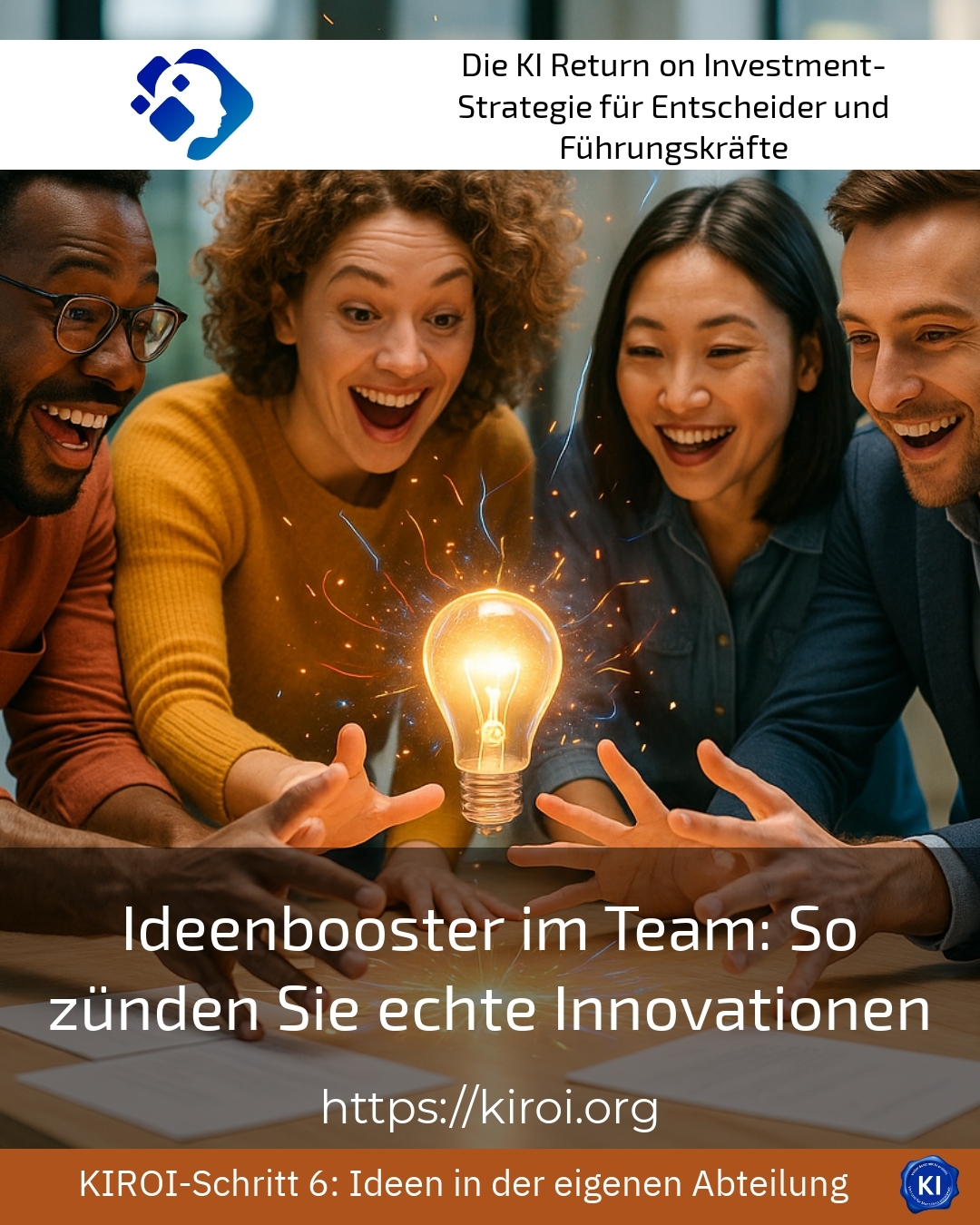
Do you know that feeling when a meeting ends and everyone involved is left with nothing? They had hoped for a creative spark, but instead, there's a suffocating silence. Team idea booster is missing, and nobody really knows how to activate it. This is precisely where this article comes in, because innovative breakthroughs rarely happen by chance; rather, they follow specific patterns and methods. In a rapidly changing world, companies need fresh impulses from within their organisation more than ever. Let's explore together how you can unleash the creative potential of your employees and generate real innovation.
The foundations for a sustainable idea booster in a team
Before we delve into specific methods, we must understand why some teams seemingly generate innovation effortlessly, while others remain in mediocrity despite all efforts. The answer often lies in the psychological safety that prevails within the group. Employees who fear criticism or negative consequences will keep their unconventional thoughts to themselves. An automotive supplier from southern Germany recognised this problem and introduced so-called "failure celebrations," where failed projects were not condemned but analysed for their learning potential. A medium-sized mechanical engineering company implemented anonymous suggestion boxes, accessible digitally via an internal platform, and thereby increased the number of submitted improvement suggestions by an impressive eighty percent. An electronics group deliberately created heterogeneous teams from different departments because the varying perspectives led to richer discussions.
Psychological safety forms the foundation upon which all further measures can be built. Without this foundation, even the best methods will bear no fruit. Transruptions Coaching supports companies in creating and sustainably anchoring these fundamentals. The support encompasses both leadership development and the design of conducive frameworks for creative processes.
Establishing structured creativity as an idea booster in the team
Many people mistakenly believe that creativity cannot be controlled and depends solely on flashes of inspiration. This assumption leads companies to not establish systematic processes for idea generation and instead rely on happy coincidence. However, reality is different, as structured creativity methods help teams to call upon their potential in a targeted manner. A manufacturer of precision tools introduced weekly innovation sprints, during which small teams developed solution approaches for specific challenges within four hours. A company in the chemical industry used the SCAMPER method to systematically examine existing products for improvement possibilities, thus generating several patentable new developments. A manufacturer of industrial robots combined design thinking with agile methods, thereby shortening development cycles by almost half.
Best practice with a KIROI customer
A medium-sized plant manufacturer approached us with the challenge that their innovation rate was stagnating, despite high investment in research and development. Employees found the existing processes restrictive and uninspiring. Together, we analysed the existing structures and identified several obstacles that blocked the creative flow. The company's hierarchy was deeply entrenched, meaning junior employees rarely managed to get their ideas to the decision-making level. We implemented a multi-stage programme that initially made managers aware of the importance of psychological safety. We then introduced cross-departmental innovation workshops, where deliberately hierarchical-free spaces were created. Participants learned various creativity techniques and applied them to real company problems. After six months, the company had not only gathered numerous new product ideas but also initiated a noticeable change in corporate culture. Employees frequently reported that they now felt confident suggesting unconventional ideas because they knew their input was valued.
Utilising technological tools for idea generation
Digital transformation opens up entirely new possibilities for collaborative idea development. Modern software solutions enable teams to work together irrespective of location and share their thoughts in real time [1]. These tools do not replace human creativity but support and enhance it in remarkable ways. A manufacturer of measuring technology used an AI-powered platform that automatically established connections between seemingly unrelated ideas, thereby revealing entirely new approaches to solutions. A manufacturer of pumps and fittings used virtual reality to make prototypes tangible early on and gather feedback from various stakeholders. A company in the packaging industry implemented a gamification platform that rewarded employees with points for innovative suggestions, significantly increasing participation.
The selection of the right tools depends heavily on the specific needs and culture of the company. Transruption Coaching supports organisations in evaluating and implementing such systems, ensuring that the technology actually delivers the desired benefits. Clients frequently report that the introduction of digital collaboration tools has also had positive side effects, such as improved cross-departmental communication.
The role of leadership in the team's idea booster
Leaders significantly shape whether a team can unfold its creative potential or not. Their behaviour sends daily signals about which types of contributions are desired and which are not [2]. An authoritarian leadership style, which sanctions deviations from the norm, stifles innovation at its root. A manufacturer of conveyor technology experienced a change after management began specifically asking for dissenting opinions in meetings and publicly appreciating them. A producer of hydraulic components trained its leaders in coaching techniques so that they could better support their employees in developing ideas. A company in the semiconductor industry introduced reverse mentoring, where younger employees provided leaders with new perspectives on technological trends.
The transformation of leadership culture requires time and continuous support. Transruption coaching provides impetus for this change and supports leaders in redefining their roles. The support includes both individual coaching sessions and team workshops, where new behaviours can be practised.
Spatial design as a catalyst for innovation
The physical environment influences our thinking more than we often want to admit [3]. Sterile office landscapes with identical workstations encourage standardised thinking, while varied spaces stimulate creativity. A sensor technology manufacturer completely redesigned its innovation area, creating different zones for different work modes, from quiet retreats to lively collaboration spaces. A drive systems producer set up a workshop where employees could immediately turn their ideas into physical prototypes without having to go through complicated approval processes. A medical technology company integrated elements from nature into its offices because studies showed that natural environments promote creative thinking.
Designing spaces that foster innovation requires a deep understanding of work processes and company culture. Not every concept is suitable for every company, and unthinkingly adopting trends can even be counterproductive. Guidance from experienced consultants helps to develop tailor-made solutions that genuinely fit the organisation.
Best practice with a KIROI customer
A family-run business with a rich tradition in the plastics processing sector approached us because, despite a solid market position, they were increasingly struggling to keep pace with the innovation speed of their competitors. The existing structures had grown over decades and had proven their worth, but they made it difficult to implement new ideas quickly. Together, we developed a concept for an innovation hub that was spatially and organisationally separate from day-to-day operations. Interdisciplinary teams worked on future-oriented projects in this hub without having to adhere to the usual hierarchies and processes. The spatial design was deliberately chosen to be different from that of the rest of the company, with flexible furniture, large wall areas for visualisations, and an open-plan kitchen as a social centre. The results exceeded expectations significantly, as three marketable product concepts were created within the first year, one of which has already been successfully launched. Furthermore, the hub served as a beacon for the entire organisation, inspiring other departments to be more willing to experiment.
Diversity as a driver for the idea booster in the team
Homogeneous teams tend to repeatedly develop similar solutions because all participants draw from comparable backgrounds of experience. True innovation, however, often arises at the intersections of different disciplines and perspectives. A machine tool manufacturer deliberately brought in career changers from completely different industries into its development department and benefited from their unbiased view of established processes. An automation solutions producer formed teams of engineers, designers, and psychologists because the different approaches led to more holistic product concepts. An aerospace supplier company regularly held hackathons, to which external participants were also invited, in order to bring fresh momentum into the organisation.
Team composition should not be left to chance but should be deliberately designed. Transruptions Coaching supports companies in strategically promoting diversity and mastering the associated challenges. Because different perspectives also mean different communication styles and potential conflicts that need to be constructively utilised.
From Idea to Implementation: The Critical Transition
Many companies fail not due to a lack of ideas, but due to the inability to turn them into reality [4]. The famous innovation gap describes the phenomenon where promising concepts disappear into drawers because no one takes responsibility for the next steps. A manufacturer of industrial electronics established a dedicated innovation board that regularly decided on submitted ideas and immediately provided resources for promising suggestions. A producer of connection technology introduced a stage-gate model that defined clear criteria for transitioning from one development phase to the next. A company in the glass industry created the role of an innovation manager, who acted as a bridge between creative teams and operational business.
The transition from idea generation to implementation requires different skills and processes than the creative phase itself. Clients often report that this is precisely where they need support, because internal structures are not designed for rapid experimentation. Guidance from experienced partners helps to develop and implement suitable mechanisms.
My KIROI Analysis
After intensive engagement with the topic of idea promotion in companies, a clear pattern emerges. Successful organisations are distinguished from less successful ones not primarily by the quality of their employees, but by the conditions they create. Psychological safety forms the indispensable foundation upon which all further measures build. Without the certainty that mistakes will not be punished and that unconventional ideas are welcome, no amount of sophisticated innovation programme will be able to unfold its effect.
Technological development opens up new possibilities that should be wisely utilised. Digital tools can improve collaboration and build connections that would not otherwise come about. At the same time, we must not forget that technology is always just a means to an end and cannot replace the human factor. The culture of leadership is a decisive factor in the success or failure of innovation initiatives, which is why this is where the greatest lever for change lies.
Diversity in teams is not an end in itself, but a strategic necessity for organisations that want to survive in complex markets. However, bringing together different perspectives also requires the ability to deal constructively with the resulting tensions. Finally, it becomes clear that the transition from idea to implementation is often the most critical point at which many companies fail. This requires clear processes, dedicated resources, and the courage to quickly test even unfinished concepts.
Further links from the text above:
[1] McKinsey: Psychological Safety and Leadership Development
[2] Harvard Business Review: Creating Psychological Safety in the Workplace
[3] Steelcase: How Space Affects Creativity
[4] Boston Consulting Group: Most Innovative Companies Report
For more information and if you have any questions, please contact Contact us or read more blog posts on the topic Artificial intelligence here.











 Deutsch
  English (UK)