
Have you ever wondered why some companies master technological change effortlessly, while others fail despite enormous investments?
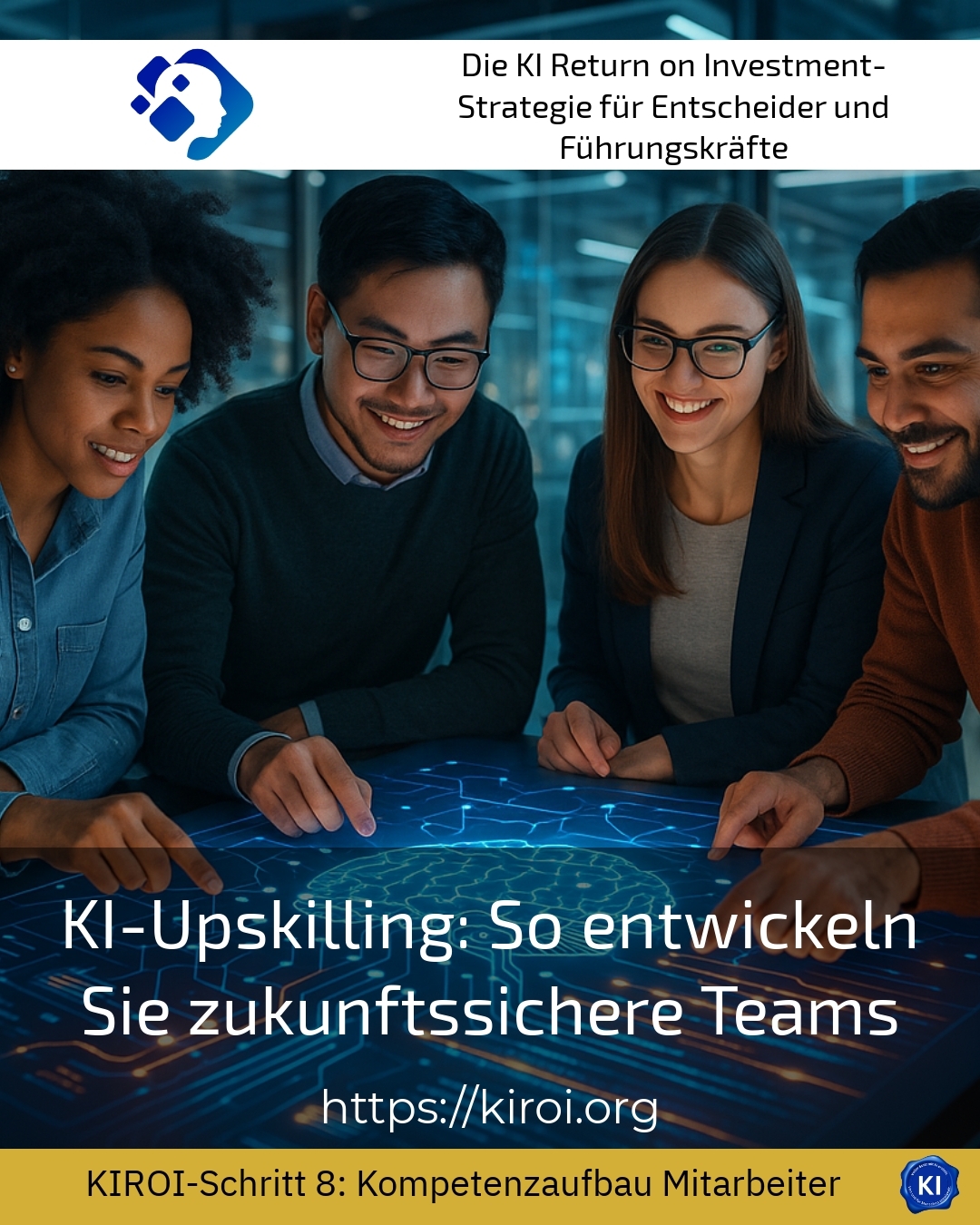
The answer rarely lies in the technology itself. It lies in the people who are supposed to use this technology. AI Upskilling It has emerged as a crucial success factor. Many leaders underestimate the complexity of this transformation. They purchase state-of-the-art systems and then wonder why they are not accepted. At the same time, more and more human resources managers report increasing gaps in competence in their teams. The good news, however, is that this challenge can be tackled systematically. With the right strategy, you develop teams that not only function today. You create structures that will remain relevant and competitive tomorrow as well.
Why traditional further education is no longer enough
Traditional training programs follow a familiar pattern. Employees attend a seminar and then return to their day-to-day work. However, this approach is increasingly reaching its limits. Technological progress continues to develop exponentially. What is considered innovative today may already be outdated tomorrow. Therefore, organizations need new approaches for developing the competencies of their workforce.
A medium-sized machine engineering company from southern Germany illustrates this problem impressively. The management invested considerable sums in external training courses on data analysis. However, after six months, it was found that hardly anyone applied what they had learned. The employees had indeed acquired theoretical knowledge. However, they lacked practical experience in their own work context. Similarly, a logistics company from the Hamburg area faced similar problems. There, extensive e-learning modules had been provided. However, the completion rates remained disappointingly low. A automotive supplier reported similar experiences in the introduction of new planning systems. The findings were identical in all cases: learning needs to be designed differently.
Best practice with a AIROI customer
An international manufacturer of industrial components faced a special challenge. The workforce consisted of employees from four different generations with very different digital skills. Initially, they tried to train all employees using a uniform approach. However, this approach led to frustration on both sides of the spectrum. The younger colleagues became bored, while the older team members were overwhelmed. In the framework of the transruptions coaching, we jointly developed a differentiated learning path model. Each employee received an individual assessment of their current skills. Based on this, personalized development plans were created with different speeds. The introduction of learning teams was particularly effective. Digitally adept and less experienced employees supported each other digitally. The results surprised even skeptical executives. Within eight months, the adoption rate of new analytical tools increased by over sixty percent. At the same time, the operating climate improved significantly, as cross-generational collaboration was actively promoted.
AI Upskilling as a Strategic Leadership Challenge
The development of future-proof competencies is now on the agenda of every management team. However, many times executives and managers delegate this topic entirely to the human resources department. This is a mistake with far-reaching consequences. Because AI Upskilling it touches upon fundamental questions of corporate strategy. It involves much more than just individual training measures.
An example from the chemical industry illustrates this connection. A specialty chemicals manufacturer had formulated ambitious digitization goals. The senior management expected that automated processes would be implemented within two years. At the same time, no one had analyzed what competencies were available in the company for this. The project came to a standstill because important skills simply were not present. A pharmaceutical company experienced similar experiences with the implementation of intelligent quality assurance systems. The technical implementation was straightforward. However, the human side of the transformation was neglected. A medical technology manufacturer also reported delays in a predictive maintenance project. The reason was not in the technology. There was a shortage of employees who could make sense of the data.
The role of leaders in AI upskilling
Leaders decisively shape a company’s learning culture. When they themselves demonstrate openness to new technologies, teams follow this example. Conversely, skeptical supervisors often block the entire transformation process. Therefore, effective change management starts with a clear understanding of the underlying factors. AI Upskilling Always at the leadership level. However, this does not mean that managers themselves have to become programmers. Rather, it is about a fundamental understanding of the possibilities and limitations of new technologies.
A packaging machinery manufacturer from North Rhine-Westphalia took an interesting approach in this regard. The entire management initially underwent a compact basic training program. This did not involve technical details. It focused on strategic implications and ethical issues. A plant builder from Bavaria followed a similar approach for its management. Thereafter, cross-departmental working groups were formed to identify use cases. A manufacturer of measurement and control technology integrated digital topics firmly into its management development for its executives. These examples show that change must start from the top.
Best practice with a AIROI customer
A long-established family business in the field of drive technology approached us with a specific request. The younger generation of the family owners was pushing for rapid digitalization. At the same time, they did not want to overburden long-standing employees or even lose them. As part of the transruptive coaching process, we developed a multi-stage approach. First, we conducted detailed discussions with employees at all levels of the hierarchy. It became clear that the resistance often had less to do with the technology itself. Many employees feared losing their relevance and status within the company. Based on these findings, we completely redesigned the qualification program. We focused on valuing and recognizing existing competencies. Experienced professionals were given the role of process experts who were consulted on system design. This involvement fundamentally changed the atmosphere. Clients often report similar positive changes when fears are taken seriously. In the end, the project results exceeded the original expectations significantly. The company was even able to recruit new staff because it was now perceived as an innovative employer.
Practical approaches for sustainable competence development
Successful qualification programs are characterized by certain features. They are practically oriented, individualized, and continuously designed. One-time events rarely generate lasting behavioral changes. Instead, regular learning impulses are needed that are integrated into everyday work routines. Only in this way do real competencies emerge that remain accessible even under pressure.
A manufacturer of machine tools has developed an interesting model. There are weekly learning sessions of thirty minutes each. During this time, teams experiment with new tools and methods. One company in the plastics processing industry uses a similar rhythm for knowledge exchange. Every Friday, colleagues present short practical examples from their work. A supplier of medical technology has produced internal micro-learning units. These short videos convey specific knowledge about internal systems and processes. All three examples show how learning can become a natural part of work.
Learning formats that really work
The selection of suitable learning formats depends on various factors. These include the company culture, the existing infrastructure, and the target audience. Clients often report positive experiences with blended formats. The combination of in-person events and digital elements appears to be particularly effective. It is important to find the right balance for your specific context.
An electronics manufacturing company has set up so-called sandbox environments. There, employees can experiment with new systems without risk. Errors here have no negative consequences and are even encouraged. A machine builder relies on peer learning in small groups. Colleagues support each other in acquiring competencies. A manufacturer of sensor technology has integrated external experts as regular impetus providers. These bring fresh perspectives and new ideas into the organization. The diversity of approaches shows that there is no one-size-fits-all solution.
Understanding and constructively using resistance
Change processes almost always generate resistance. This is normal and even healthy. Resistance signals that people are grappling with change. It also shows where clarification is needed or where fears need to be addressed. Therefore, wise leaders do not suppress resistance. They use it as a valuable source of information for shaping change.
An equipment manufacturer for the food industry made this experience in a striking way. Initially, the project management team tried to quickly dispel concerns. However, this led to increased resistance and even open conflicts. Only when they began actively involving critical voices did the tide turn. A manufacturer of packaging solutions reported similar findings during a system implementation. There, a group of skeptics was formed as internal test pilots. Their initial criticism turned into constructive feedback for improving the system. A company in the conveyor technology sector went one step further. It appointed a well-known critic as the project ambassador. This person enjoyed high trust among colleagues.
My AIROI Analysis
Co-leading numerous transformation projects has given me deep insights into success patterns and stumbling blocks. One central insight emerges again and again: Technological investments only achieve their potential when people are empowered and included. AI Upskilling Therefore, it is not an optional addition to the digitization strategy. It is its indispensable foundation and deserves appropriate attention at the leadership level.
What particularly impresses me about my work is the adaptability of people. Even long-standing employees develop enthusiasm for new technologies when given the right framework. Transruptive coaching supports organizations in exactly this way. It involves creating individual learning paths and creating psychological safety. At the same time, ambitious goals must be formulated and consistently pursued. Finding this balance is an art that needs to be practiced.
The companies that are in business today AI Upskilling By investing, they gain significant competitive advantages. They build not only technical competencies; they also develop a learning culture that makes them future-proof. Because change will not stop. On the contrary, it will accelerate. Organizations whose employees have learned to learn will master this dynamic. All others will increasingly have difficulty keeping up. The decision as to which path your company takes is yours to make.
Further links from the text above:
[1] McKinsey: AI and the future of skills
[2] World Economic Forum: The Future of Jobs Report
[3] Bitkom: Artificial Intelligence in Germany
For more information and if you have any questions, please contact Contact us or read more blog posts on the topic Artificial intelligence here.






 Deutsch
 English (UK)