
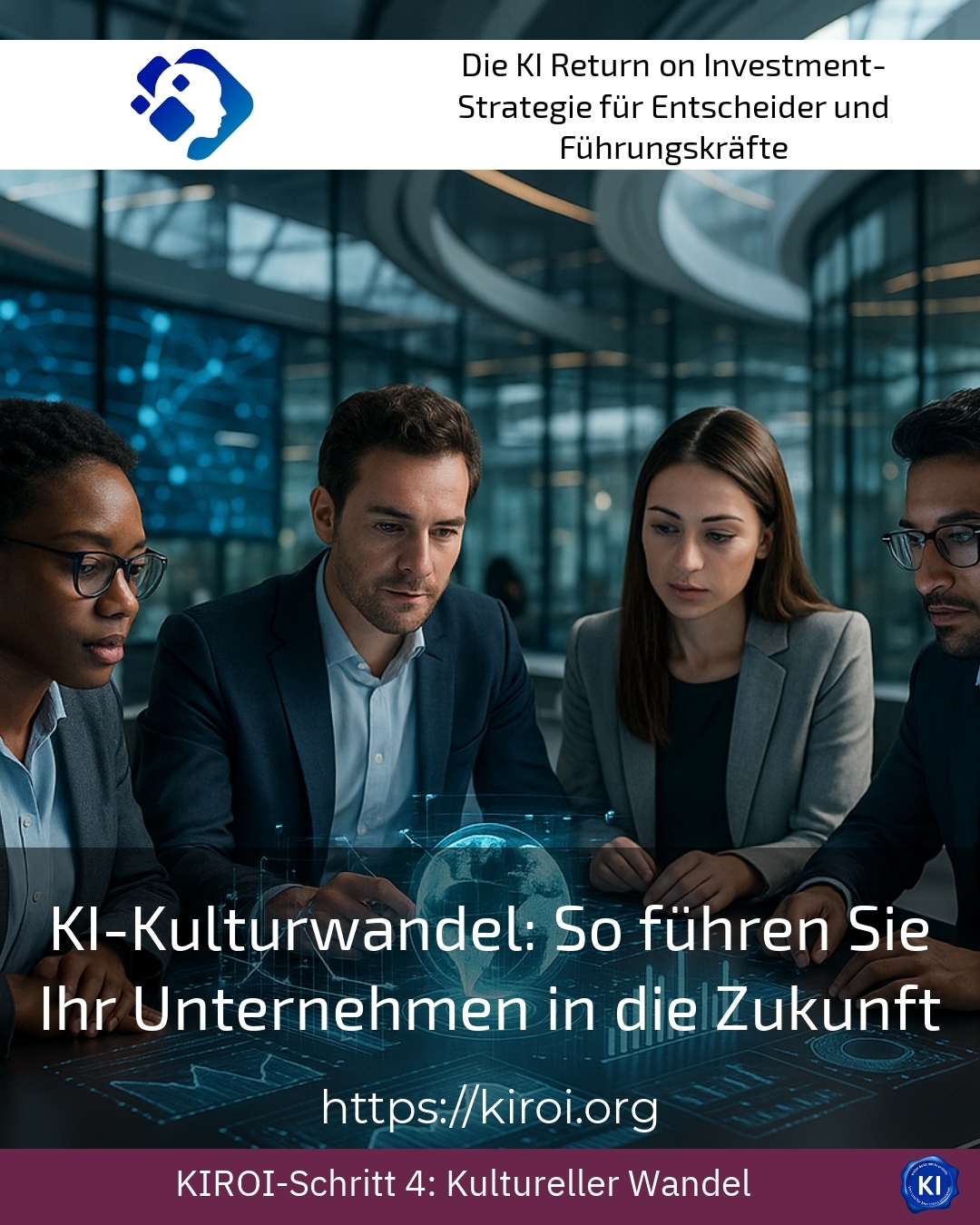
Imagine your entire organization suddenly working completely differently. Decisions are made faster and processes run more efficiently. This is exactly what companies experience who adopt AI cultural change Managing change successfully. But this change does not start with technology; it begins in people’s minds. Leaders face the exciting challenge of taking their teams on a journey. This journey fundamentally changes working practices, mindsets, and established habits. In this article, you will learn how to actively shape this transformation process. You will discover concrete approaches for your daily leadership work.
Understanding the fundamentals of AI-driven cultural change
Any profound change in organizations first requires a deep understanding of the underlying dynamics. Many companies begin by introducing new tools and systems. However, they often overlook the human component of this transformation. Employees bring different experiences and expectations. Some respond enthusiastically to new opportunities. Others develop reservations or even fears about change. Successful leaders recognize this diversity of reactions early on. They develop differentiated strategies for different groups of employees.
In retail, this dynamic is particularly evident in the introduction of intelligent cash register systems. Experienced cashiers see their expertise initially threatened. At the same time, new tasks arise in customer consulting and service. Manufacturing companies experience similar tensions when implementing predictive maintenance systems. Technicians must fundamentally rethink their working methods and develop new competencies. Financial service providers also report initial resistance to the introduction of automated analysis tools. Employees need time and guidance for these adaptation processes.
Best practice with a AIROI customer
A medium-sized logistics company faced the challenge of modernizing its entire warehouse management. The management recognized that intelligent systems could significantly increase efficiency. At the same time, there was concern about losing long-standing employees or demotivating them. The transruptions coaching accompanied the leadership team over several months during this sensitive process. Initially, we conducted detailed discussions with employees from all levels and departments. These conversations revealed concrete concerns, but also surprisingly many constructive improvement suggestions from the workforce. Together, we developed a communication strategy that placed transparency and involvement at the forefront. The employees were given the opportunity to familiarize themselves with the new systems in protected spaces and to try them out first. Experienced warehouse workers were trained to become internal ambassadors and actively supported their colleagues. The result far exceeded all expectations and was sustainable. During the transformation phase, the turnover rate even fell below the industry average. Employee satisfaction increased measurably, as people felt taken seriously and valued.
Developing leadership skills for a successful AI culture change
The requirements for leaders are fundamentally and profoundly changing in times of technological upheaval. While classic management skills remain important and relevant, they are no longer sufficient for the complex challenges of today. Modern leaders need a deep understanding of technological possibilities and their limitations. At the same time, they must act with emotional intelligence and be able to communicate empathically. This combination of technical expertise and human competence forms the foundation of successful transformation.
In healthcare, this need is particularly evident in the introduction of diagnostic support systems. Physicians must learn to deal with algorithmic recommendations and critically evaluate them. Nurses experience new documentation requirements and changed workflows on their wards. Administrative staff in clinics work with automated billing systems and intelligent scheduling. Each of these groups requires specific support and individualized development paths. Leaders must recognize this diversity and be able to respond in a differentiated manner.
Educational institutions face similar challenges in integrating assistive technology into their daily routines. Teachers develop different attitudes towards digital tools and their pedagogical use. School administrations must balance technological possibilities with pedagogical principles and build bridges. Universities are also grappling with questions of academic integrity in an era of automated text generation. The training of executives in these areas is therefore becoming increasingly important.
Communication as the Key to AI Culture Change
Successful transformation always relies on clear, honest, and continuous communication between all involved parties. Employees want to understand why changes are necessary and where the journey will lead. They want to know how their personal work situation will develop. Vague statements or evasive answers only increase uncertainty and significantly fuel rumors. Successful leaders communicate openly about opportunities and also about possible risks. They create spaces for questions, concerns, and constructive dialogue at eye level [1].
In the automotive industry, we experience this communication challenge particularly acutely during the transition to new manufacturing processes. Plant managers must explain technical changes in a comprehensible manner and relate them to a broader context. Master craftsmen serve as important intermediaries between management and production workers on the ground. Works councils rightly demand transparency and early involvement in strategic decision-making processes. Supplier companies also need clear information about changed requirements and future expectations. The communication chain must function across all these levels and convey consistent messages.
Best practice with a AIROI customer
A traditional family-run machine-building company wanted to fundamentally modernize and digitize its service processes. The management had developed a vision of predictive maintenance and automated customer communication. However, the service technicians in the field initially reacted skeptically to these change plans. They feared that their valuable experience and expertise would be devalued. Transruptive coaching supported the development of a comprehensive communication strategy for this change process. We initially organized open dialogue sessions in which all concerns were heard. The technicians recognized that their expertise would remain indispensable. The new tools were meant to relieve them of their workload and not replace them in their daily work. Together, the teams developed training concepts that built on the existing competencies and expanded them. The service technicians were actively involved in designing the new processes. This involvement created acceptance and identification with the changes from the very beginning. Customer satisfaction increased measurably after the introduction, because the technicians actively used the new opportunities.
Rethinking structures and processes
Technological changes often require organizational adjustments in various business areas and at various levels as well. Rigid hierarchies and fixed processes significantly hinder the flexible utilization of new opportunities. Agile working methods enable faster adjustments and promote the joy of innovation in teams. Cross-functional teams bring together different perspectives and create synergies between departments. Experimental spaces allow the safe testing of new approaches without existential risks [2].
Media companies have had to experience these structural adjustments particularly early and intensively. Today, newsrooms operate completely differently than just a few years ago. Journalists use automated research tools and data-based analysis tools for their work. Content management systems enable the personalized delivery of content to different target groups. Marketing departments experiment with automated ad optimization and dynamic pricing. These changes require new organizational forms and changed collaboration models between departments.
The banking sector is undergoing similarly profound structural changes in its core processes. Customer advisors are working with intelligent recommendation systems and automated risk assessments. Compliance departments are using automated monitoring tools to ensure regulatory compliance. Back-office functions are becoming increasingly automated and centralized in central locations. At the same time, new roles are emerging in the interface between humans and technical systems. Banks must continuously adapt their organizational structures to these new realities.
Strategically plan for qualification and competence development
The skills that employees need today differ significantly from the requirements of previous years. Lifelong learning is evolving from a buzzword to an existential necessity for all employees. Companies must build systematic qualification programs and be able to finance them in the long term. Individual learning paths take into account the different starting situations and development potentials of employees. Informal learning forms complement traditional training formats and enable continuous development in the workplace [3].
In the insurance industry, the need for training is particularly evident when introducing automated claims processing systems. Claims handlers must learn to handle and verify algorithmic decision-making recommendations. Actuaries work with more powerful modeling tools and larger data sets than ever before. Sales staff require new skills in using customer-specific analysis results. Executives also need to understand how automated systems prepare decisions and what the limits are.
The tourism industry faces similar qualification challenges when implementing intelligent booking systems and customer service applications. Travel consultants must master the use of technological tools while maintaining personal consulting skills. Hotel managers work with automated revenue management systems and dynamic pricing. Airlines rely on automated customer service processes and intelligent route planning. The qualification of employees is crucial for the success of these technological investments.
Best practice with a AIROI customer
A nationwide-based trading company wanted to take its merchandise management and inventory planning to a new level. The introduction of an intelligent forecasting system promised significant efficiency gains and cost savings. However, the employees in purchasing and logistics brought very different backgrounds in handling digital tools. The transruptions coaching supported the development of a differentiated qualification concept for all involved. We first conducted a systematic analysis of the existing competencies and individual learning needs. Based on this, customized learning paths were created for different employee groups and functional areas. Experienced colleagues were trained to become internal multipliers and contact persons. They supported their teams in the practical application and answered everyday questions directly on site. Regular feedback loops enabled the continuous adaptation of training content to real needs. The learning culture in the company changed in a lasting and positive way through this process. Employees began to ask for opportunities for further development independently and to contribute their own ideas for improvement. The quality of the forecasts of the new systems exceeded expectations because people used them competently and with dedication.
Constructively use resistance and take fears seriously
Resistance to change is a normal and understandable reaction to uncertainty and perceived threats to established patterns of behavior. It signals important information about the concerns, needs, and limits of those involved in the organization. Successful transformations do not arise through breaking down resistance, but through integrating it. Leaders who take objections seriously and respond constructively build trust and acceptance. They harness the energy of resistance to improve their change concepts and implementation plans.
In the energy industry, we are witnessing intense debates about the transition to decentralized and intelligent grid systems. Technicians in conventional power plants see their jobs threatened and their expertise devalued. Grid operators must be able to understand and implement completely new control logics. Customer service employees receive inquiries regarding complex new tariff models and smart home applications. The honest discussion of these concerns promotes better solutions and higher acceptance among all parties involved.
Typical resistance patterns are also evident in the craft sector when it comes to the introduction of digital planning and documentation tools. Experienced craftsmen rely on their proven methods and their craftsmanship knowledge. Younger employees bring other expectations of digital work environments into the company. The integration of both perspectives requires patience, dialogue, and mutual learning. Businesses that utilize these differences as a resource develop particularly viable solutions for their specific needs.
My AIROI Analysis
The AI cultural change It presents companies with multifaceted challenges that go far beyond technical implementation issues and affect the entire organization. My experience from numerous mentoring projects clearly shows that success depends significantly on the quality of leadership. Technology alone does not create sustainable change in organizations and their cultures. People must understand, participate in, and be able to develop trust in change.
The presented examples from various industries illustrate recurring patterns and success factors of this transformation. Transparent communication, systematic qualification, and honest dealing with resistance form the foundation of successful change processes. Leaders need new competencies at the intersection of technology and human collaboration. Transruptions coaching provides impulses and supports in dealing with these complex challenges of organizational transformation.
Clients often report initial overwhelm due to the complexity of the task. The structured approach of the AIROI-approach helps them gain orientation and plan their first steps. Each company brings its own requirements, cultures, and development potential to this process. Standard solutions rarely work, while tailor-made concepts can have a lasting effect. Investing in people and their development is increasingly worthwhile in the long term, more so than simply investing in technology alone. Organizations that invest in people and their development are increasingly more profitable in the long run than simply investing in technology alone. AI cultural change Taking this opportunity to develop comprehensively, they position themselves successfully for the years to come.
Further links from the text above:
[1] Harvard Business Review – Insights on Change Management
[2] McKinsey – People and Organisational Performance
[3] World Economic Forum – Future of Work Initiative
For more information and if you have any questions, please contact Contact us or read more blog posts on the topic Artificial intelligence here.










 Deutsch
  English (UK)