
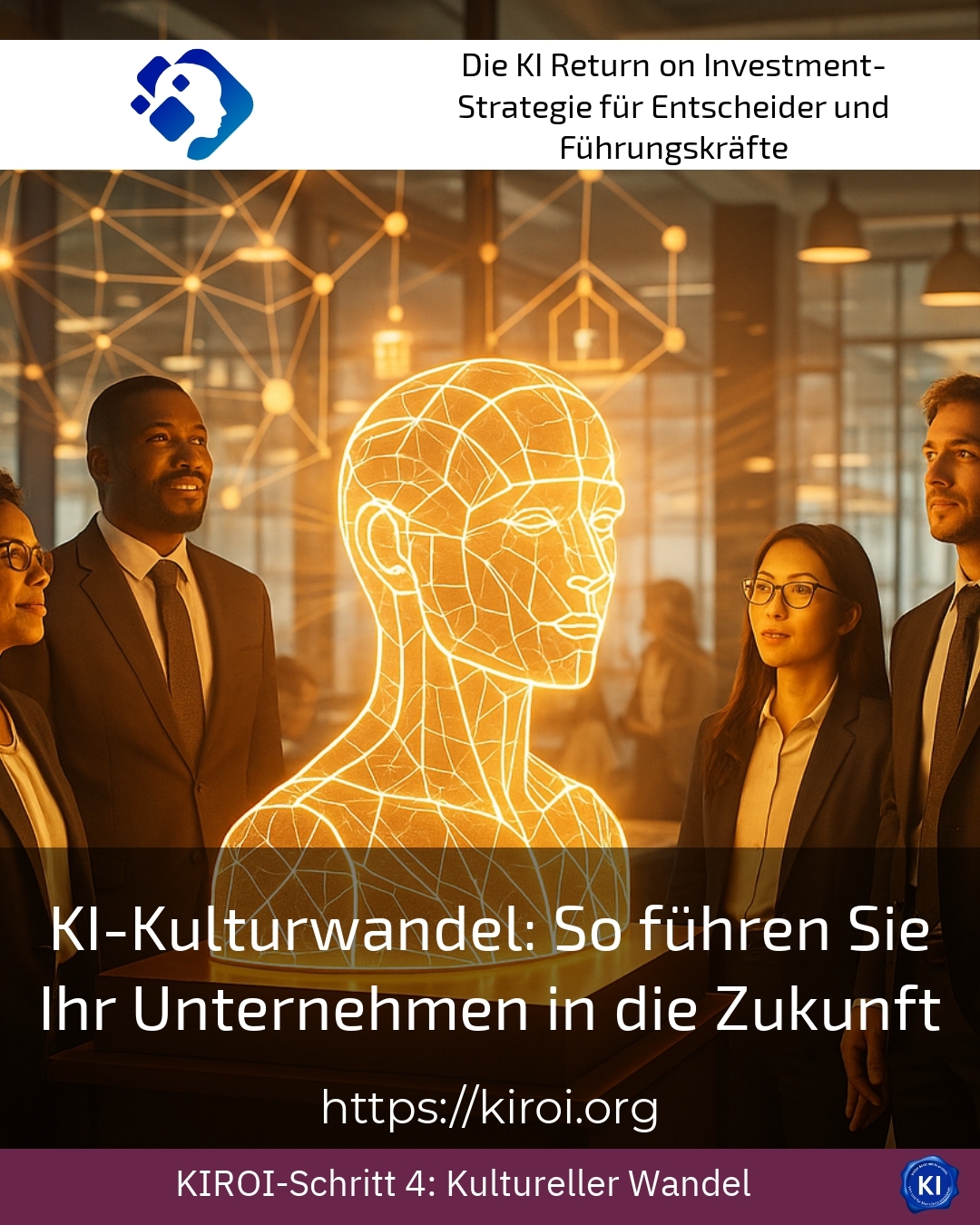
Imagine your entire organisation is fundamentally transforming. Not through new software or more modern machinery, but through a completely new way of thinking and working. The AI cultural change is just around the corner for many businesses. Yet only a few know how to successfully shape this transformation. Most executives underestimate a crucial factor in the process: people must not only accept the change, but actively want to help shape it. This is precisely where the real challenge begins, which goes far beyond technical implementations.
Why the AI culture shift requires more than just technology
Many companies invest significant sums in intelligent systems. They buy licences, train their IT departments and expect quick results. Yet managers frequently report disappointing outcomes. The systems are not used, employees remain sceptical and old processes persist. This situation arises because the cultural aspect has been neglected. Technology alone does not change a corporate culture. People change culture, specifically through new behaviours and beliefs.
For example, a medium-sized mechanical engineering company introduced an intelligent maintenance system. The technicians were supposed to be able to predict failures with it. After six months, however, hardly anyone was using the system regularly. The root cause lay not in the technology, but in the lack of support for the change process. A logistics company experienced something similar when introducing automated route planning. The drivers preferred to trust their own experience rather than the system's recommendations. A retail group also struggled with the acceptance of new inventory management solutions. The store managers felt patronised by the algorithms and ignored their suggestions.
Best practice with a AIROI customer
A long-established family business in the manufacturing sector was facing a major challenge. The management team wanted to introduce intelligent quality control, but the workforce was sceptical. Many employees had worked in the company for decades and feared for their expertise. The transruptions coaching accompanied the entire process over several months. First, we jointly identified the greatest concerns and resistance within the team. Then, we developed formats in which experienced employees could combine their knowledge with the new systems. The quality inspectors became experts in human-machine collaboration. Suddenly, their experience was more valuable than ever because they were able to train and improve the systems. After nine months, acceptance rose to over eighty per cent, and the error rate dropped significantly. The company benefited not only from better quality, but also from more motivated employees.
The five pillars of a successful AI cultural change
Successful transformations are based on clear guiding principles. These principles help organisations to anchor changes sustainably. The first pillar is transparent communication regarding goals and impacts. Employees must understand why changes are necessary. The second pillar concerns the active involvement of all hierarchy levels in the process. Leaders should act as role models and practise new working methods themselves.
A pharmaceutical company impressively demonstrated the third pillar: continuous further training and skills development. It offered all employees individual learning pathways tailored to their respective roles. An insurance group focused on the fourth pillar, namely gradual introduction instead of radical change. The teams were able to slowly get used to new ways of working and build trust. An energy supplier embodied the fifth pillar by consistently celebrating successes. Every small step of progress was made visible and appreciated.
How transruption coaching accompanies change
Support from experienced coaches can provide decisive momentum. Transruption coaching positions itself clearly as a partner in complex transformation projects. The coaching approaches combine strategic perspectives with practical implementation support. At the same time, the individual needs of the organisation remain central. Clients frequently approach us with issues such as resistance in middle management or a lack of acceptance among long-standing employees.
An automotive supplier used this guidance during the introduction of intelligent production control. The shift supervisors were initially identified as sceptics and specifically involved. A telecommunications provider benefited from coaching during the transformation of its customer service. The advisors learned to perceive intelligent assistance systems as support rather than a threat. A banking institution also sought guidance during the digitalisation of its credit processes. Together with coaches, the clerks developed new working routines that combined human expertise and automated analyses.
Understanding and constructively using resistance
Resistance to change is natural and even valuable. It shows what matters to people and where uncertainties lie. Wise leaders do not treat resistance as a disruption, but as valuable information. This attitude enables deeper and more sustainable change processes. Clients frequently report that real progress only became possible by understanding the resistance.
A chemical company discovered important safety concerns raised by its engineers through resistance analysis. These concerns led to improved control mechanisms that would otherwise have been overlooked. A retail company identified weaknesses in its customer recommendation systems through critical voices from sales. The sales staff intuitively knew what the algorithms could not yet capture. A healthcare provider used the scepticism of its nursing staff to develop better documentation systems. The practical experience of the employees made the technical solutions significantly more suitable for everyday use.
Best practice with a AIROI customer
An internationally active service provider wanted to fundamentally modernise its project management processes. The experienced project managers initially reacted with rejection to the planned changes. As part of transruption coaching, we introduced structured dialogue formats in which all concerns were gathered and analysed. It transpired that the project managers were primarily afraid for their autonomy in decision-making. They feared that intelligent systems would replace their strategic assessments. Together, we developed a model that positioned the systems as decision support. Final responsibility remained with the human experts, but they were provided with significantly better data foundations. The project managers became co-creators of the new way of working, and their expertise was enhanced rather than devalued. As a result, the company was able to reduce project durations whilst simultaneously increasing employee satisfaction. This success was only possible because resistance was taken seriously and used constructively.
AI cultural change as a leadership task
The role of leaders in transformation processes can hardly be overestimated. They set the framework, provide direction and embody the desired culture. If leaders themselves remain sceptical, their teams are unlikely to develop any enthusiasm. This is why successful AI cultural change always at the executive level. Leaders do not have to become tech experts, but they should model openness and a willingness to learn.
The board of directors of a construction company demonstrated this impressively through their own use of new planning tools. Their visible enthusiasm proved infectious for the entire organisation. A female managing director in the media sector openly shared her own learning processes with intelligent text assistants. This transparency encouraged the editors to experiment themselves and gain experience. A clinic director regularly used diagnostic support systems and spoke publicly about their value. As a result, the doctors and nursing staff felt encouraged to try out these tools as well.
Sustainable embedding of change
Many transformation initiatives fizzle out after initial enthusiasm. This happens because sustainable anchoring is neglected. Changes must be integrated into structures, processes and incentive systems. Only then do new behaviours become second nature rather than the exception. The AI cultural change therefore requires long-term commitment and continuous attention.
A consumer goods corporation embedded new ways of working through adapted target agreements and evaluation criteria. The use of intelligent systems became part of the performance appraisal, but in a constructive way. A technology company created new roles for internal transformation facilitators from its own ranks. These multipliers ensured continuous knowledge transfer and daily support. A logistics service provider set up regular reflection formats to discuss successes and challenges together. These institutionalised learning loops helped to keep the transformation vibrant and adaptable [1].
My AIROI Analysis
Guiding numerous organisations through their transformation projects reveals recurring patterns and success factors. Companies that take the cultural aspect seriously achieve significantly better results than purely technology-driven initiatives. The human component ultimately determines the success or failure of complex change processes. Time and again, this shows that early involvement and transparent communication are indispensable. Organisations benefit enormously from external guidance because internal players are often blinkered or have to take political considerations into account. Transruption coaching can provide valuable momentum here and act as a neutral catalyst.
The greatest challenge often lies not in the technology itself, but in overcoming established mindsets. Leaders must learn to relinquish control while simultaneously providing direction. Employees need to experience that their expertise is enhanced by new tools. Finding this balance requires time, patience and professional guidance. Companies that consistently take this path position themselves for long-term success. They develop a culture of continuous adaptation and mutual learning [2]. This culture becomes the decisive competitive advantage in a constantly changing economic world.
Further links from the text above:
[1] McKinsey: Culture for a Digital Age
[2] Harvard Business Review: Organisational Culture
For more information and if you have any questions, please contact Contact us or read more blog posts on the topic Artificial intelligence here.








 Deutsch
  English (UK)