
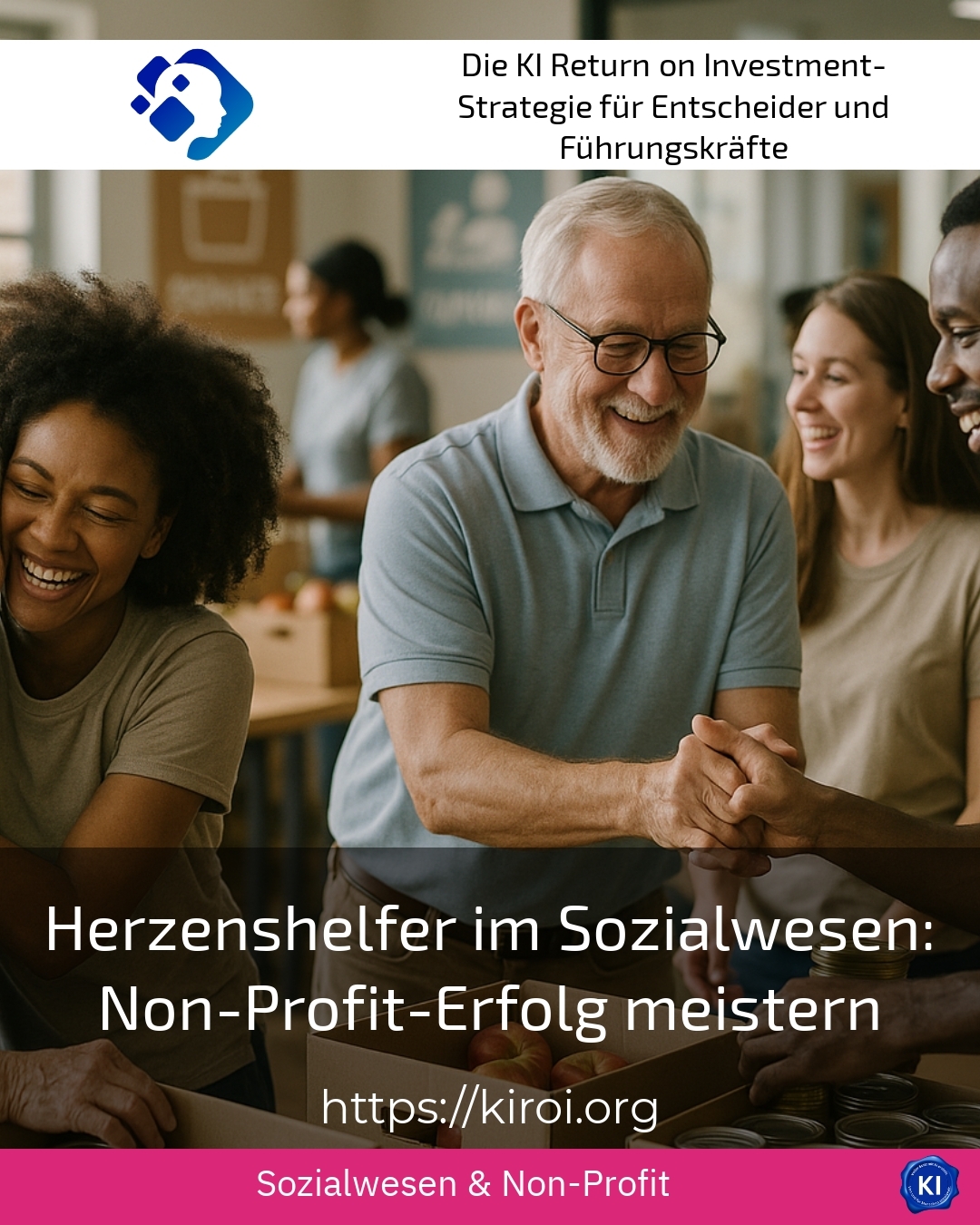
What distinguishes organisations that achieve truly sustainable impact from those that, despite the best of intentions, sink into the quagmire of bureaucratic hurdles and lose sight of their actual mission? This question occupies numerous leaders and employees in the non-profit sector, as pressure is steadily growing while resources are frequently becoming scarcer and social challenges appear more complex than ever before. care workers with a heart face the daily challenge of reconciling human needs with organisational requirements, and it is precisely here that it is decided whether an organisation flourishes or stagnates. In this article, you will learn which strategies truly support, how transruptional coaching can provide impetus as accompaniment in projects relating to digital transformation and organisational development, and why authentic leadership is the key to sustainable success in the non-profit sector.
Understanding the invisible burden of helpers
People who work in the social sector often carry a burden that barely seems visible from the outside. This burden consists of emotional demands, administrative duties and the constant balancing act between compassion and professional distance. An example from elderly care illustrates this impressively: care workers frequently report that they can barely switch off in the evenings because the fates of their residents accompany them in their thoughts. Similarly, social workers in youth welfare offices daily experience situations in which they have to make serious decisions that affect the lives of entire families. Furthermore, staff in homeless shelters face the challenge of supporting people with complex multiple problems without burning out themselves.
Reality shows that many organisations their care workers with a heart fail to provide adequate support simply because the structures that would enable a healthy balance are lacking. Although supervision is offered, it is frequently only sporadic or in groups that are too large to address individual needs. This creates spirals of burnout that not only place a burden on those affected, but also significantly impair the quality of the work with clients.
Social care heroes need clear structures
Without clear structures, even the most dedicated members of staff lose their sense of direction. An example from disability support services shows how important transparent processes are: a residential facility for people with learning disabilities introduced digital documentation systems without adequately training the staff, which led to massive frustration and ultimately to increased staff turnover [1]. By contrast, hospice facilities that involve their teams in change processes from the very beginning report significantly higher acceptance and motivation. Advice centres for migrants have also recognised that clear responsibilities and regular team meetings noticeably improve the quality of work.
Best practice with a AIROI customer
A medium-sized welfare organisation with multiple locations and around 150 employees approached us because internal communication between the various departments had almost ground to a halt and important information was regularly going missing. The management reported increasing conflicts between administration and operational teams, while at the same time funders were demanding stricter reporting obligations. As part of transruption coaching, we first analysed the existing communication channels and identified several critical vulnerabilities that had developed over years. Together with the team leaders, we developed a new communication concept that integrated both digital and analogue elements while taking into account the different working realities of the various areas. It was particularly important not to overwhelm the employees, which is why we broke the introduction down into small, manageable steps and incorporated regular feedback loops. After six months, the managers reported significantly improved collaboration, and the employee survey also showed measurable progress in the areas of satisfaction and flow of information.
Combine empathetic leadership with strategic vision
Leaders in the non-profit sector face a particular challenge, as they must think economically on the one hand while preserving the value-oriented mission of their organisation on the other. This dual role requires skills that are often neglected in traditional management training. An example from debt advice illustrates this tension: the head of a municipal advisory centre had to increase case numbers to secure funding, while at the time the quality of advice suffered under time pressure and clients received less intensive support.
Managing directors of workshops for people with disabilities experience similar conflicts, having to balance the economic demands of production orders with the rehabilitation mandate. Managers of women's refuges also frequently report being constantly torn between acute crises and strategic planning. The question of how to remain authentic as a leader while simultaneously having to make unpleasant decisions occupies many those responsible in this sector.
Shaping strategic development as a heart-centred helper in the social sector
The further development of a social organisation requires perseverance and the willingness to leave familiar paths. Transruption coaching accompanies this as a neutral entity that keeps both human and structural aspects in view. An example from outpatient youth welfare illustrates this: an organisation with decades of tradition recognised that its working methods no longer matched the needs of today's families and initiated a comprehensive change process [2]. Similarly, food banks in various cities have begun to diversify their services and integrate advisory services alongside food distribution. Addiction support facilities, in turn, are increasingly opening up to digital counselling formats in order to reach people who shy away from visiting a counselling centre.
Digital transformation presents many organisations with significant challenges because it requires not only technical, but also cultural changes. Employees who have worked with paper files for years need time and support to internalise new ways of working. At the same time, digitalisation offers enormous opportunities, such as through more efficient administrative processes that free up more time for the actual work with people.
Best practice with a AIROI customer
An operator of several day-care nurseries approached us with the challenge that the educational concepts of the individual facilities differed greatly from one another and there was no uniform quality standard that would have made the work comparable. The management desired more coherence, while the individual nursery managers feared for their autonomy and signalled resistance to central guidelines. As part of the support, we moderated a participatory process in which all facilities were able to contribute their respective strengths and jointly developed a quality framework concept. This approach proved to be far more sustainable than a top-down mandate because the staff viewed the result as their own work and were correspondingly motivated to implement it. Particularly enriching was the exchange between experienced professionals and younger colleagues, which led to a vibrant transfer of knowledge. Parent satisfaction rose measurably, and employee retention also improved significantly, which is invaluable in times of skilled labour shortages.
Make effective use of resources and maximise impact
The question of the efficient use of scarce resources concerns every non-profit organisation. This involves not only financial resources, but equally time, energy and the expertise of employees. An example from offender support illustrates this: an organisation realised that it was spending a significant portion of its capacity on administrative tasks that had no direct benefit for the clients [3]. As a result, processes were streamlined and partially digitised, freeing up more time for the actual support work.
Similar experiences are shared by development cooperation organisations, which must regularly review their project structures to meet the requirements of donors without losing sight of the needs of their target groups. Self-help organisations also face the challenge of creating professional services using structures that are often voluntary, and maintaining them over the long term.
Establish sustainability as a guiding principle for compassionate helpers in the social sector
In the social sector, sustainability means more than just ecological aspects. It is about creating structures that are viable in the long term and do not depend on individuals. An example from refugee support illustrates this impressively: an initiative founded during the peak of the refugee movements had to learn to transition from a spontaneous group of helpers into a professionally managed organisation without losing its original spirit. Similarly, neighbourhood centres have recognised that they must continuously adapt their services to changing needs in order to remain relevant. Hospice associations are also increasingly investing in the systematic recruitment and training of volunteers to secure their work for the long term.
Establishing a learning organisation represents a vital success factor. Regular reflection processes, in which both successes and failures are discussed openly, create the foundation for continuous improvement. Transruption coaching helps to create and moderate such spaces for reflection without falling into didactic or patronising patterns.
My AIROI Analysis
Working in the social sector requires a unique combination of empathy, professional competence and organisational skill that is demanded to this intensity in hardly any other field of work. My analysis shows that successful organisations in this sector are primarily characterised by the fact that they view their employees as their most valuable resource and accordingly invest in their development and wellbeing. The greatest challenges often lie not in a lack of financial resources, but in unclear structures, poor communication and a culture that perceives change as a threat rather than an opportunity.
It is particularly striking that while many organisations have committed leaders, these individuals are often so heavily involved in day-to-day operations that there is barely any room for strategic development. This is where external support can provide valuable impetus by bringing in an outside perspective and helping to identify blind spots. Experience shows that change processes are most successfully sustained when they are designed collaboratively and all participants have the opportunity to contribute their viewpoints.
In conclusion, it can be stated that the key to success lies in combining a value-oriented approach with professional management. Organisations that unite both manage to make a difference for both their clients and their employees whilst remaining stable in the long term.
Further links from the text above:
[1] Digitalisation in social facilities – challenges and opportunities
[2] Future of social work – Caritas Germany
[3] Efficient administration in non-profit organisations – Diakonie
For more information and if you have any questions, please contact Contact us or read more blog posts on the topic Artificial intelligence here.









 Deutsch
  English (UK)