
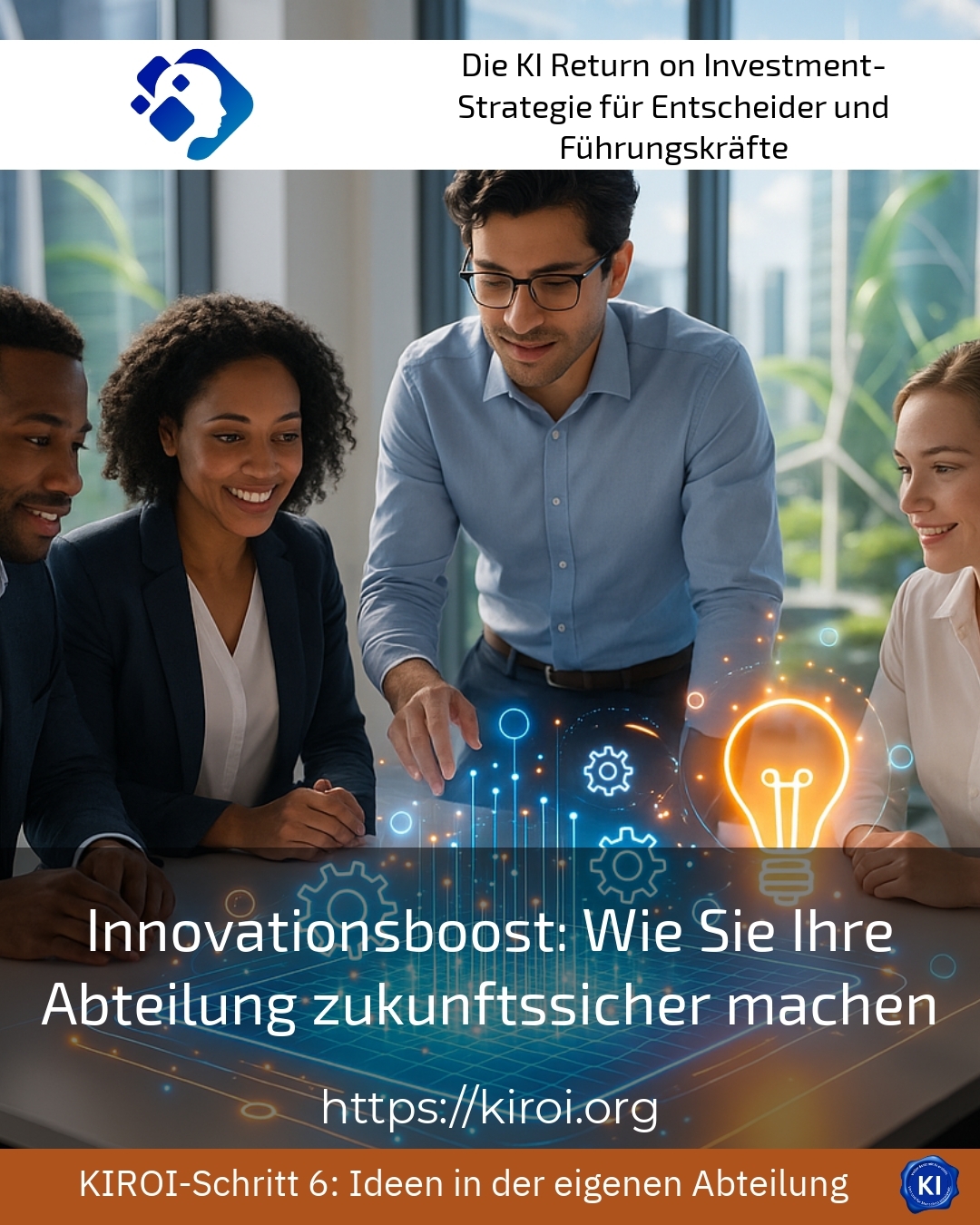
Imagine your department becoming the engine of change rather than the brake on transformation. At a time when technological disruption is reshaping entire business models overnight, you need a real Innovation Boost: How to Make Your Department Future-Proof, Today's decisions determine tomorrow's success. The question is no longer whether change is coming, but how you can actively shape it. This involves far more than new software or digital tools, as true future-proofing arises from a combination of mindset, methodology, and bold decisions. Leaders often report that they fail to achieve sustainable results despite high investments. This is precisely where a well-thought-out strategy comes in, involving all levels of your organisation and drawing on proven impulses.
Why traditional approaches are no longer sufficient
The dynamics of the markets have fundamentally changed. Previously, it was enough to optimise established processes and introduce incremental improvements. Today, however, disruptive technologies can render established structures obsolete within a matter of months. A medium-sized logistics company, for example, had to digitise its entire route planning within six months. The competition had already implemented automated systems and was therefore able to offer significantly lower prices. Without a swift response, the company would have disappeared from the market.
A similar picture emerges in the financial industry, as FinTech startups challenge established banks with innovative business models. Department heads often report the challenge of managing day-to-day business while simultaneously driving strategic innovation projects. The pressure is mounting because customers today expect faster, personalised, and digital solutions. Those who fail to meet these expectations will successively lose market share to more agile competitors.
The healthcare sector, too, is experiencing a fundamental shift that challenges traditional structures. Telemedicine, AI-assisted diagnostics, and networked patient records are no longer pipe dreams. Clinics and doctor's practices that sleep through these developments are increasingly being shunned by younger generations of patients. The innovation boost: How to make your department future-proof therefore begins with an honest assessment of your current position.
The pillars of a sustainable departmental culture
A sustainable transformation is based on several foundations that interlock and reinforce each other. Firstly, it requires an open culture of mistakes, in which experiments are permitted and even welcomed. Employees must feel they can contribute new ideas without fearing negative consequences. For instance, a major automotive supplier has established so-called „innovation labs“ where teams can work on future topics away from day-to-day operations.
Furthermore, continuous professional development plays a crucial role in long-term success. In retail, leading companies are investing heavily in the digital skills of their workforce. Cashiers are being retrained as omnichannel experts, and store managers are learning to make data-driven decisions. This investment in people pays off because motivated and well-trained employees make the difference.
The third foundation is an agile working method, which enables rapid adjustments and reduces bureaucratic hurdles. In the insurance industry, some companies have dissolved their rigid hierarchies and replaced them with cross-functional teams. These teams can make decisions independently and drive projects forward. The results speak for themselves, as product development times have sometimes been reduced by more than half.
Best practice with a AIROI customer
A medium-sized mechanical engineering company from southern Germany faced the challenge of fundamentally transforming its service department. Response times to customer inquiries were too long, and customer satisfaction levels were continuously declining. As part of a transruption coaching process, we intensively supported the company over a period of eight months. Initially, together with the management team, we analysed the existing processes and identified critical bottlenecks. It became apparent that the information flows between field service and internal service were significantly disrupted. Technicians in the field did not have access to current spare part availability and frequently had to visit customers multiple times. We jointly developed a mobile solution that provided real-time data and simultaneously enabled AI-supported fault diagnosis. The transruption coaching helped not only to support the technical implementation but also to overcome cultural resistance within the team. Older employees were supported by younger colleagues as mentors, fostering intergenerational knowledge transfer. Upon completion of the project, the average processing time could be reduced by forty percent. Customer satisfaction increased measurably, and the department became an internal role model for other areas.
Innovation boost through digital tools and methods
Choosing the right digital tools can make the difference between success and failure. However, technology should always serve the business purpose and not become an end in itself. In the food industry, progressive companies are already using AI-powered quality controls. Cameras automatically detect faulty products and sort them out before they reach the market. This significantly reduces the error rate, while at the same time freeing up personnel resources for more value-adding activities.
In the energy sector, smart grids are revolutionising the control of electricity flows and enabling more efficient use of renewable resources. Predictive maintenance is becoming the standard because failures in wind turbines or solar farms can be detected early. A major energy provider has reduced its maintenance costs by a third through such systems. At the same time, the availability of the facilities has been significantly increased, which ultimately benefits customers.
Digital tools also offer entirely new possibilities in the education sector, complementing or replacing traditional forms of learning. Adaptive learning systems automatically adjust to learners' knowledge levels and offer personalised support. Universities are experimenting with virtual laboratories where students can conduct dangerous experiments safely. The innovation boost: how to future-proof your department therefore also requires a rethink of the resources used [1].
Leadership as a catalyst for change
Without committed leaders, any transformation initiative remains a toothless tiger with no real impact. In this context, leadership means providing direction while simultaneously creating space for creativity. The hotel industry demonstrates how different leadership styles can affect innovation projects. While autocratically managed establishments often cling to rigid processes, participatively managed businesses constantly develop new service concepts.
The pharmaceutical industry offers further insightful examples of successful leadership transformations in complex environments. Research leaders who grant autonomy to their teams often achieve better results in the development of new active ingredients. They understand their role as facilitators rather than controllers, which increases the motivation of scientists. At the same time, clear objectives ensure that creativity is channelled into productive paths.
In the telecommunications sector, some companies have successfully implemented the concept of servant leadership. Here, managers see themselves as supporters of their teams and clear away obstacles. This leads to greater employee identification with company goals and increased willingness to innovate. Transruption coaching can support the gradual introduction and sustainable anchoring of such leadership models [2].
Recognising and constructively using resistance
Change always creates resistance, and this should not be fundamentally assessed as negative or destructive. Critical voices often highlight real problems that were overlooked during planning. In the chemical industry, for example, a company initially ignored the concerns of its production employees. The planned automation of a critical process subsequently failed due to practical hurdles. Only when the employees' experiences were taken into account could a functioning solution be developed.
Similar patterns are emerging in the construction industry, as experienced tradespeople are often sceptical of digital planning tools. However, their objections are based on decades of practical experience and deserve consideration. Smart change management actively incorporates this expertise and builds bridges between the old and the new. This results in hybrid solutions that combine the best of both worlds.
The media industry provides impressive examples of how resistance can be transformed into creative energy. Journalists who initially shied away from digital publishing formats developed innovative multimedia reports. Their initial scepticism led to a critical engagement with the new possibilities. The result was high-quality formats that neither colleagues thinking purely digitally nor purely analog would have developed.
Best practice with a AIROI customer
An international logistics service provider approached us because its IT department was perceived as a brake on innovation. The other business units complained about long waiting times for the implementation of digital projects and a lack of flexibility. As part of the transruption coaching, we initially conducted detailed interviews with all stakeholders. This revealed that the IT department was under enormous pressure and struggling with outdated systems. At the same time, there was a lack of clear prioritisation of incoming requests from the business units. Together, we established transparent requirements management with clear criteria and defined escalation paths. Furthermore, we developed a training program to familiarise IT employees with modern development methods. The introduction of agile working methods was carried out step-by-step and supported by experienced coaches. The creation of quick wins, i.e. rapid successes that strengthened confidence in the change process, was particularly important. After twelve months, the average project duration had halved, and the satisfaction of internal customers increased significantly. The IT department transformed from a perceived obstacle into a valued innovation partner for the business units.
Innovation Boost: How to future-proof your department through networks
No single department can generate all innovations on its own, which is why strategic partnerships are becoming increasingly important. In the automotive industry, traditional manufacturers are increasingly cooperating with tech start-ups and research institutions. This collaboration provides access to new knowledge and significantly accelerates development cycles. One German premium manufacturer now operates several innovation centres in Silicon Valley and China.
Retail demonstrates how cross-industry collaborations enable new business models and create competitive advantages. Large retail chains work together with delivery services, financial service providers, and technology suppliers. This creates integrated ecosystems that offer customers a seamless shopping experience. This networking would not have been achievable for individual companies on their own.
In the healthcare sector too, networks are becoming increasingly important because complex treatments require multidisciplinary expertise. Clinics are networking with rehabilitation facilities, nursing services, and outpatient doctors. Digital platforms enable the secure exchange of patient data and improve the quality of care [3].
Measurability as a basis for continuous improvement
What isn't measured can't be improved, which is why clear key figures are indispensable. In the manufacturing industry, OEE (Overall Equipment Effectiveness) figures have established themselves as the standard for evaluating production efficiency. This metric combines availability, performance, and quality into a meaningful overall assessment. This allows companies to specifically identify potential for improvement and prioritise measures.
In the service sector, customer satisfaction scores and Net Promoter Scores play a central role in measuring success. Banks use these metrics to assess the effectiveness of innovations at the customer interface. A high NPS is demonstrably correlated with customer loyalty and willingness to recommend, which supports long-term growth.
The software industry has set standards with DevOps metrics like deployment frequency and mean time to recovery. These indicators make the performance of development teams objectively comparable and encourage continuous improvement. The innovation boost: how to make your department future-proof is therefore also based on a culture of transparent performance measurement.
My AIROI Analysis
Following intensive consideration of the various aspects of securing the future of departments, some key insights emerge that are of great importance for practical implementation. Firstly, it becomes clear that technological solutions alone are never sufficient to bring about sustainable change. The human being is at the centre of every successful transformation, and their needs, fears, and potential must be taken into account. Leaders bear a particular responsibility in this regard, as they act as role models and enablers.
Transruptive coaching has proven to be valuable support in practice for complex change projects. It provides external impetus and helps to identify blind spots within one's own organisation. At the same time, it supports the development of tailored solutions that fit the respective corporate culture. The combination of methodical expertise and empathetic guidance creates the foundation for sustainable success.
Particularly noteworthy is the realisation that resistance to change often contains valuable information. Savvy leaders use these signals to refine their strategies and foster acceptance. Engaging sceptical employees can even lead to better solutions than pure top-down actionism. For the future, I expect that the ability to adapt continuously will become even more important than achieving static target states. Departments that develop this learning capability will also be able to overcome unforeseen challenges.
Further links from the text above:
[1] McKinsey Digital Insights on Digital Transformation
[2] Harvard Business Review Leadership Articles
[3] World Economic Forum Digital Transformation Archive
For more information and if you have any questions, please contact Contact us or read more blog posts on the topic Artificial intelligence here.









 Deutsch
  English (UK)