
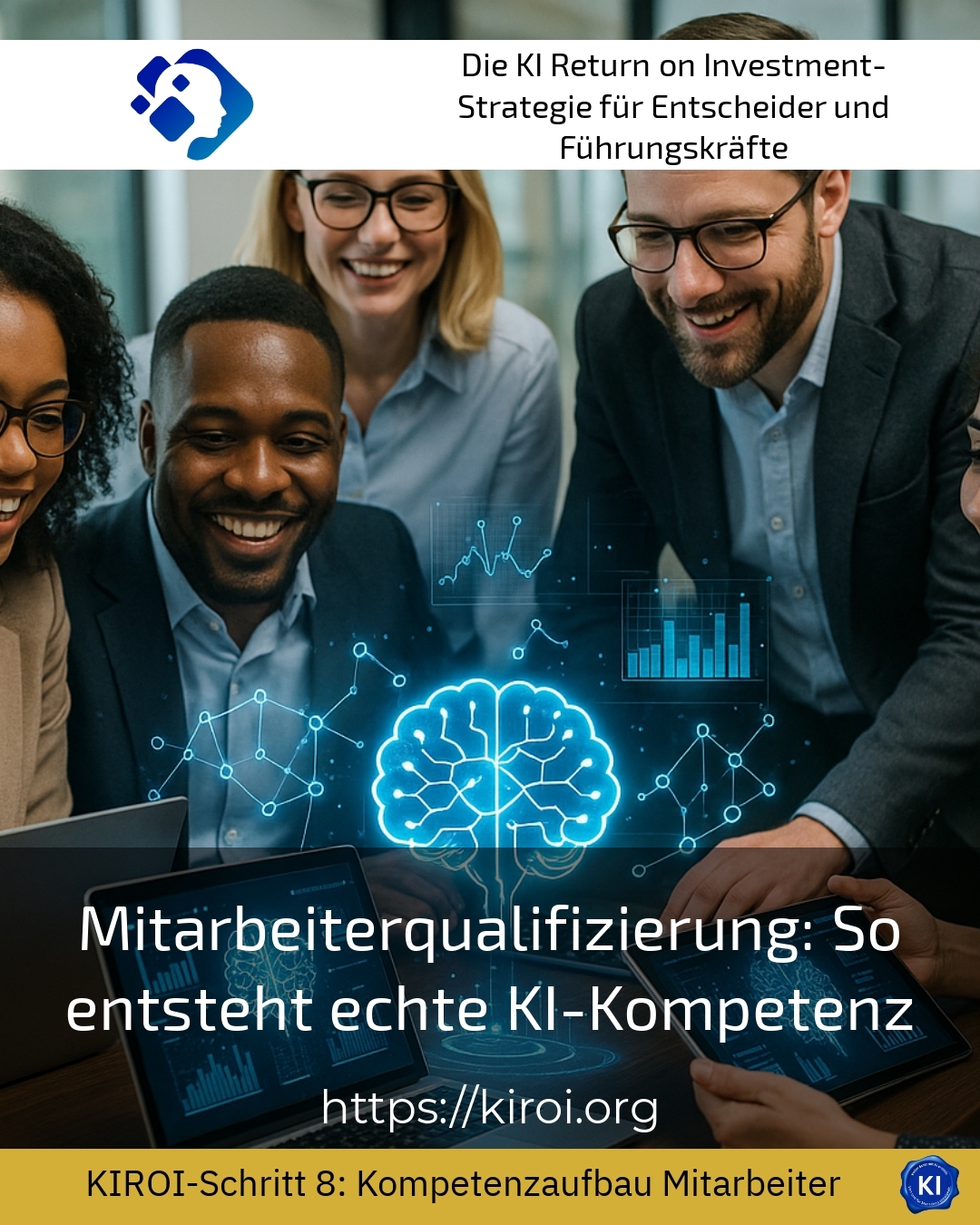
The digital transformation is fundamentally changing almost every organisation, and those who hesitate today are already losing touch with crucial developments tomorrow. Employee Qualification: How to Build Real AI Competence This is the central theme that occupies leaders and teams alike. But how can we not only familiarise people with new tools, but also empower them to truly understand and creatively use these technologies? This article shows you practical ways in which organisations can develop their workforce sustainably. It's not about superficial training, but about profound change processes that foster real competence.
Why traditional training concepts are no longer sufficient today
Traditional approaches to staff development are increasingly reaching their limits. While one-day seminars provide basic information, they rarely bring about sustainable behavioural changes. Many participants report forgetting what they learned after just a few weeks. This is less due to a lack of motivation and more to the way knowledge is imparted. People learn best through practical application, through mistakes, and through continuous support. This is precisely where a modern understanding of Employee Qualification: How to Build Real AI Competence an.
A software company invested significant sums in external training for its development teams. However, the results fell short of expectations. It was only when the company started establishing internal learning groups that measurable progress was seen. A medium-sized IT service provider, which completely revised its training formats, had similar experiences. Instead of frontal knowledge transfer, the company focused on project-based learning. The teams worked on real customer challenges, thereby developing practical skills. A third example is provided by a consulting firm that brought its consultants together in interdisciplinary groups, thus promoting knowledge exchange.
The significance of learning culture for sustainable employee development
A genuine learning culture doesn't arise from regulations or service instructions. It grows organically when leaders lead by example. Teams that are regularly given time for reflection and development show better results in the long term. Psychological safety plays a crucial role in this. Employees must feel safe to ask questions and admit when they don't know something. Only then can an environment be created in which genuine learning is possible.
A system house from southern Germany introduced weekly learning sessions. Participation was voluntary, but senior management actively took part. Within a few months, participation rose to over eighty percent. A cloud provider went a step further and established internal academies. These academies offered structured learning paths tailored to different roles. A business application software developer established mentoring programmes, where experienced colleagues shared their knowledge with new entrants.
Best practice with a KIROI customer
An internationally operating IT service provider faced the challenge of retraining its entire workforce on new technologies within eighteen months. Previous approaches had not yielded the desired results, and frustration was palpable on all sides. As part of transruption coaching, we jointly developed a multi-stage qualification programme that combined various learning formats. First, we analysed existing competencies and identified the biggest gaps. Subsequently, we designed individual learning paths for different groups of employees. The involvement of managers, who acted as learning facilitators, was particularly important. The programme included self-study phases as well as practical workshops and project work. After twelve months, the evaluation showed impressive results. Employee satisfaction increased significantly, and productivity improved measurably. Clients frequently report similar successes when they systematically work on their learning culture.
Practical approaches to employee upskilling: How to build real AI expertise in everyday work
The transfer from theory to practice presents the biggest hurdle for many organisations. Abstract concepts need to be translated into concrete actions. This is best achieved through small, manageable steps. A tried-and-tested approach is the integration of learning elements into the regular workflow. This eliminates the artificial separation between learning and working. The boundaries blur, and development becomes an intrinsic part of everyday life.
A business software provider introduced so-called Learning Sprints. These two-week phases combined regular project work with targeted learning units. Employees applied new methods directly and received immediate feedback. A data centre service provider used peer-learning formats, where colleagues trained each other. This not only strengthened competencies but also team cohesion. A third example comes from a managed services provider that used gamified learning elements, which were particularly well-received by younger employees.
The role of leaders as enablers of learning
Leaders hold a key position when it comes to developing their teams. They can enable learning or unconsciously block it. Clients often report that a lack of time is the biggest obstacle to further training. However, it is often up to the leaders to create space for this. They must set priorities and communicate that learning is not a side issue. Instead, further development should be understood as a strategic investment.
The managing director of an IT consultancy decided to set aside at least one day each month for their own professional development. This attitude radiated throughout the organisation. A department head at a software provider established regular development discussions with her team members. These discussions focused exclusively on learning and growth, not on operational matters. A technical lead at a systems integrator introduced open debriefs where the team learned collectively from failures [1].
Technological tools to support learning processes
Modern learning platforms offer diverse opportunities for individual skills development. They enable self-directed learning and adapt to different learning styles. However, they do not replace human support. Technology can assist, but genuine transformation arises through relationships. transruptions-coaching supports organisations in finding the right balance between digital and personal formats.
A software-as-a-service company implemented a learning management system with adaptive elements. The system analysed individual learning progress and suggested suitable content. An IT security service provider used virtual reality scenarios for incident response training. The immersive experience significantly enhanced the learning effect. A data analytics company relied on microlearning units that could be consumed during short breaks, thereby enabling continuous learning [2].
Best practice with a KIROI customer
A medium-sized software company with around two hundred employees was looking for ways to get their teams excited about new technologies. Previously, training offers had been poorly attended, and the general mood was more sceptical than curious. We accompanied the company over several months in developing a tailor-made qualification programme. Initially, we conducted interviews with employees from various departments to understand their needs and concerns. Based on this, we designed a programme that offered low-threshold entry points while also allowing for deeper dives. The internal showcase events, where colleagues presented their projects, were particularly successful. These formats generated enthusiasm and made abstract topics tangible. We also provided impetus by involving external experts who brought fresh perspectives. After six months, the learning culture had significantly changed, and employees were actively requesting further training opportunities.
Employee Qualification: How Genuine AI Competence is Built Through Structured Programmes
Structured qualification programmes provide orientation and create binding frameworks. They help to maintain an overview and make progress measurable. At the same time, they must be flexible enough to cater to individual needs. A good programme structure considers different competence levels and allows for varying learning speeds. The combination of compulsory and elective elements has proven effective in practice.
An enterprise software provider developed a three-tier certification programme for its consultants. Each tier comprised theoretical and practical elements, as well as a final examination. An IT infrastructure company relied on competency matrices, which made transparent what skills were required for which roles. A provider of collaboration tools introduced a buddy system, where new employees were paired with an experienced colleague right from the start [3].
Avoiding challenges and typical pitfalls
When implementing qualification programmes, organisations regularly encounter similar challenges. Time pressure in day-to-day business competes with learning time. Old habits act as invisible brakes. Resistance from individual employees can affect entire teams. These obstacles cannot be ignored, but they can be worked on. Open communication and genuine listening are indispensable in this process.
A system integrator initially encountered strong resistance to new learning formats. Moderated workshops helped to understand and take these concerns seriously. A software development company struggled with the motivation of experienced employees who considered themselves sufficiently qualified. Reverse mentoring programmes, in which younger colleagues shared their knowledge of new technologies, proved helpful here. A cloud service provider solved the time issue by integrating fixed learning times into project planning and declaring them non-negotiable.
My KIROI Analysis
Supporting numerous organisations with qualification projects has shown me that there are no standard solutions. Each company brings its own history, culture, and dynamics. What works for a software house may fail for an IT service provider. Nevertheless, certain success factors are emerging that are relevant across industries. First and foremost is the sincere commitment of the management level. If decision-makers merely see qualification as a tedious duty, employees will sense it immediately. Real change begins with genuine conviction.
Secondly, it requires staying power. Competence development is not project work with a clearly defined endpoint. It is a continuous process that takes time and must withstand setbacks. Thirdly, it repeatedly becomes clear that the link between individual and organisational learning is crucial. Highly qualified individual employees are of little use if the environment doesn't keep pace. Fourthly, many organisations underestimate the emotional dimension of change. Fear of the new, uncertainty, and self-doubt accompany every learning process. Those who take these feelings seriously and create space for them enable deeper transformation [4].
Finally, I would like to stress that Employee Qualification: How to Build Real AI Competence cannot be a one-off initiative. It is a strategic, ongoing task that requires continuous attention and resources. Organisations that understand this and act accordingly will be more successful in the long term than those that rely on short-term measures.
Further links from the text above:
[1] Harvard Business Review – Leading and Managing People
[2] McKinsey – People and Organisational Performance
[3] Gartner – Human Resources Research
[4] Forbes – Leadership Insights
For more information and if you have any questions, please contact Contact us or read more blog posts on the topic Artificial intelligence here.






 Deutsch
  English (UK)