
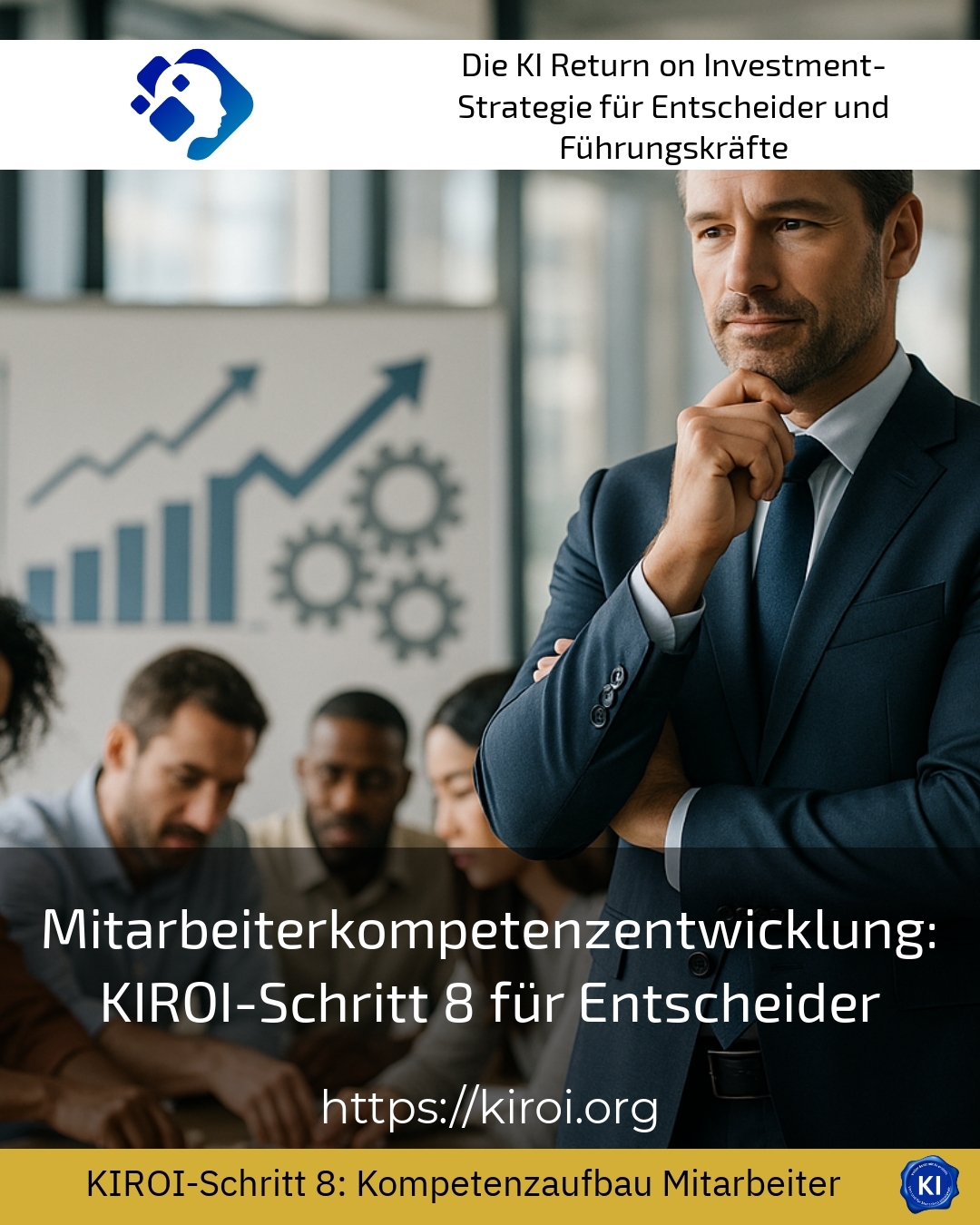
The targeted Employee skills development is a key success factor for businesses. Especially in the eighth step of the KIROI model, it becomes clear how crucial structured support for competence development is. Decision-makers receive valuable impulses to systematically develop employees while closely aligning company goals with individual potential.
Employee Competence Development in KIROI Step 8: Structured Support for Learning Processes
The eighth KIROI step focuses on a Structured support for competence development through diverse learning formats. Companies combine, for example, training on the job, training near the job, and training off the job to cater to different learning needs and enable sustainable development. A balanced mix of practical learning directly at the workplace, internal seminars, and external further training has proven effective.
A practical example from production: Experienced specialists take on the role of direct learning mentors in a mentoring programme. They impart practically relevant knowledge directly within the work process. In parallel, in-house workshops are offered to supplement methodical and theoretical competencies. In addition, employees participate in external training courses, for example, on new technologies or quality standards.
Even in the IT sector, the effectiveness of this structured support is evident. Artificial intelligence assists in creating individual learning paths. Employees receive automated recommendations on which programming languages or frameworks are useful for better meeting current project requirements. This promotes employee competency development in a precise and targeted manner.
Practical examples for targeted skills development in various industries
In mechanical engineering, structured further training programmes for future executives are common. Industrial masters go through academic courses, practical workshops, and individual coaching. This combined learning approach optimally prepares them for complex leadership topics and supports their personal development.
In the retail sector, job rotation is a tried-and-tested method: employees gain experience in different departments. This wide-ranging learning enhances individual competencies and promotes adaptability to changing areas of responsibility.
In financial services companies, the importance of transparent career paths is evident. AI-powered systems help to analyse qualification profiles and recommend individual development steps. This method strengthens employee retention and motivates through achievable prospects.
BEST PRACTICE with one customer (name hidden due to NDA contract)A medium-sized technology company implemented a mentoring program combined with practical on-the-job training. Employees report that this direct support significantly improved their methodological competence. This results in increased self-confidence and more autonomous work on complex projects.
Key building blocks of employee competency development
Decision-makers can specifically support employee competence development through various measures:
- Identification of individual and corporate competence requirements through comprehensive analyses.
- Promoting self-learning processes and collaborative learning formats that strengthen exchange within teams.
- Integration of coaching and mentoring for individual support, providing impetus for personal strengths and development potential.
- Utilise innovative technologies, particularly AI-powered learning platforms, to make learning experiences more personalised and efficient.
- Networking different learning settings so that theoretical knowledge can be immediately transferred into daily practice.
A combination of these elements promotes the sustainable expansion of subject-specific competence, social competence, methodological competence and self-competence – the four central dimensions of all employee competence development.
Action recommendations for decision-makers
To successfully implement the eighth KIROI step, it is advisable to plan learning processes well and to monitor them continuously. The following tips will help:
- Requirements analysis Analysis of current competencies and future requirements as a basis for targeted development measures.
- Added value through combination Combining different learning formats to best cater to diverse learning styles.
- Coaching as individual support Supportive conversations enable the recognition of personal strengths and encourage the overcoming of challenges.
- Integrate Technology Utilising AI-powered tools for learning needs analysis and recommendations to increase efficiency.
- Ensuring practical relevance: Rapidly apply learned knowledge in daily work to increase the sustainability of the learning process.
This is how to competently support employees and retain them long-term.
My analysis
Employee competence development is an ongoing and strategically important task for companies. The KIROI Step 8 offers valuable impetus for structured support in competence development. Decision-makers benefit from a blend of practical learning formats, coaching, and intelligent technologies. This combination supports employees in building relevant skills, increases their self-efficacy, and positively impacts the organisation's competitiveness.
Examples from production, IT, trade, and the financial industry demonstrate how diverse and practical employee competence development can be designed. Decision-makers benefit from tried-and-tested methods that foster individual potential while simultaneously strengthening strategic corporate goals. Meaningful support and development, in the spirit of KIROI step 8, is therefore a key component of successful personnel development.
Further links from the text above:
Mastering Employee Development: Focusing on KIROI Step 8
Employee competence development: KIROI Step 8 for decision-makers
Employee Competence Development: KIROI Step 8 at Sauldie
Competence Development: Definition + Successful Examples
Successful Competence Development in 5 Steps
For more information and if you have any questions, please contact Contact us or read more blog posts on the topic Artificial intelligence here.











 Deutsch
  English (UK)