
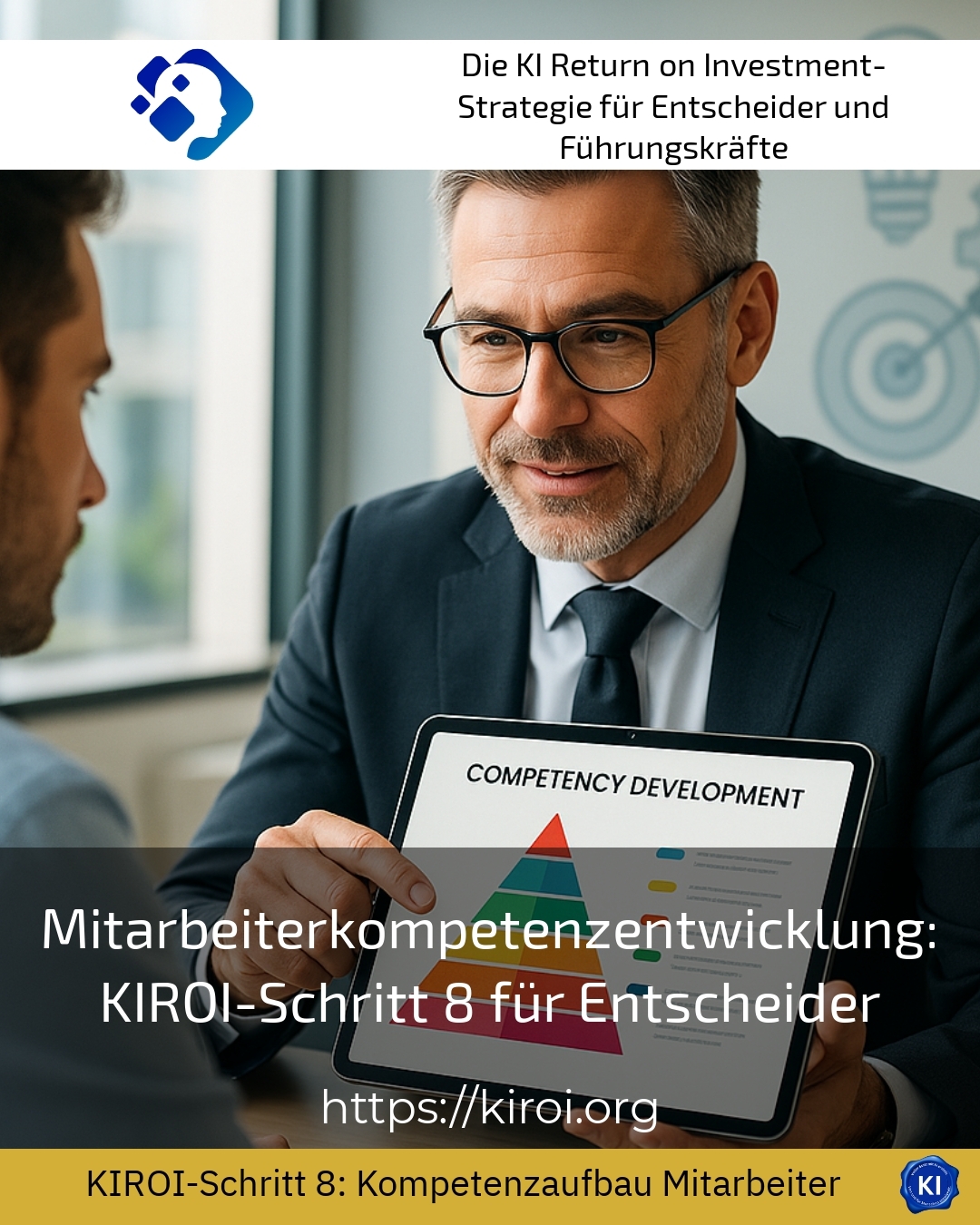
Employee competency development is a key success factor for companies. It supports the targeted promotion of skills and knowledge that organisations need to remain competitive in a dynamic market environment. AIROI Step 8 provides important impetus for decision-makers to effectively design this process. This allows both individual potential and strategic company goals to be optimally linked.
Focus on Employee Competence Development: AIROI Step 8 as a Crucial Stage
In the eighth step of the AIROI model, employee competence development is supported in a targeted and technology-based manner. Artificial intelligence enables the individual adaptation of learning content and the offering of personalised development programmes. This allows employees to build precisely the competencies they currently and will in future need within the company.
For instance, in the manufacturing sector, companies are using AI-powered systems to automatically identify training needs and initiate tailored training programmes. This prevents employees from being either undertrained or overtrained, while simultaneously boosting their motivation.
Valuable practical examples are also emerging in the IT industry: employees automatically receive suggestions for programming languages and frameworks they should learn for new projects – based on the analyses of AI systems. This precisely accompanies and supports competence development.
In the financial services sector, such AI solutions often lead to improved transparency in career paths and development options, which positively influences employee retention.
Practical implementation of employee competency development in the company
Effective employee skills development takes place on various levels. Three central areas stand out:
Practical level: Learning by doing
Through job rotation or project work, employees gain new skills directly at the workplace. In mechanical engineering, for example, specialists move between departments to learn about different technologies and understand practical requirements.
In retail, employees are often deployed in various sales formats to deepen their customer orientation and enhance their communication skills.
On-the-job training is also effective in the services sector for learning to deal routinely with changing customer demands and situations.
2. Coaching Level: Individual support and development
Mentoring programmes or individual coaching sessions help to develop personal strengths. In pharmaceutical companies, an experienced mentor accompanies young employees in the development of project-related expertise and soft skills.
In the technology industry, professionals receive support through coaching to tackle complex issues and develop leadership skills.
Coaching also offers those working in social institutions the opportunity to approach challenging situations reflectively and improve their skills in dealing with clients.
3. Training Level: Deepen theoretical knowledge
For structured skills development, workshops and seminars are offered. In the field of marketing, such formats train, for example, how to use new digital advertising platforms.
In healthcare, training focuses on conveying medical innovations and new treatment methods.
Furthermore, banks regularly offer compliance seminars, which are important for adhering to legal requirements.
Best practices for employee skills development with AIROI
BEST PRACTICE with one customer (name hidden due to NDA contract) In a medium-sized IT company, employee skills development was specifically promoted using AI-based learning paths. Employees received personalised training recommendations based on their current projects and individual abilities. This led to a measurable increase in project quality and higher team satisfaction.
BEST PRACTICE with one customer (name hidden due to NDA contract) A manufacturing company has implemented AI-powered systems to automatically identify training needs and offer suitable training sessions in a timely manner. This has enabled the flexible adaptation of employee qualifications in key areas to market requirements.
BEST PRACTICE with one customer (name hidden due to NDA contract) In the financial sector, a company supported its specialists with AI-assisted career planning. Employees received transparent insights into development opportunities, which sustainably strengthened their commitment to the company.
Action recommendations for decision-makers
Decision-makers should consider employee competency development as an integral part of corporate strategy. Regular analysis of current and target competencies is essential. AI-powered tools can help to identify development needs early on and plan tailored measures.
It is also recommended to combine various development formats such as on-the-job training, coaching, and structured training offerings. This comprehensively promotes technical, methodological, and social skills.
Furthermore, the use of intelligent technologies that individually adapt learning content is recommended. This increases employee motivation and ensures efficient further training.
My analysis
Staff competence development remains a dynamic process that must constantly react to new challenges. AIROI Step 8 illustrates how technical innovations can help to personalise and optimise this process. Decision-makers are well advised to understand staff competence development as a strategic task and to support it with targeted measures and modern technology.
By consciously employing diverse methods and utilising modern tools, individual development opportunities can be maximised. This not only secures competitiveness but also increases employee satisfaction.
Further links from the text above:
Competence Development: Definition + Successful Examples
Employee competence development: AIROI Step 8 for decision-makers
Successful Competence Development: 9 Tips and 3 Methods
Sanjay Sauldie: Expert in Employee Competency Development
AIROI step 8: Strengthen employee development in a targeted manner with AI
For more information and if you have any questions, please contact Contact us or read more blog posts on the topic Artificial intelligence here.










 Deutsch
  English (UK)