
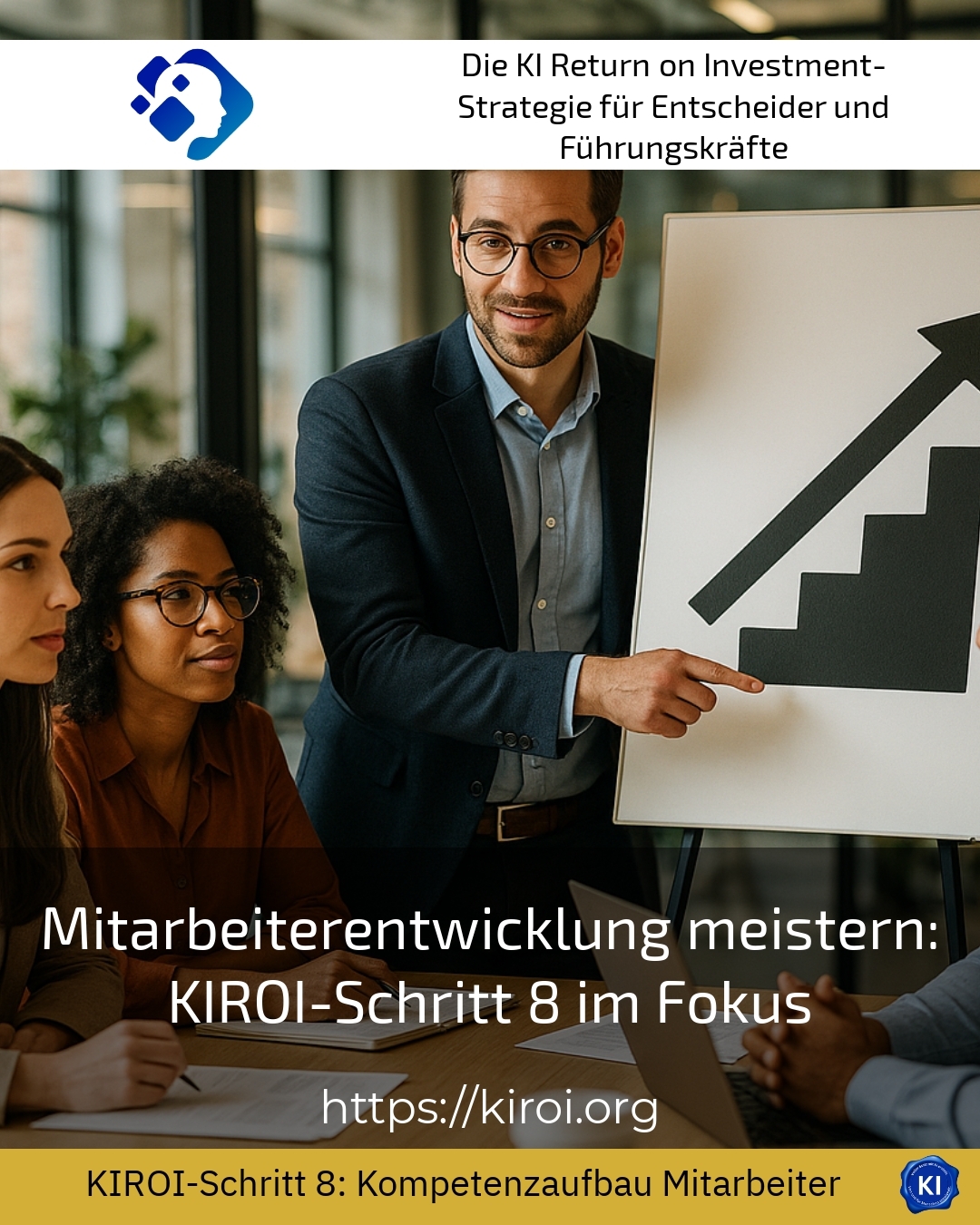
Targeted employee development is highly valued in companies to foster talent long-term and secure competitive advantages. The focus on AIROI Step 8 shows the importance of systematically building competencies and sustainably supporting development perspectives. Employee development thus creates potential for both employees and the organisation.
Structuring employee development with AIROI - Step 8
The eighth step within the proven AIROI model focuses on **structured support for competence development**. Companies systematically assist their employees in expanding their technical and methodological skills. The blend of different learning formats, such as training on the job and off the job, promotes targeted learning both in the workplace and externally.
For example, experienced employees in production companies can be used as mentors who pass on their knowledge directly at the workplace. Meanwhile, theoretical foundations are taught in depth in in-house seminars. In addition, external workshops and e-learning offers help to broaden horizons.
BEST PRACTICE with a client (name withheld due to NDA agreement): In a medium-sized technology company, a mentoring programme was introduced, combined with practical on-the-job training. Employees reported that this direct support significantly improved their methodological competence and enabled them to handle complex assignments more independently.
Practical examples from various industries
In mechanical engineering, further training programmes for industrial foremen are standard practice, designed to specifically prepare skilled workers for leadership roles. These consist of academic courses, complemented by practical learning workshops and coaching. Such measures support individually tailored employee development and help to ensure a sustainable pipeline of future leaders.
The integration of artificial intelligence is also gaining importance in the IT sector. Systems automatically identify deficits and recommend personalised learning content. Through AI-supported platforms, employees can therefore purposefully expand their skills in programming languages and remain marketable.
In retail, job rotation is often practiced, where employees move through different departments. This allows them to gain diverse experiences and develop key skills beyond their original area of responsibility. This practical learning promotes flexibility and prepares them for broader responsibilities.
Employee Development: Tips for Implementation in the Company
To successfully establish employee development, a combination of different formats is recommended. Companies should pay attention to:
- To promote on-the-job training, where learning occurs through daily tasks and project work.
- To offer seminars and workshops specifically tailored to individual development needs.
- To use external coaches as mentors to make potential visible and overcome challenges.
- Using digital learning platforms that enable personalised learning paths.
- To conduct regular performance appraisals for progress reviews and objective setting.
Another tried-and-tested example is mentoring, where experienced professionals guide new colleagues through their first steps in the company. They provide valuable input and help build trust and competence.
Technology supports employee development
Artificial intelligence increasingly offers opportunities to make employee development more efficient. For example, AI-powered tools analyse skills and recommend tailored further training. This enables individual development through digital learning solutions that dynamically adapt to needs.
In the financial sector, such systems help to make career paths more transparent. This allows employees to better understand their development opportunities and remain motivated. At the same time, automated HR assistance relieves teams of administrative tasks and creates scope for strategic personnel development.
My analysis
Employee development is multidimensional and requires individually tailored support. AIROI Step 8 highlights the importance of structured and versatile promotion of competence building in order to strengthen employees in a target-oriented way and to retain them long-term. Tried-and-tested methods such as on-the-job training, coaching, mentoring, and digital learning formats complement each other excellently.
Companies that consistently pursue this approach create a working environment in which employees can develop their potential. Thus, employee development not only supports the individual, but also the sustainable success of the entire company.
Further links from the text above:
[1] Employee competence development: AIROI Step 8 for decision-makers
[2] Personal Development: Goals, Measures, and Practical Examples
[3] AIROI step 8: Strengthen employee development in a targeted manner with AI
[4] Employee Development: 5 Concepts, Examples & Tips
[6] The 10 best examples of employee development plans
For more information and if you have any questions, please contact Contact us or read more blog posts on the topic Artificial intelligence here.








 Deutsch
  English (UK)