
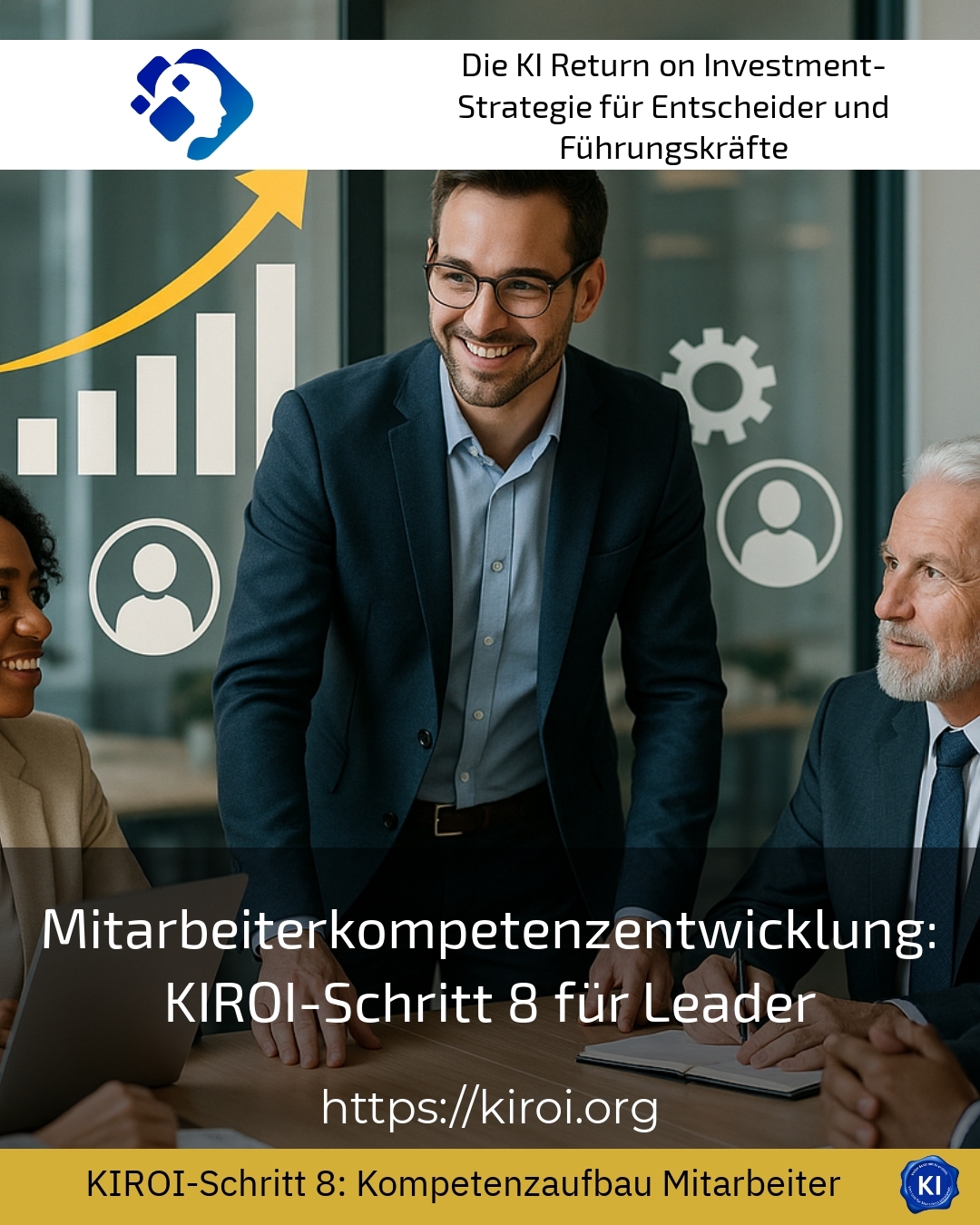
Developing employee competence is a key success factor for modern leaders. The systematic promotion of skills, knowledge, and behaviours within the workforce helps companies to adapt dynamically to new challenges and secure competitive advantages. The eighth step of the AIROI model for leaders specifically focuses on the sustainable support of employee competence development.
Employee competence development as the foundation of successful leadership
In practice, managers often face the challenge of optimally utilising individual potential while also fostering collective success through targeted skills development. Methods such as job rotation, project work, and on-the-job training are proven tools for this purpose. They enable employees to expand their skills directly within the work context and apply them in a practical way.
For example, a manufacturing company deliberately uses job rotation to systematically build technical and social skills. This way, an employee in quality control also gets to know production processes and develops a more comprehensive understanding of the process. A software house, on the other hand, relies on project work, where developers try out new technologies in interdisciplinary teams. In retail, however, regular training and coaching strengthen customer communication and conflict resolution skills.
This variety of development opportunities caters to the diverse learning preferences and professional requirements that constitute effective employee competency development within a company.
AIROI Step 8: Supporting and sustainably fostering employee competency development
The eighth step in the AIROI process is dedicated to the continuous support of competency development. Leadership is understood here as an active process, viewing development not as a one-off measure, but as an ongoing strategy. In this process, leaders support not only through clear goal agreements but also through regular feedback and tailored coaching offers.
An energy supplier reports how innovation capability was strengthened through supporting employees in feedback cultures. A logistics service provider uses external coaching sessions to specifically prepare managers for complex demands. And at a consulting firm, mastermind groups promote the exchange of experience, thereby contributing to the development of social and methodological competencies.
These examples show how valuable it is to actively support employee competence development – this increases the sustainability of the measures and promotes a learning-friendly corporate culture.
Practical tips for leaders to foster employee competence development
Leaders can support the development of their teams by implementing the following strategies:
- Conduct regular competency analyses to identify current strengths and areas for development.
- Agreeing motivational development plans with employees.
- Promoting on-the-job training, for example through challenging projects and job rotation.
- Anchor mentoring and coaching offerings as an integral part of personnel development.
- Establish feedback and learning cultures that promote openness and continuous improvement.
Thus, a medium-sized manufacturing company has reduced staff turnover and simultaneously boosted its innovative capacity through targeted competency analyses and individual development agreements. An international IT company reports that a combination of training and project work helped to introduce new technologies more quickly and securely. A bank, too, has achieved better leadership skills and increased employee satisfaction through systematically integrated coaching.
BEST PRACTICE with one customer (name hidden due to NDA contract) The support for employee competency development was implemented here through a comprehensive coaching programme. This involved providing individual guidance to leaders to strengthen their role as development facilitators. This combination of personal coaching and project-oriented further training contributed to a sustainable increase in team performance and the safeguarding of key competencies.
Synchronisation of strategy and employee competency development
One of the biggest challenges is aligning employee competency development with business strategy. Leaders play a crucial role in identifying the right skills needed for future requirements[1][8].
So, a healthcare provider is proactively planning further training steps that address new regulatory requirements, while a mechanical engineering company is increasingly promoting digital skills such as data analysis and automation expertise. In a start-up, particular emphasis is placed on agile methods expertise to enable rapid adjustments.
The integration of competence models helps to design development measures systematically and transparently. Leadership then also encompasses the task of making these frameworks known and creating a learning-conducive atmosphere.
My analysis
Employee competency development is not just a process step, but an ongoing companion for leaders. The eighth AIROI step clearly illustrates the importance of sustainable and individual support. Through practical methods such as coaching, feedback cultures, and project-based learning, not only technical but also social and methodological competencies are developed. At the same time, alignment with the corporate strategy is better ensured. Managers who actively support this development thus secure long-term competitiveness and create an appreciative, development-oriented work context.
Further links from the text above:
Competence Development: Definition + Successful Examples
11 Methods of Staff Development & Benefits
Skills development: importance and methods
For more information and if you have any questions, please contact Contact us or read more blog posts on the topic Artificial intelligence here.








 Deutsch
  English (UK)