
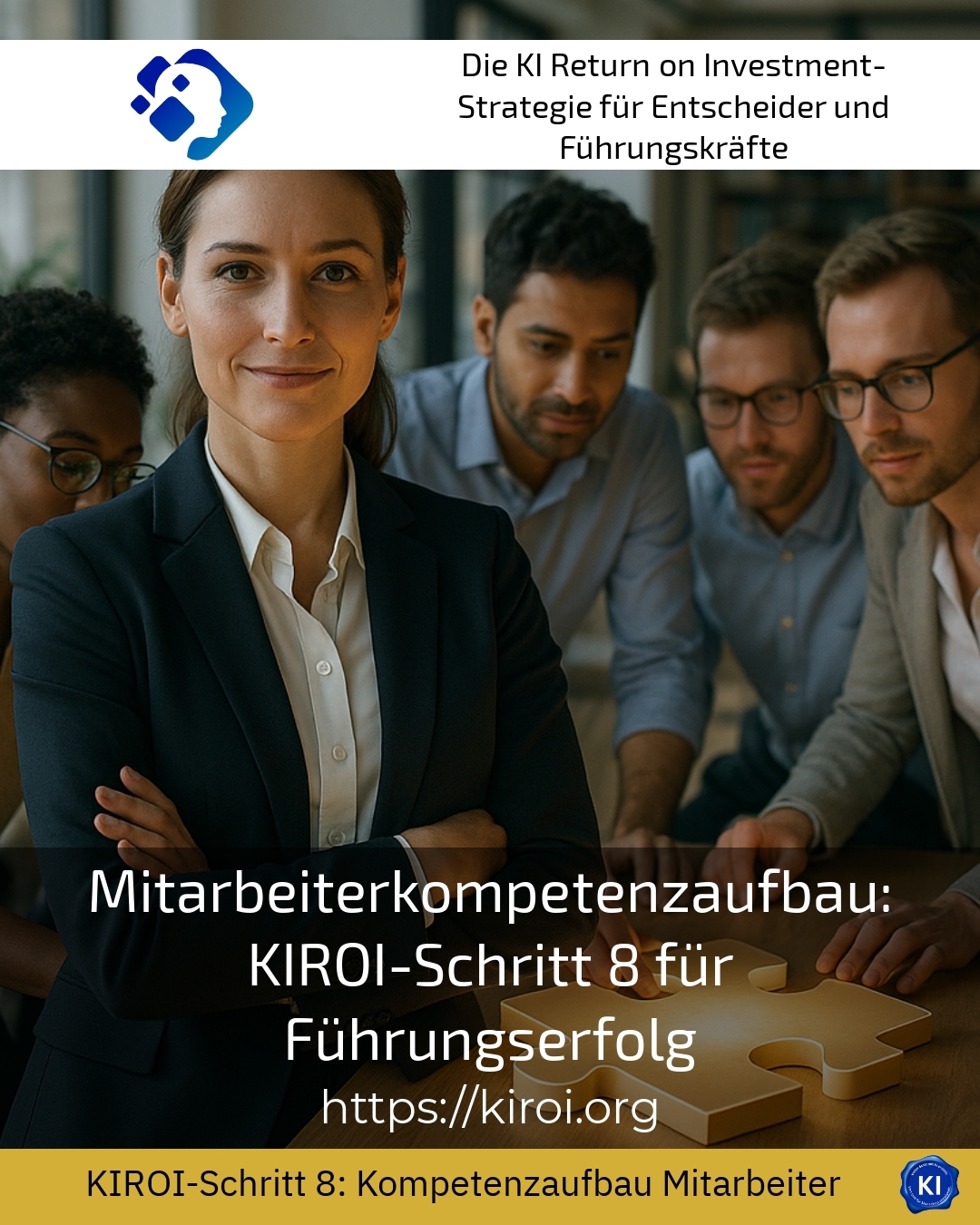
Targeted employee skills development is a central pillar for sustainable leadership success. In particular, Step 8 of the AIROI model offers practical and effective impetus for managers who wish to strengthen and develop their teams in a focused manner. Employee skills development means much more than just knowledge transfer; it is about combining technical, methodological, and social skills that are coordinated to enable sustainable performance.
Employee competency development as a strategic leadership task
In practice, many managers report that challenges such as digitalisation, increasing complexity, and changing market demands require targeted skill development. Employee skills development within the scope of Step 8 includes not only pure further training, but above all the systematic identification of skills gaps and the closing of these gaps through precisely tailored formats.
A classic example can be found in the IT industry: here employees constantly have to adapt to new technologies, which is why pure specialist knowledge is often not enough. Companies therefore supplement theoretical training with practical project work and coaching in order to specifically promote methodological competence. In the manufacturing industry too, teams benefit from job rotation to network interdisciplinary skills. The retail sector is increasingly relying on peer learning formats where experiences from customer projects are reflected upon together.
The strategic interplay of competence development across theoretical, practical, and individual support levels sustainably shapes the success of companies and leaders.
Step 8 of the AIROI model: Design targeted employee skills development
The eighth step in the AIROI process focuses on holistic support that facilitates employee competency development. The combination of different forms of competence is crucial:
- Expertise – deep knowledge and sound experience in the respective specialist field
- Methodological competence – the ability to apply suitable techniques for problem-solving and organisation
- Social competence - communication, teamwork and conflict resolution as the basis for productive coexistence
An example from the banking sector shows how a manager links existing expertise with social skills through targeted coaching conversations and workshops featuring simulated customer cases. This allows employees to learn to act empathetically in critical situations while simultaneously developing structured solutions.
In the service sector, the use of master-mind groups ensures that employees systematically exchange knowledge and learn from each other. The method promotes self-confidence in independently developing further skills. In logistics, agile teams are supported in continuously optimising processes and strengthening individual employee potential through regular reflection sessions.
The role of the leader here is primarily one of accompaniment, providing impetus, and targeted feedback. This is because clients often report that it is the only way to overcome obstacles in competence development.
Best Practice: Practice-oriented employee competency building with a customer
BEST PRACTICE with one customer (name hidden due to NDA contract) shows how sustainable competence development is achieved through a combination of on-the-job training, e-learning, and peer feedback rounds. Managers were specifically trained in coaching to identify individual potential and support it with suitable development opportunities. This significantly increased the self-organisation of employees, leading to higher motivation and better results.
Action-oriented tips for successful employee skills development
To implement staff competency development in a practical way, the following steps are recommended:
- Systematically analyse competence needs: Define important competences for the respective roles and prioritise identified gaps.
- Combining diverse learning formats: Integrating face-to-face seminars, digital learning offerings, and practical projects to cater to various learning needs.
- Establishing coaching and mentoring: individual support promotes self-reflection and sustainable development.
- Shaping a culture of feedback: Managers should regularly give constructive feedback and encourage dialogue.
- Securing knowledge transfer: Collaborative methods such as peer learning or master-mind groups strengthen shared learning.
In a pharmaceutical company, for instance, the introduction of internal workshops combined with subject-specific online courses led to improved methodological competence in quality management. Employees were thus able to use new tools in a more structured way and reduce quality errors. In the IT industry, agile training formats bring teams closer together, fostering self-responsibility and technical expertise equally. The retail sector uses practical case studies from customer service to strengthen problem-solving skills and customer orientation.
Embedding employee skills development into daily routines
It is important not to view employee skills development as a one-off project, but as a continuous process. Managers best support this process by creating learning opportunities in everyday work and encouraging employees to pursue their own development goals.
For example, weekly short feedback rounds should be firmly established in production teams to make development progress immediately visible. In marketing, regular creative workshops facilitate the exchange of new ideas and, at the same time, promote methodological competence. In social work, collegial case consultations strengthen not only professional expertise but also social competence in dealing with clients.
My analysis
Building employee competence is an indispensable pillar for long-term leadership success. Step 8 of the AIROI model illustrates how technical, methodological, and social skills can be purposefully developed through a combination of theory, practice, and individual support. Leaders play the crucial role of moderating this process, providing impetus, and creating a learning-conducive atmosphere. Practical examples from a wide range of industries show that diverse learning formats and a continuous development process are crucial for preparing employees for future challenges. Consequently, building employee competence is not an isolated task, but an integral component of modern and resilient corporate leadership.
Further links from the text above:
[1] Successful Competence Development: 9 Tips and 3 Levels
[2] Methodological Competence: Why it is Crucial
[3] Formats for competence building in public administration
[4] Popular methods for developing employee competencies
[5] Competence management in the company
[6] Methodical competence – definition and examples
[8] Methodenkompetenz simply explained with examples
For more information and if you have any questions, please contact Contact us or read more blog posts on the topic Artificial intelligence here.








 Deutsch
  English (UK)