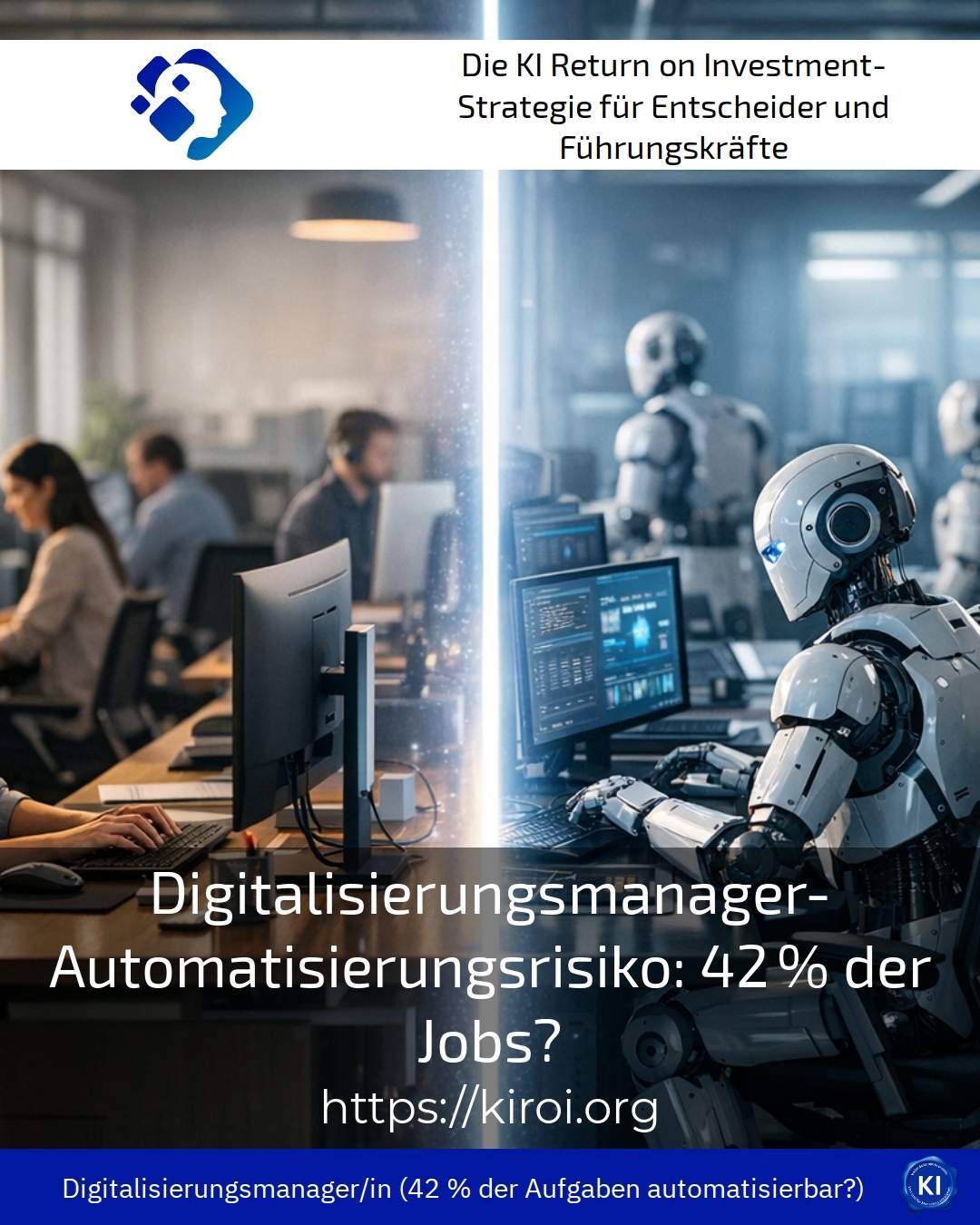
Will more than four out of ten jobs soon be replaced by machines – and is your position among them?
This question currently concerns millions of professionals in Germany. According to the Job Future Report of the Institute for Employment Research, the figure is Digitalization manager automation risk: 42% of jobs? in an area that causes many people to take notice [1]. At first glance, the numbers seem alarming. However, upon closer inspection, they reveal far more opportunities than risks. Those who actively shape the digital transformation will not become victims of change. Instead, professionals can become creators of a new working world. In this article, we highlight the concrete implications for various fields of activity. Additionally, we show practical ways for companies and individuals to successfully navigate this change.
The importance of the 42 percent mark for the labor market
The Institute for Employment Research provides a valuable analytical tool with the Job-Futureometer. This tool calculates the so-called substitutability value for each profession. This is the proportion of core activities that could already be taken over by computers or machines today. A value of 42 percent therefore does not automatically mean the loss of a job. Rather, it indicates which job segments are potentially automatable.
In the area of strategic corporate management, for example, repetitive data analyses fall into this category. The creation of standardized reports is also included. The coordination of routine processes between different departments can also increasingly be automated. However, creative problem-solving, interpersonal communication, and complex decision-making remain reserved for human professionals. Thus, transruptions coaching helps companies clearly identify this distinction.
A medium-sized logistics company recently automated its entire route planning. The dispatch is now performed algorithmically. Nevertheless, the dispatchers remain indispensable for special cases and customer relationships. An insurance company used chatbots for standard inquiries. However, experienced claims handlers continue to handle the complex claims settlement process. A manufacturing company implemented predictive maintenance systems. Nevertheless, strategic maintenance planning remains in human responsibility.
The digitization manager automation risk: 42% of jobs? in the industry comparison
The potential for automation varies greatly across different economic sectors. In manufacturing, the degree of substitutability is often above average. In contrast, knowledge-intensive services often have lower values. However, the development in hybrid professional fields is particularly interesting. In these fields, technical expertise merges with business understanding and leadership skills.
The automotive industry is currently undergoing a fundamental structural change. Production lines are increasingly operating autonomously. At the same time, new job profiles are emerging for human-machine coordination. The banking sector is also transforming rapidly. Branch operations are being digitized. In response, the fields of cybersecurity and algorithmic risk assessment are growing. In healthcare, diagnostic systems support medical decision-making. However, empathetic patient care remains indispensable.
Best practice with a AIROI customer
A traditional family-run machine-building company faced the challenge of fundamentally modernizing its management processes. The management initially feared massive layoffs due to the planned automation. Together with the transruptions coaching team, we analyzed all workflows in the commercial department. It turned out that 38 percent of the activities were actually automatable. These mainly consisted of manual data entry and the creation of recurring reports. Instead of laying off employees, we developed a comprehensive training program. The affected professionals took on more demanding tasks in customer consultation and process optimization. Employee satisfaction increased measurably. Productivity increased by a considerable 27 percent. At the same time, the error rate in order processing dropped to almost zero. This example impressively demonstrates how automation can become a win-win situation for all involved parties. The early involvement of the workforce in the transformation process was crucial. Open communication about goals and perspectives created trust. Today, the company is regarded as a pioneer in human-centric digitalization in its industry.
Strategies for actively shaping change
Given the potential for automation, the central question is what appropriate action to take. Those who act proactively today secure their own professional future. Individual and organizational factors both play an important role in this. Companies and employees alike bear responsibility for successful transformation.
Continuous education forms the foundation of any future-oriented career planning. Digital skills are becoming increasingly important across industries. At the same time, social skills remain indispensable in complex work environments. The combination of technical understanding and emotional intelligence creates unique selling points. A retailer trained its sales staff in the use of augmented reality applications. Employees now advise customers using virtual product visualizations. An architectural firm integrated generative design systems into its workflow. The architects have since focused more on creative concept development.
Concrete measures against the risk of digitalization manager automation: 42% of jobs?
Transruptions coaching offers companies and individuals valuable insights for navigating the digital transformation. Clients often report uncertainties regarding their professional prospects. Others seek support in strategically reorienting their departments. Still others require guidance on concrete automation projects. All share a common desire for a human-centric approach to the transformation.
An energy provider implemented intelligent meter systems throughout its supply area. The previous readers now took on advisory tasks regarding energy efficiency. A media company automated the creation of standardized sports reports. The editors are now devoting more time to investigative research. A pharmaceutical company implemented robot-assisted laboratory analyses. The laboratory technicians are now focusing on interpreting complex experimental results and developing new test methods.
Accompanying experienced coaches can make the difference between successful transformation and painful structural disruption. Transruptive coaching positions itself as a neutral partner for all involved parties. The methodological approach combines analytical precision with empathic process support. This results in solutions that are both economically viable and socially compatible.
Best practice with a AIROI customer
A medium-sized financial services provider approached us with an urgent question. The management had recognized that almost half of all processing tasks could be automated. The mood among employees was tense and characterized by fears about the future. Within the framework of a six-month consulting project, we jointly developed a transformation strategy. First, we identified those activities that should actually be taken over by algorithms. Subsequently, we analyzed the individual strengths and development potential of each team member. This resulted in customized development paths for all concerned parties. Some employees specialized in the support of wealthy private clients. Others developed into internal process experts for the new digital systems. Others took on training tasks for colleagues in other branches. At the end of the project, we had not recorded a single reason for termination of employment. Customer satisfaction simultaneously rose to record levels. Employees reported increased job satisfaction due to more demanding tasks. This project exemplifies the added value of professional transformation support.
The human dimension of the technological revolution
Beyond all numbers and statistics, human experience lies at the heart of change. The concern about losing one's job is understandable and justified. At the same time, automation opens up opportunities for more meaningful and fulfilling activities. This ambivalent situation requires a sensitive and at the same time pragmatic approach.
A call center operator introduced voice-controlled assistance systems for simple customer inquiries. Since then, employees have handled more complex requests with greater respect. A tax consulting firm automated the capture of documents and standard bookings. The advisors now have more time for individual tax optimization and personal client support. A staffing agency uses algorithms to pre-screen job applications. The recruiters hold more intensive conversations with pre-selected candidates for this purpose.
The psychological dimension of the pressure of automation deserves special attention. Many professionals define a significant part of their identity through their professional activities. When machines take on these tasks, this can trigger profound uncertainty. Transruptive coaching offers valuable support in this process of reorientation. The accompaniment helps to discover new sources of meaning and areas of competence.
My AIROI Analysis
The confrontation with the Digitalization manager automation risk: 42% of jobs? It reveals a multifaceted reality that goes far beyond simple black-and-white interpretations. The figure of 42 percent of activities that can be automated is neither a cause for panic nor a license to remain passive. Rather, it represents an important reference point for strategic decisions at the individual and organizational level.
The practical experiences from numerous consulting projects consistently show positive development potential. Companies that involve their workforce early achieve the best transformation results. Professionals who actively invest in their own development benefit in the long term from technological progress. The combination of technological innovation and human-centric leadership proves to be a recipe for success.
Particularly noteworthy is the finding that automation often leads to an enhancement of the remaining human activities. Routine tasks disappear in favor of more demanding tasks. Monotonous activities give way to more creative problem solving and interpersonal interaction. This qualitative shift represents a real gain for the working world.
The challenge lies in actively shaping this transition. Those who wait risk losing their place in the ranks. Those who act proactively position themselves as winners of the transformation. Transruptions coaching is happy to accompany you on this journey. Together we develop strategies for your successful future in the digital workplace.
Further links from the text above:
[1] Job-Futuromat of the Institute for Employment Research
For more information and if you have any questions, please contact Contact us or read more blog posts on the topic Artificial intelligence here.





 Deutsch
 English (UK)