
Have you ever wondered why so many projects around intelligent technologies fail in companies, even though the technical prerequisites are actually in place? The answer often lies not in the technology itself, but in the order of implementation. Many organizations start their initiatives at places that appear technically simple but offer no noticeable added value for daily collaboration. This is exactly where the crucial question arises: Which task should AI really prioritize first? This consideration decisively determines the success or failure of any digital transformation. Companies that strategically answer this question often report significantly better results and higher acceptance among their employees [1].
The classic approach of average companies
In many organizations, we observe a recurring pattern in the introduction of intelligent systems. Decision-makers choose use cases that appear technically particularly easy to implement. This approach follows the motto: We start where AI is technically easy to implement. At first glance, this strategy seems reasonable and low-risk. However, the decision-makers overlook a crucial aspect of implementation.
Let’s take the example of a medium-sized manufacturing company that initially implements automatic sorting of incoming emails. The technical implementation succeeds without any problems within a few weeks. However, employees hardly notice any difference in their daily work. Another example is seen in a logistics service provider that introduces intelligent systems for warehouse management. The software works flawlessly, but the communication between departments does not improve as a result. Similarly, a trading company that enables the generation of automated product descriptions experiences the same problem. The texts are generated faster, but collaboration between marketing and sales remains difficult [2].
The fundamental problem with this approach lies in the lack of connection to the human level. Technical feasibility alone does not guarantee organizational effectiveness. Employees perceive the new tools as additional systems that they have to operate. They do not see any direct benefit to their core tasks. This reduces motivation to actively engage with the new possibilities. The initial enthusiasm quickly gives way to a certain indifference towards further innovation projects.
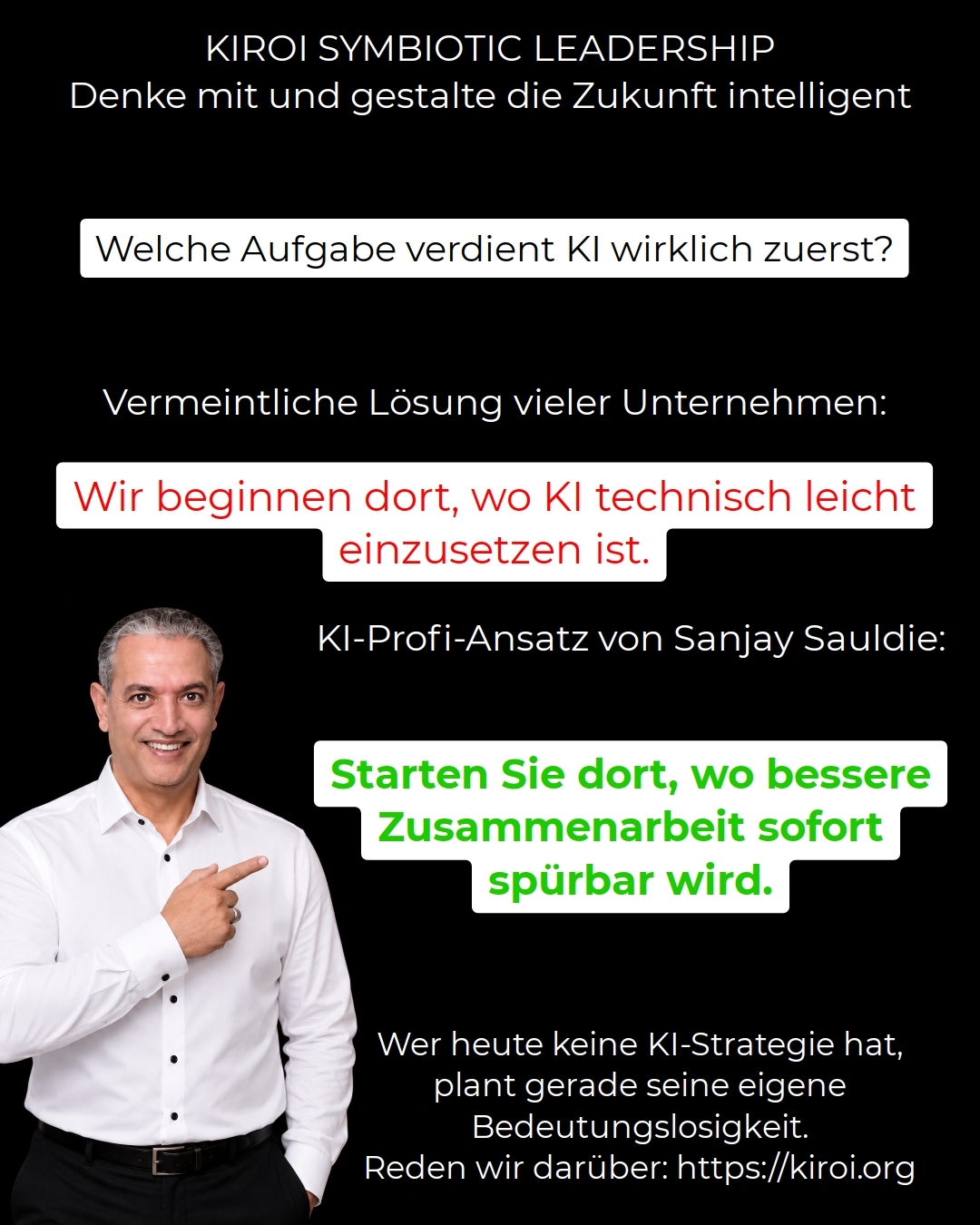
Which task should AI really take on first in your organization?
The AIROI methodology offers a fundamentally different approach to this strategic question. Instead of using technical simplicity as a selection criterion, this approach focuses on improving collaboration. The guiding question is: Start where better collaboration is immediately noticeable. This perspective changes the entire prioritization of use cases within a company.
For example, a mechanical engineering company decided against automatic document creation and for an intelligent knowledge platform. The employees in the design department suddenly had access to the experience of long-time colleagues. Communication between different project teams improved measurably. At an energy provider, they initially implemented a system to improve shift handover. The handover protocols became more complete and the subsequent teams received better information. A construction company prioritized improving coordination between the construction management and subcontractors through intelligent communication support [3].
Best practice with a AIROI customer
An international manufacturing company faced the challenge of better networking several locations and improving collaboration between the various production sites. The management had originally planned to initially deploy intelligent systems for quality control of individual production lines. However, as part of the transruptions coaching, we jointly identified a much more effective starting point. The greatest friction arose from the coordination between sales, production planning, and the individual plants. Information was lost, commitments were not kept, and customer orders were regularly delayed. We supported the project team in implementing an intelligent communication bridge between these three areas. The system automatically gathered relevant information and distributed it to the appropriate contact persons. After just six weeks, the team leaders reported a significantly improved quality of voting. The lead times for complex customer orders were reduced by about a fifth. What was particularly remarkable was the high acceptance among the employees, as they experienced the benefits directly in their daily work.
The human dimension of technology adoption
In answering the question Which task is really worth AI first? Psychological factors play a central role. People accept changes more easily if they perceive a personal benefit. This benefit must be tangible and immediately experienced. Abstract efficiency gains at the corporate level hardly motivate individual employees to actively participate.
One chemical company experienced this dynamic particularly vividly during the introduction of new analytical tools. The first initiative to optimize laboratory processes met with little enthusiasm. The scientists perceived the system’s suggestions as interference with their professional expertise. On a second attempt, the managers prioritized improving interdisciplinary project work. The same scientists now willingly used tools that helped them find relevant research results from other departments. One pharmaceutical company reported similar experiences in networking between the research and approval departments. The improvement of the flow of information immediately generated positive reactions from all involved parties [4].
Strategic prioritization based on the AIROI model
Transruptions coaching systematically guides executives in identifying suitable starting points. Together, we analyze which interfaces in the organization exhibit the greatest friction losses. This analysis goes beyond technical aspects and takes into account cultural as well as communicative factors. The results often surprise the participants, because the greatest potential lies in unexpected places.
At a food manufacturer, we identified the interface between product development and marketing as the optimal starting point. Communication about new product features had previously been sluggish and prone to errors. An automotive supplier focused on improving coordination with its key customers during ongoing development projects. A textile company prioritized connecting designers with production planning to resolve feasibility issues early on. In all three cases, the implementations immediately produced tangible improvements for the participating teams [5].
Best practice with a AIROI customer
A service company with several hundred employees approached us with the request for assistance in a transformation project. The management had already undertaken several attempts to introduce intelligent systems, but none of these efforts resulted in sustainable improvements. As part of our transruptive coaching, we first conducted detailed discussions with employees from various departments and levels of the hierarchy. It turned out that the biggest frustration stemmed from the lack of information sharing between project teams and the sales department. Customers received contradictory information, and project members often only learned about important customer expectations late. Together, we developed a solution that automatically prepared relevant project information and made it available to the right people. The implementation took about eight weeks, and the first positive feedback came to us after just two weeks of productive use. Customer satisfaction improved measurably, and internal conflicts between departments decreased significantly. This success motivated the entire company to pursue further innovation projects.
Sustainable transformation through the right order
The question Which task is really worth AI first? It not only influences the first implementation step. It shapes the entire transformation journey of an organization. Positive initial experiences generate momentum for further changes. Employees who have experienced the benefits of intelligent systems approach new projects with openness instead of skepticism.
A packaging manufacturer documented this development over a period of several months. After the successful launch of a communication tool for shift handover, the employees themselves demanded more applications. An electronics company observed how a genuine innovation culture developed after improving development collaboration. The employees brought their own ideas for further uses. At a medical technology manufacturer, the successful introduction of better project documentation led to a corporate-wide knowledge database that is now actively used by all departments [6].
My AIROI Analysis
Coaching numerous transformation projects has taught me an important lesson: The simplest path rarely leads to the best outcome. Companies that align their implementation strategy with improving human collaboration achieve more sustainable success than those that primarily rely on technical feasibility. This observation holds true across industries for manufacturing companies, service providers, and trade organizations alike.
The AIROI methodology provides a structured framework for this strategic realignment. Through targeted analysis of organizational interfaces, we identify with management the truly valuable starting points. These points are characterized by the fact that improvements are immediately perceived by the stakeholders. Transruptive coaching not only supports the technical implementation but also accompanies the cultural change.
My recommendation to decision-makers is therefore: Take the time to answer the strategic fundamental question. Invest in the analysis of your most important communication channels. Involve employees early in the prioritization process. In this way, you create the foundation for a transformation that is supported and driven by your organization. The initial extra effort required for this careful preparation will often pay off in higher acceptance and better results.
Further links from the text above:
[1] McKinsey: The State of AI
[2] Harvard Business Review: Artificial Intelligence Insights
[3] Gartner: AI Research and Insights
[4] Forbes: AI Coverage and Analysis
[5] World Economic Forum: AI and Robotics
[6] IMD: Digital Transformation Leadership
Are you a leader and would you like to learn how you can genuinely introduce AI into your company in a valuable and sustainable way, away from the hype? Take part Contact us or read more blog posts on the topic Artificial intelligence here.







 Deutsch
 English (UK)