
Have you ever wondered why some leaders seemingly effortlessly coordinate complex teams, while others, despite their best intentions, get lost in chaos?
The answer may lie in an ability that we have completely underestimated so far. Prompting as a leadership discipline It is currently fundamentally changing the way we think about communication, delegation, and strategic control. What many organizations still consider purely technical tools turns out to be one of the most important management competencies of our time upon closer analysis. In this article, you will learn why clear communication structures can enable both people and digital systems to achieve peak performance.
The misunderstanding of the average organization
Most companies treat interaction with intelligent systems as an isolated IT task. They delegate this competence to specialist departments or external service providers. This leads to a fundamental misjudgment. The ability to formulate precise instructions applies to every aspect of an organization. In practice, many executives report similar challenges. They invest substantial budgets in digital tools. Yet the results remain far below expectations.
A typical scenario is seen in internal communication. A department manager gives her team vague instructions for an important project. She expects initiative and self-responsibility. Instead, she receives follow-up questions, misunderstandings, and suboptimal results. At the same time, the same management uses an AI-based analysis tool. Here again, she formulates her requests in an unclear manner. The results again disappoint. The common denominator in both situations is the quality of the communication.
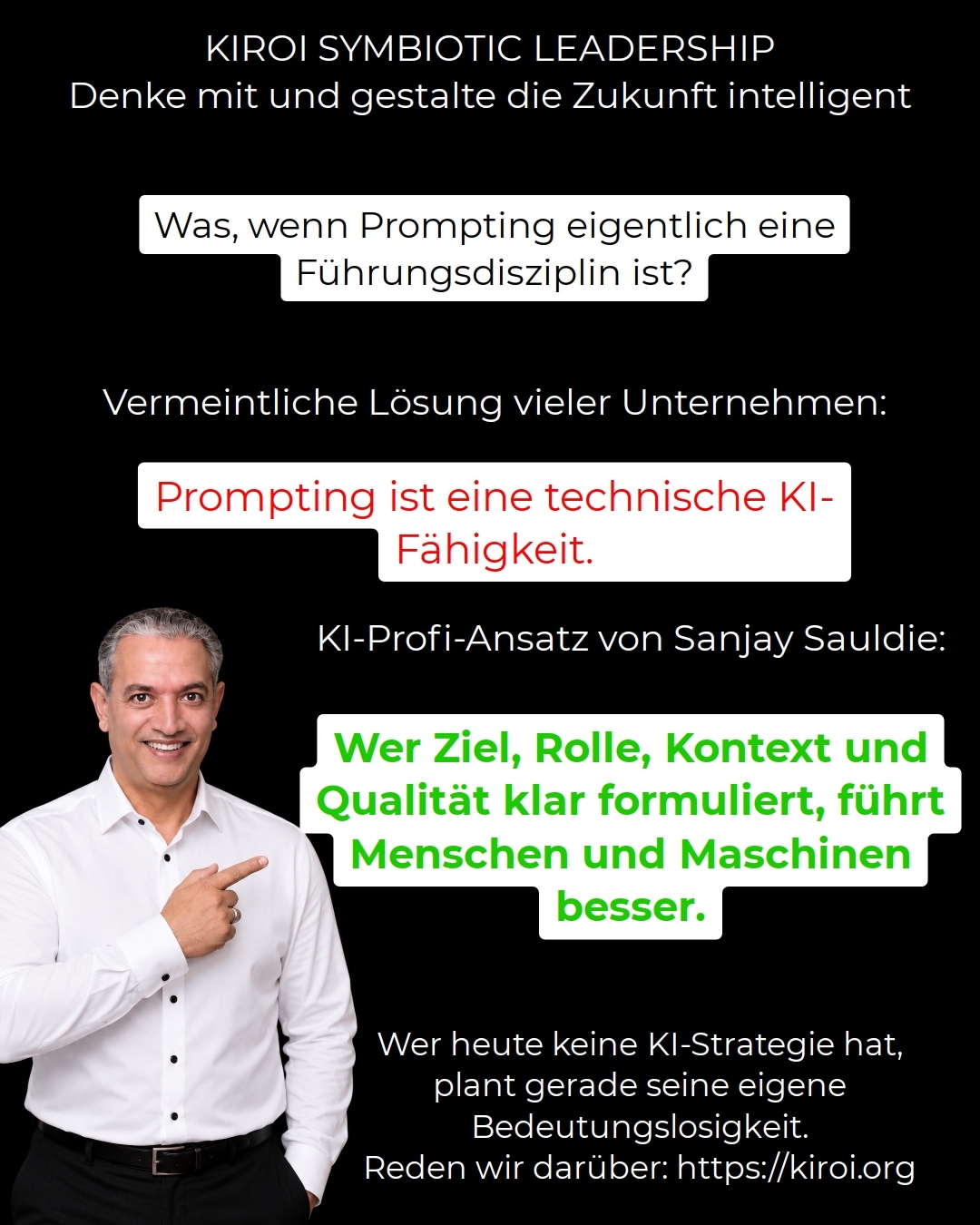
Average organizations consider Prompting as a technical AI capability. They train individual employees in the correct syntax. They create manuals for specific applications. However, they overlook the very core of this competence. It is not about technical expertise. It is about the ability to structure thoughts and clearly communicate expectations. This ability has always distinguished average leaders from excellent executives.
Prompting is being rethought as a leadership discipline
The realization that structured communication leads people and systems alike to better results revolutionizes our understanding of management. Leadership essentially means empowering others to achieve common goals. This is exactly what excellent prompting achieves. It creates clarity, defines expectations, and enables precise results. The AIROI approach provides a systematic framework for this new perspective.
The four pillars of this framework are purpose, role, context, and quality. Anyone who considers these elements in every communication transforms their leadership effectiveness. This applies regardless of whether the recipient is a human or a digital system. A production manager who assigns his team to optimize a manufacturing process can benefit from this principle. He defines the goal: a reduction in the lead time by fifteen percent. He clarifies the role: the team acts as an autonomous project group with decision-making authority. He provides the context: the available resources, existing constraints, and relevant experiences from past projects. He describes the expected quality: measurable results, documented processes, and sustainable implementation.
Best practice with a AIROI customer
A medium-sized company in the machinery sector faced a critical challenge in its development department. Communication between engineers and project managers regularly led to misunderstandings and delays. As part of the transruptions coaching, the leadership team first analyzed existing communication patterns. It revealed a clear pattern: tasks were often delegated without sufficient context information. The accompanying implementation of the AIROI framework sustainably changed the corporate culture. Each project assignment henceforth included explicit information about goals, expected roles, relevant context, and quality standards. The results surprised even skeptical executives. The lead time for projects decreased by more than thirty percent. Employees reported higher satisfaction due to clearer expectations. At the same time, the use of digital assistance systems improved significantly. Because the same principles that optimized human communication also enhanced the quality of interaction with AI-powered tools. Management recognized: Prompting as a leadership discipline It is not a separate competence, but an extension of basic leadership skills.
The role of context in modern business management
Context is the most often underestimated factor in organizational communication. Leaders often assume that employees possess the same background knowledge as themselves. This assumption leads to costly errors. A sales manager asks his team to analyze customer satisfaction. Without contextual information, the team produces a superficial evaluation. With precise context, a strategically valuable analysis is generated that informs decisions based on facts. The difference lies not in the team’s ability; it lies in the quality of leadership communication.
In the logistics industry, this principle is particularly evident. A warehouse manager optimizes his inventory management with an intelligent system [1]. He initially forms his request without sufficient context. The result is generic recommendations with no practical value. After a training session using the AIROI framework, he reformulates his request. He describes seasonal fluctuations, specific supplier conditions, and internal process constraints. The resulting suggestions are directly actionable and deliver measurable value.
Quality standards as a management tool
The definition of quality expectations fundamentally distinguishes excellent from mediocre leadership. Vague formulations like „good work“ or „on time“ create room for interpretation. This room for interpretation leads to frustration on both sides. The employee believes they have met expectations. The leader is disappointed with the result. This dynamic repeats itself daily in countless organizations worldwide.
A quality manager in the automotive parts industry illustrates this principle vividly. He implemented AIROI structures for his entire team [2]. Each order now includes explicit quality criteria. These are measurable, timed, and realistic. The transformation not only affected human team members. The interaction with analysis systems also improved. Clear quality definitions help everyone involved, whether human or machine.
Practical implementation in day-to-day management
Implementing these principles does not require radical restructuring. It begins with small, consistent changes in daily communication behavior. Executives who embrace this challenge often report amazing results. The investment in structured communication quickly pays off through reduced follow-up questions and higher quality results.
An example from the healthcare sector illustrates the practical application. A clinic director introduced structured briefings for her nursing staff. Each instruction follows the AIROI scheme. The goal: better patient care through clearer communication. The role clearly defines responsibilities. The context provides relevant patient information. The quality criteria describe expected standards. The results speak for themselves: fewer communication errors, higher employee satisfaction, and improved patient safety.
In retail, a store manager uses the same principles for her sales team. She no longer defines sales goals as abstract numbers. Instead, she clearly communicates context, role, and quality expectations. The team not only understands what, but also why and how. This clarity motivates and empowers at the same time.
Best practice with a AIROI customer
A financial services provider with several hundred employees sought ways to modernize its leadership culture. The existing communication structures were grown and inconsistent. During the transruptions coaching, the project team identified a central starting point: the quality of work assignments and delegation. The implementation of the AIROI framework was carried out gradually over several months. First, the company trained the top management in the basic principles. These executives became multipliers for their respective areas. Particularly noteworthy was the parallel nature of the improvements: the same communication principles that made employee interactions more effective also optimized the use of analytical systems. A department manager aptly formulated it: he had learned that good leadership and Prompting as a leadership discipline The long-term support provided by the coaching program helped to sustainably change old habits. Relapses in vague communication patterns were detected early and corrected. After one year, management reported measurable improvements in project lead times, employee satisfaction, and the quality of data-driven decisions.
The connection between human and technical leadership
The realization that the same communication principles apply to humans and digital systems opens up new perspectives. Leaders who improve their human communication become automatically more effective in handling intelligent tools. The opposite effect is equally relevant: Those who learn to interact precisely with AI systems develop skills that are also valuable in interpersonal relationships [3].
An example from the construction industry illustrates this interaction. A construction manager uses an AI-powered planning system for complex projects. Initially, the system delivers unsatisfactory results. Through coaching sessions led by transruptive coaching, he learns to structure his requests. He describes project objectives precisely. He defines the role of the system as a supporting analytical tool. He provides comprehensive context regarding resources, constraints, and priorities. He formulates clear quality expectations for the desired outputs. The improvement in the system’s results is remarkable. Even more remarkable is the transformation of his leadership communication with the project team.
My AIROI Analysis
The profound analysis of the described relationships reveals a fundamental truth about modern leadership. We are at a turning point in the history of management. The ability to communicate clearly and in a structured manner has always been important. But in a world where we increasingly interact with intelligent systems, it becomes a critical core competency.
The AIROI principles offer a pragmatic framework for this transformation. They combine proven leadership practices with the requirements of a digitized work environment. Organizations that recognize and capitalize on this connection gain a sustainable competitive advantage. They develop leaders who can effectively manage both people and technology.
Accompanying this transformation process with specialized coaching can significantly accelerate it. External perspectives help identify blind spots in existing communication patterns. Structured implementation programs ensure lasting behavioral changes. The investment in this development pays off multiple times: through more effective leadership, better use of digital tools, and higher employee satisfaction.
Ultimately, it turns out: Prompting as a leadership discipline It is not a fashion phenomenon. It is the logical evolution of what good leadership has always been about. Clarity, structure, and precise communication lead to better results. This was true for human teams. This is also true for interacting with intelligent systems. And this will also be the decisive differentiating factor for successful leaders in the future.
Further links from the text above:
[1] McKinsey: Supply Chain of the Future
[2] Harvard Business Review: Quality Management Insights
[3] Gartner: Artificial Intelligence Research
Are you a leader and would you like to learn how you can genuinely introduce AI into your company in a valuable and sustainable way, away from the hype? Take part Contact us or read more blog posts on the topic Artificial intelligence here.







 Deutsch
 English (UK)