
Are you faced with the question of whether intelligent systems could soon take over more than half of your daily work, while you wonder what skills will still be needed in the future?
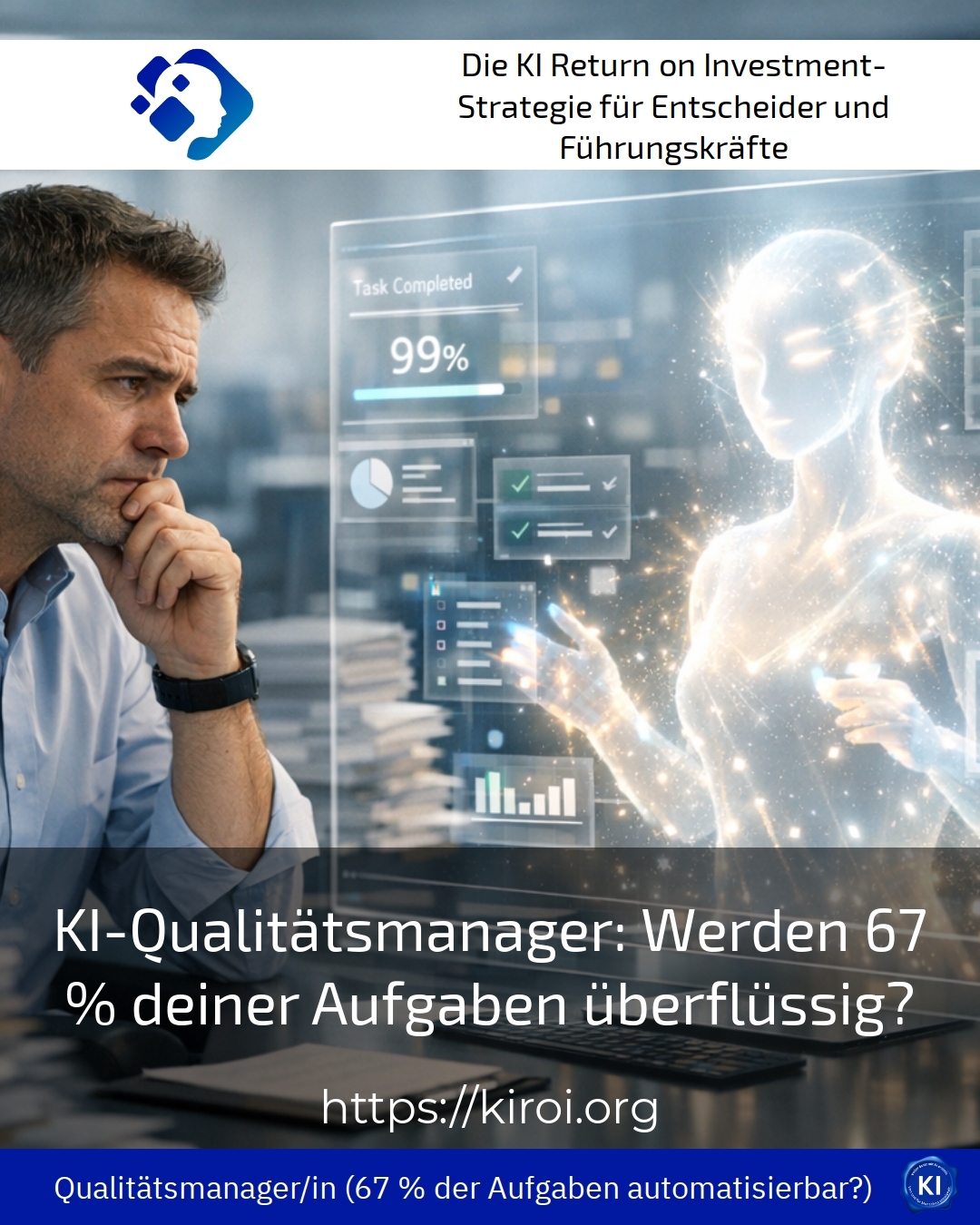
Digitalization is changing professional roles at a pace that many professionals are surprised by and at the same time uncertain about. According to the Job Future Report of the Institute for Employment Research [1], up to 67 percent of core activities in professionals who are involved in testing processes and standard setting could be replaced by technology. This figure seems alarming at first, but it does not tell the whole story. AI Quality Manager It represents an example of a change that presents opportunities and challenges alike. In this article, you will learn what this development means in concrete terms and how you can strategically position yourself.
The starting point: Why automated activities do not mean the end
Many standard assurance professionals work daily with recurring testing routines, documentation tasks, and analysis processes. These activities are well structured and therefore particularly suitable for algorithmic support. An example from the food industry illustrates this clearly: Sensor-based systems now monitor temperature patterns, humidity levels, and microbiological parameters in real time. Previously, professionals had to manually capture and document these values. Today, intelligent platforms perform this task more reliably and quickly.
Another example comes from the automotive industry, where image recognition systems automatically check paint finishes and welds. The error rate thus decreases measurably, and recall actions become less necessary. Similarly, in the pharmaceutical industry, batch inspections are increasingly supported by learning algorithms. However, these developments do not mean that human expertise becomes superfluous. Rather, the focus shifts from performing tasks to designing them.
The AI Quality Manager as a strategic partner for transformation
The role of professionals in standard-setting is changing fundamentally, and this change opens up new perspectives. Instead of repetitive verification processes, tasks such as the validation of algorithms, the ethical evaluation of automated decisions, and the strategic design of processes are taking center stage. AI Quality Manager This makes it the link between technical systems and human value systems.
In medical technology, for example, professionals must ensure that algorithmic diagnostic tools do not exhibit systematic biases. They examine whether training data were representative and whether the results are equally reliable for all patient groups. In electronics manufacturing, specialists develop test protocols for self-learning production systems that continuously adapt to changes. And in the chemical industry, professionals work on simulation models that predict quality deviations before they occur.
Best practice with a AIROI customer
A medium-sized company in the packaging industry faced the challenge of modernizing its testing processes without losing experienced employees. The company produces several million packaging units daily for food and cosmetics. The previous testing procedures were based on random sampling and manual documentation, which was time-consuming and prone to errors. Together with transruptive coaching, the company developed a strategy that combined intelligent image analysis with human expertise. The staff who previously performed the sampling tasks were trained to become system administrators and learned to evaluate algorithmic decisions. They developed criteria for when the system should sound the alarm and what tolerances were acceptable. Within eight months, the testing coverage increased from three percent to nearly one hundred percent, while the rejection rate dropped by a third. What was particularly remarkable was that not a single employee was laid off; instead, everyone was promoted to new roles that they considered more meaningful.
Skills that will be in demand in the future
The ability to understand and critically evaluate complex issues is becoming increasingly important. Professionals will need to be able to assess whether an algorithm is working reliably and where its limits lie. They will need communication skills to explain technical concepts to different audiences. And they will need strategic thinking to design testing processes proactively.
An example from the textile industry illustrates this: Here, professionals work with systems that evaluate fabric quality based on texture analysis. They need to understand how these systems were trained and which materials could potentially be misclassified. In the construction materials industry, meanwhile, specialists develop testing scenarios for self-compacting concrete, whose properties depend heavily on environmental conditions. And in aerospace, professionals must oversee certification processes for components manufactured using additive manufacturing methods.
How transruptive coaching supports professional realignment
Many professionals come to me with specific questions concerning their professional future. They report uncertainty in the face of technological changes in their work environment. They ask themselves what further training is useful and how they can transfer their experience to new contexts. Often, clients report that they feel torn between preserving and changing.
Transruptions coaching helps you gain clarity about your strengths and development potential. It provides insights for strategic decisions and supports the development of a personal competency profile. The approach is based on the belief that technological change is manageable and that every person possesses valuable skills that are also needed in changing professional roles.
The AI Quality Manager and the question of value creation
The real question is not whether activities are automated, but what value human work creates in automated environments. A system can capture measurements, but it cannot assess whether a threshold in a specific context is appropriate. It can detect patterns, but it cannot decide whether an unusual pattern represents a danger or an innovation. This distinction requires experience, context knowledge, and ethical judgment.
In the food industry, for example, professionals must assess whether a product meets cultural expectations that an algorithm cannot capture. In the toy industry, they decide whether a material change is safety-relevant or merely represents a production fluctuation. And in the cosmetics industry, they assess whether a production defect impairs the user experience or is tolerable.
Best practice with a AIROI customer
A manufacturer of precision instruments for medical technology wanted to modernize its end-of-line inspection and at the same time meet regulatory requirements. The challenge was that each instrument had to be calibrated individually and minimal deviations could have significant consequences. The company implemented a learning system that analyzed calibration data and reported any abnormalities. The professionals took on the role of validation experts, who had to evaluate and document each alarm. Together with the development team, they developed rules for when human follow-up inspection is required and when the system can autonomously release the data. These rules were regularly reviewed and adjusted based on practical experience. The result was a reduction in cycle time by forty percent while simultaneously improving documentation quality, which was particularly appreciated in audits.
Practical steps for your professional development
The first step is to honestly analyze and categorize one’s own activities. Which tasks are repetitive and based on routine, and which require judgment and creativity? The job futurist offers a useful starting point for this, but it does not replace personal reflection. The second step involves identifying gaps in skills and planning targeted further training. The third step involves active exchange with other professionals to learn from their experiences.
In the printing industry, for example, experts are engaged in working groups that develop standards for algorithmic color control. In the furniture industry, they participate in projects that integrate sustainability criteria into automated testing processes. And in the semiconductor industry, they are working on developing testing methods for quantum computer components.
Why the AI Quality Manager remains indispensable
Despite all the potential for automation, human expertise remains indispensable in standard assurance. Systems can be trained to recognize known errors, but they often fail in the face of novel problems. They can identify correlations, but they do not understand causality. And they can follow rules, but they cannot develop new rules to meet changing requirements.
The 67 percent from the Job Future report describe potential automation, not actual automation realities. They show where technological support is possible, not where it is useful or desired. The decision about the deployment of intelligent systems remains a human decision, and it requires professionals who understand both worlds.
My AIROI Analysis
The discussion about automation potential in standards assurance shows a fundamental pattern that can be observed in many professional fields. Technology changes job profiles, but it rarely replaces entire professions. The professionals who are today involved with testing processes and quality assurance will be needed in the future as well, albeit with changed focuses. Their task will be to understand, evaluate, and further develop intelligent systems. They will have to design interfaces between algorithmic precision and human judgment. The AI Quality Manager This is not a new professional designation, but rather an evolution of existing roles that combines technological understanding with professional expertise. The challenge lies in actively shaping this change rather than passively accepting it. Transruptive coaching can be a valuable support that provides guidance and shows individual development paths. The future belongs to those who see change as an opportunity and strategically develop their competencies.
Further links from the text above:
[1] Job-Futuromat of the Institute for Employment Research
For more information and if you have any questions, please contact Contact us or read more blog posts on the topic Artificial intelligence here.






 Deutsch
 English (UK)