
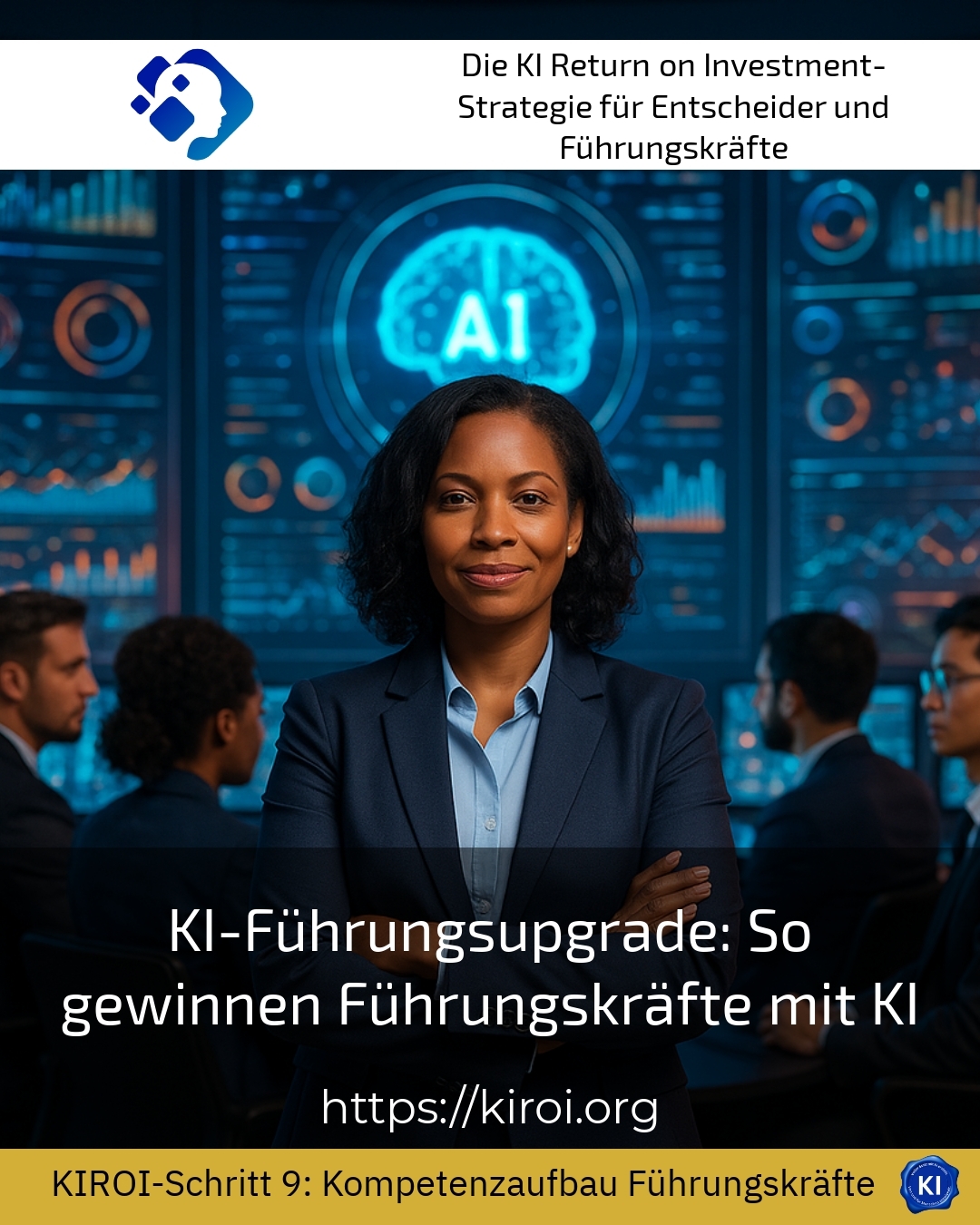
Imagine walking into your office tomorrow and every strategic decision is prepared by intelligent systems that provide you with precise recommendations for action. AI Leadership Upgrade revolutionises the way modern decision-makers manage their organisations, develop teams and secure competitive advantages. While many still hesitate, progressive leaders are already leveraging the transformative potential of algorithmic support. The question is no longer whether artificial intelligence will enter the executive suites. The crucial question is rather: How quickly are you adapting these tools for your own success?
Why the AI leadership upgrade is becoming indispensable
The demands on leaders have fundamentally changed. Complexity, speed, and information density often exceed human processing capacity. This is precisely where intelligent technology comes in, supporting decision-makers in overcoming these challenges. This is by no means about replacing human intuition. Rather, it creates a synergistic connection between analytical precision and emotional intelligence.
In the manufacturing industry, production managers are already using predictive analytics to optimise maintenance cycles [1]. Retail companies rely on automated demand forecasting to intelligently manage stock levels. Financial services providers are implementing systems that conduct risk assessments in real-time and proactively inform decision-makers. These examples illustrate the breadth of application possibilities.
Clients often report initial scepticism towards technology-assisted leadership. However, these reservations quickly recede once initial successes become apparent. Support from experienced coaches sustainably aids this transformation process. Transruption Coaching positions itself as a valuable partner in integrating new technologies into existing leadership structures.
Data-driven decision-making as a core competency
Modern leaders must master the art of extracting relevant insights from mountains of data. Intelligent systems take on the heavy lifting of pattern recognition. However, humans retain the final decision-making authority and contribute ethical considerations. This division of labour enables informed decisions based on solid evidence.
A logistics company analyses millions of data points daily for route optimisation. HR managers in large corporations use algorithmic evaluations for fairer promotion decisions. Marketing directors manage campaigns based on real-time analysis of customer behaviour [2]. All these applications, however, require competent interpretation by trained managers.
Best practice with a AIROI customer
A medium-sized mechanical engineering company faced the challenge of fundamentally modernising its management culture. The management recognised that traditional decision-making processes had become too slow. As part of a support process lasting several months, the company gradually implemented intelligent analytical tools. Department heads first received training in the use of data-driven dashboards. The combination of technological implementation and personal coaching proved particularly valuable. Managers learnt to view algorithms as a support, not as a threat to their position. After six months, all the managers involved reported greater confidence in their decision-making. The turnaround time for strategic decisions was reduced by an average of forty per cent. At the same time, staff satisfaction increased as decisions became more transparent and easier to understand. Looking back, the managing director emphasised the value of professional support during the transformation phase. Without this support, the cultural change would have been significantly more difficult.
Leveraging the AI leadership upgrade in team management
Leading teams is experiencing a remarkable expansion of possibilities through technological support. Intelligent systems analyse communication patterns and identify potential conflicts early on. Leaders receive suggestions for the optimal composition of project teams. Technology provides guidance, but never replaces personal conversation.
Software companies are turning to automated sentiment analysis for internal communications [3]. Consultancy firms use algorithms to optimise team composition for complex projects. Healthcare organisations are implementing systems to improve shift planning, taking individual preferences into account. These applications demonstrate the enormous potential for day-to-day management work.
Numerous executives seek consultation due to feeling overwhelmed. They report constantly increasing demands with static resources. Technological support can offer significant relief here. The time gained can then be channelled into value-adding leadership tasks such as employee development and strategic planning.
Intelligent design of communication and feedback
Effective communication forms the foundation of successful leadership. Modern tools support the preparation of messages in a way that is appropriate for the target audience. Analysis systems show which communication channels work best with different employee groups. This ensures that information is conveyed more efficiently and misunderstandings are reduced.
International corporations use translation systems for multilingual executive communication. Sales organisations rely on automated analysis of customer conversations for quality assurance. Educational institutions implement feedback systems that support teachers in adapting their methods. These examples illustrate the diverse application possibilities.
The integration of these technologies, however, requires tact and a strategic approach. Transruption coaching supports leaders in the step-by-step introduction of new communication tools. The focus remains on the people, not the technology itself.
Strategic planning with intelligent support
Developing viable strategies is one of the most demanding tasks for executives. Here, analytical systems develop particular strengths by processing large amounts of information. Market trends are identified early and competitive analyses are updated automatically. This gives executives valuable time for creative and visionary work.
Automotive suppliers use scenario analyses to prepare for various market developments. Pharmaceutical companies rely on forecast models for research planning. Energy providers implement systems to predict consumption patterns and grid utilisation [4]. These strategic applications, however, require competent human interpretation.
Best practice with a AIROI customer
A service company with several hundred employees wanted to modernise its strategic planning capabilities. Previous annual planning had been largely based on historical data and gut feeling. As part of a structured transformation project, the company introduced data-driven planning tools. Managers first received intensive training on interpreting the analysis results. The support provided in developing new decision-making processes was particularly valuable. Management learned to combine quantitative analyses with qualitative assessments. After one year, there was a significantly improved hit rate for strategic forecasts. Planning certainty increased measurably, which had a positive impact on investment decisions. Employees reported increased trust in the company's leadership. The more transparent decision-making led to greater acceptance of strategic measures. The board of directors emphasised the importance of professional support throughout the entire change process.
Optimising risk management and early detection
The early detection of risks often determines the success or failure of companies. Intelligent monitoring systems continuously search relevant information sources. Executives receive automated warning alerts for critical developments. This leaves more time for proactive action instead of reactive crisis management.
Banks use algorithms to detect unusual transaction patterns. Insurance companies rely on predictive models for damage prevention. Manufacturing companies implement sensor systems for predictive maintenance of critical equipment. These applications demonstrate the practical benefits for risk management.
Accelerate personal development through AI leadership upgrade
Personal development is a key aspect of successful leadership. Modern learning platforms personalise development programmes based on individual needs analyses. Managers receive tailor-made recommendations for further training content and practice opportunities. This makes continuous learning more efficient and targeted.
Technology companies are using adaptive learning systems for leadership development [5]. Consulting firms are relying on simulation-based training with intelligent evaluation. Retail chains are implementing coaching platforms with automated progress tracking. However, these innovations never replace personal interaction with experienced mentors.
Transruptions Coaching combines technological innovation with human support. The combination of data-driven analysis and empathetic coaching frequently achieves better results. Clients report more sustainable developmental progress through this integrated approach.
Technologically supporting reflection and self-management
Self-reflection is one of the most important skills for modern leaders. Digital tools can usefully support and structure this process. Diary applications with intelligent analysis identify recurring patterns in one's own behaviour. This leads to valuable insights for personal development.
Many managers come to consulting with a desire for better work-life balance. Technology can support this by making workloads transparent. Automated analyses reveal potential for optimisation in time management. However, implementation remains a personal decision and a developmental task.
My AIROI Analysis
The integration of intelligent systems into leadership work represents a fundamental shift that goes far beyond technical implementation and requires profound cultural changes. My analysis shows that successful transformations always succeed when technology is understood as a tool that enhances, rather than replaces, human capabilities. The greatest obstacles rarely lie in the technology itself, but in mental models and organisational habits.
Particularly noteworthy is the finding that leaders with high emotional intelligence achieve the best results in technology integration. They intuitively understand how to combine algorithmic recommendations with human judgment. The future belongs to leaders who can confidently navigate both worlds.
From my consulting practice, I can report that a step-by-step approach is almost always more successful than radical changes. Small pilot projects build trust and enable organisational learning. Support from experienced coaches accelerates this process and reduces typical mistakes. However, the willingness of leaders themselves to develop personally remains crucial.
The coming years will show which organisations successfully master this transformation. Those that start now secure crucial competitive advantages. Hesitation not only costs efficiency, but endangers long-term competitiveness. The time for a comprehensive leadership upgrade is here.
Further links from the text above:
[1] McKinsey Insights on Predictive Maintenance
[2] Harvard Business Review – Data-Driven Decision Making
[3] Gartner Research – AI in Human Resources
[4] Forbes – AI in Energy Management
[5] Deloitte Insights – Leadership Development
For more information and if you have any questions, please contact Contact us or read more blog posts on the topic Artificial intelligence here.









 Deutsch
  English (UK)