
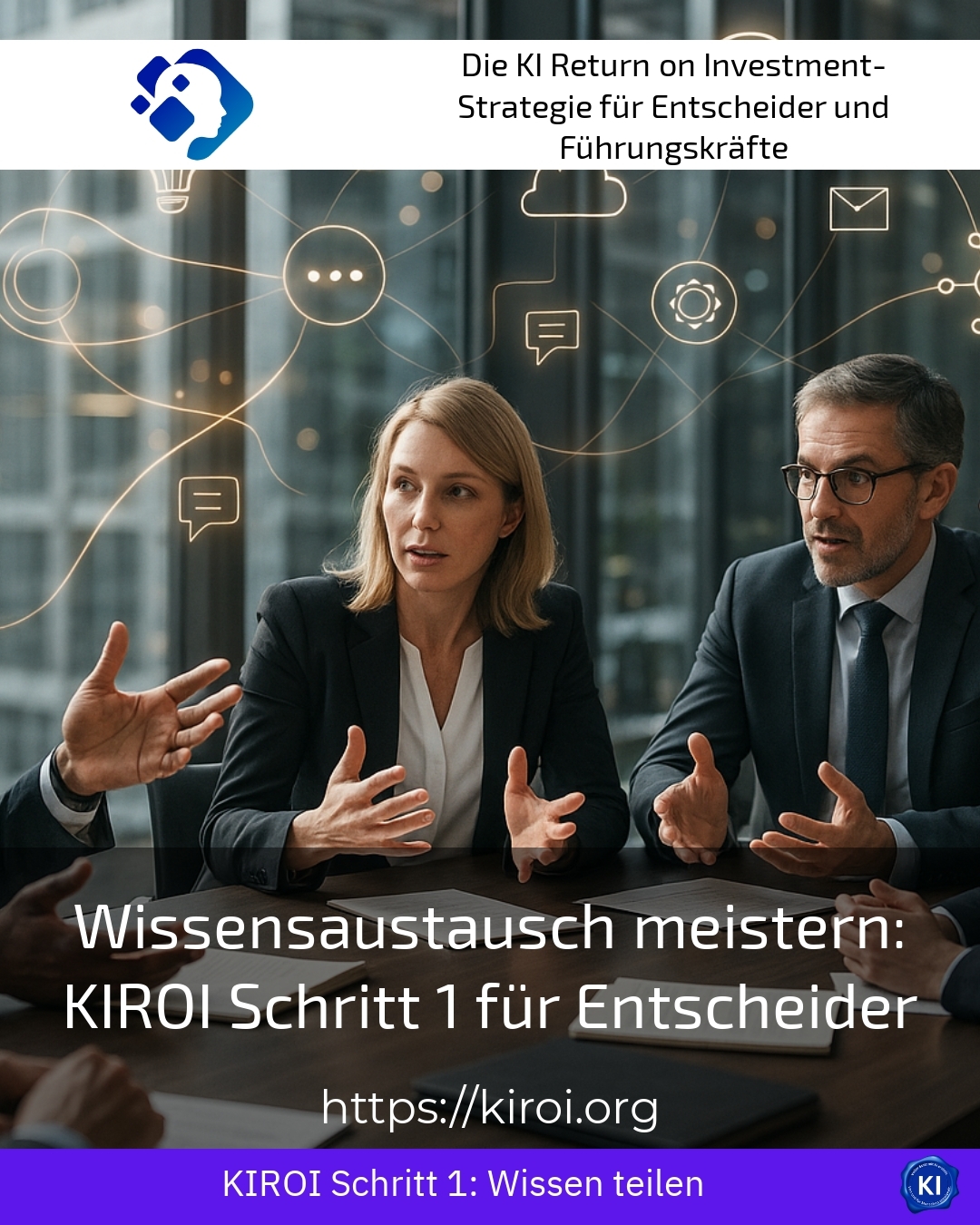
Systematic knowledge exchange is considered key to sustainable success in companies. Crucial impetus arises when relevant information and experiences are shared effectively between employees or teams. The first phase of the AIROI model offers valuable support, as it specifically helps decision-makers to successfully launch and manage knowledge exchange projects.
Knowledge sharing as the foundation for effective collaboration
Knowledge sharing refers to the conscious transfer of skills, experience, and expertise between individuals and groups. In practice, it is often apparent that companies leave potential untapped due to a lack of or inefficient sharing. Managers, in particular, face the challenge of structuring this process so that valuable knowledge within the company becomes visible and available. A common example is innovation projects, where divergent expert knowledge needs to be gathered and consolidated in order to develop viable solutions.
In the automotive industry, for example, decision-makers use knowledge-sharing methods to create stronger links between development and production departments. This allows technical challenges to be identified and resolved more quickly. In the IT sector too, the exchange of technical best practices supports the continuous improvement of products and services. Similar impulses can be found in healthcare, where medical expertise is shared between different professional groups to optimise patient care.
The significance of structure and culture in knowledge sharing
The first step in the AIROI model primarily focuses on strategic integration. Knowledge exchange requires an open culture that fosters transparency and trust. For example, many companies in the mechanical engineering sector report that open feedback sessions and interdisciplinary workshops promote exchange and improve collaboration. Without this culture, knowledge islands persist, hindering information flow. Technologies also play an important role. Digital platforms, such as intranets or specialised collaboration tools, enable knowledge to be documented and made easily accessible to employees.
In the financial sector, executives are also focusing on social learning formats, such as mentoring programmes or virtual communities, which promote the exchange of implicit knowledge. This strengthens mutual understanding and makes individual skills usable for the entire team. Some clients report that systematic knowledge sharing also significantly supports employee motivation and retention.
BEST PRACTICE at a client (name withheld due to NDA): An interdisciplinary team was deployed here, which specifically managed knowledge transfer with the help of targeted workshops and digital tools. The result was a significant acceleration of project decisions and better involvement of all stakeholders, enabling innovative solutions to be implemented more quickly.
Strategies for decision-makers for successful knowledge exchange
Decision-makers should absolutely create clear structures that facilitate communication. This includes establishing regular departmental and cross-functional meetings. For example, in the logistics sector, this speeds up the dissemination of information on supply chain risks. Similarly, in the media industry, regular creative exchange formats can sustainably secure know-how for content creation.
Business leaders also use knowledge maps to make experts and relevant information within a company visible. This means employees know at any time who they can turn to when they have specific questions. This saves time and avoids duplication of effort. Introducing incentive schemes for active knowledge sharing further strengthens the motivation of all involved.
Another important tip is to accompany and moderate knowledge-sharing processes: this includes leaders providing impetus and creating a space where exchange can also take place informally. In consulting projects, it repeatedly becomes clear that support in establishing exchange formats is crucial.
Knowledge sharing in practice: Modern tools and formats
Digital tools are playing an increasingly significant role. For example, companies in the telecommunications sector are using social intranets to share knowledge across departments. In the pharmaceutical industry, webinars are used to quickly disseminate current research findings. Virtual whiteboards and collaborative platforms also support the direct exchange of ideas and documents – regardless of employees' locations.
For instance, a software development company reported the introduction of chat groups and wikis, which vitalised knowledge sharing. This helped to bridge many knowledge gaps and made project handling more efficient. This combination of modern technology and tried-and-tested personal exchange formats shows how varied knowledge sharing can be.
My analysis
Knowledge sharing is a key success factor in today's working world. The structured promotion of this practice not only improves decision-making processes, but also supports innovation and strengthens corporate culture. Decision-makers in particular benefit from using the first phase of the AIROI model to systematically initiate and guide exchange. Diverse examples from various industries illustrate how knowledge sharing can be implemented practically and effectively today. This process provides impetus to fully unlock the potential of teams and thus sustainably support overall company success.
Further links from the text above:
Knowledge Exchange – The Office Expert
Definition Knowledge Exchange | Business Processes Glossary
Knowledge Exchange in Knowledge Management: Tools & Methods
Knowledge Sharing: The Ultimate Guide
Wissensaustausch ist der Prozess, bei dem Informationen, Fähigkeiten und Erfahrungen zwischen Einzelpersonen oder Gruppen geteilt werden. Warum ist er wichtig? Weil er Innovation, Problemlösung und kontinuierliche Verbesserung fördert.
Knowledge transfer – Wikipedia
Knowledge transfer: Definition - Sage
Knowledge transfer - methods, examples, definition
3 Ways to Leverage Knowledge Sharing – Atlassian
For more information and if you have any questions, please contact Contact us or read more blog posts on the topic Artificial intelligence here.











 Deutsch
  English (UK)