
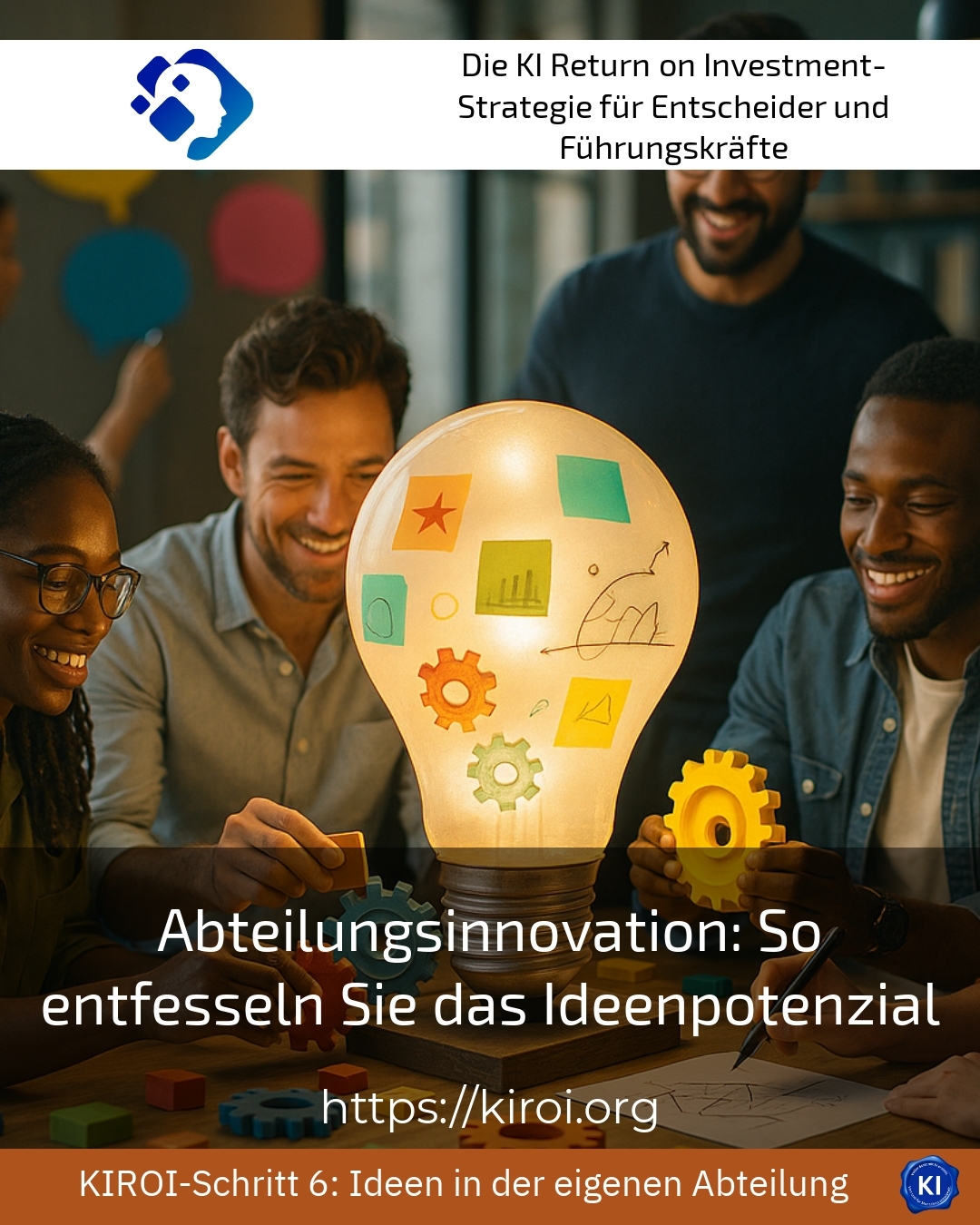
Have you ever wondered why some teams seemingly effortlessly generate groundbreaking ideas, while others, despite highly skilled employees, remain stuck in creative stagnation? The answer often lies not in a lack of talent, but in the way organizations activate and nurture the hidden potential of their departments. Departmental Innovation It refers precisely to this process, in which structures are systematically created that enable and value creative thinking. Many leaders report that their best ideas often come from unexpected sources. The challenge lies in creating spaces where these impulses can emerge and thrive.
The hidden sources of creative energy in the company
In almost every organization, unused resources lie dormant. They are just waiting to be awakened. Employees possess experiences and perspectives that often go untapped in day-to-day operations. A customer service representative knows the recurring problems of their customers better than any market research. The logistics worker sees inefficiencies daily that remain hidden from management. And the IT specialist may have long since developed an elegant solution to a problem that the senior management still doesn’t know about.
Management teams often report that they are surprised to learn what ideas their teams have already developed. However, these insights often remain unspoken because appropriate channels are lacking. For example, a manufacturing company discovered that production workers had been collecting improvement suggestions for years. However, these ideas ended up in a forgotten repository. A retail company recognized that cashiers had valuable insights into purchasing behavior. This information was never systematically captured. A service company found that reception staff had the best ideas for process improvements.
Departmental innovation begins with listening
The first step towards unleashing the potential of ideas lies in active listening. This may sound simple, but it requires a fundamental change in corporate culture. Leaders must learn to ask questions instead of giving answers. They should be able to tolerate silence and create space for unformed thoughts. One insurance company introduced weekly brainstorming sessions where discussions took place without hierarchy. Another pharmaceutical company established anonymous suggestion platforms that yielded astonishing results. A machine builder established innovation clinics that were personally moderated by the management.
Best practice with a AIROI customer
A medium-sized company in the consumer goods industry faced the challenge that innovative impulses were almost exclusively expected from the management level, while the operational workforce focused solely on fulfilling its assigned tasks and hardly contributed with any own suggestions. As part of a transruptive coaching process, the company developed a multi-stage program that initially focused on the level of individual departments and established safe spaces for creative thinking. The employees initially received training in creative techniques and learned to structure and articulate their observations from everyday work. Within six months, over two hundred documented improvement proposals were created, forty of which were implemented. The cost savings achieved through these measures exceeded the investments in the program by a factor of several times already in the first year. However, what was particularly remarkable was the change in the corporate culture, as employees began to proactively identify and communicate improvement opportunities, which set in motion a sustainable dynamic of continuous improvement.
Establishing structures for sustainable departmental innovation
Spontaneous creativity is valuable, but sustainable innovation requires thoughtful structures. However, these structures must not be rigid but remain flexible enough to enable organic growth. Successful innovation management balances clear processes with creative freedom. An automotive supplier created dedicated innovation periods where employees were allowed to work on their own projects. A technology company established cross-departmental innovation teams that rotated regularly. A financial services provider introduced departmental-level innovation budgets that allowed teams to operate independently.
Implementing such structures requires patience and perseverance. Initial results are often not seen until months of continuous work have been completed. Leaders must actively support and lead this process. They should openly communicate their own mistakes and demonstrate that failure is part of the innovation process. A retail company documented failed experiments with just as much care as successes. A logistics company explicitly celebrated failed attempts as learning opportunities. A media company established a culture of constructive failure that unleashed new energy.
Tools and methods for generating ideas
Various methods can support and structure the creative process. Design Thinking offers a proven framework for user-centered innovation. Brainstorming techniques help generate and develop initial ideas. The Walt Disney method allows for considering ideas from different perspectives. One energy provider used scenario planning to anticipate future challenges. A healthcare provider relied on rapid prototyping to make ideas quickly testable. A construction company implemented Lean Startup methods for internal innovation projects [1].
The choice of the right method depends on various factors. Corporate culture plays just as important a role as the specific problem at hand. Some organizations benefit from structured processes, while others achieve better results with more open approaches. transruptions coaching can help identify the appropriate methods for the specific situation. The guidance of experienced experts supports teams in developing their own innovation practice.
The role of leadership in departmental innovation
Leaders are crucial catalysts for innovation at the departmental level. Their attitude decisively determines whether creative impulses flourish or wither away. A leader who perceives new ideas as a threat to their authority will inevitably stifle innovation. Conversely, an open, curious leader can create creative spaces even in difficult environments. One chemical company specifically trained its leaders in innovative communication. Another textile company explicitly incorporated innovation promotion into the objectives agreed upon by its department managers. A software company established reverse mentoring programs in which younger employees mentored senior leaders [2].
Best practice with a AIROI customer
A larger division of an internationally operating service company struggled with chronic lack of ideas and a culture of risk avoidance that had grown over the years and been reinforced by several reorganizations. The management team recognized that they themselves were part of the problem, as they unconsciously sent signals that inhibited creative thinking. Within the framework of an intensive transruptive coaching process, they worked on their own attitude and developed new behaviors that promoted innovation rather than hindering it. They learned to keep questions open and not to immediately seek solutions, but to accompany the creative process. The management team practiced showing their own uncertainties and thereby signaling that even incomplete ideas were welcome. After about nine months, employees reported a noticeably changed atmosphere in which they felt confident to bring in unconventional ideas. The department developed several new service concepts that were successfully implemented and contributed to differentiating the company on the market.
Overcoming resistance and winning over sceptics
Not all employees welcome changes enthusiastically. Some see innovation initiatives as additional work or potential threats to their position. These resistance are normal and should be taken seriously. Often, behind skepticism lie legitimate concerns or valuable experiences from past failures. A food manufacturer addressed these concerns through transparent communication and genuine participation. An electronics company turned critics into allies by assigning them special responsibilities. A telecommunications company used the expertise of long-time employees specifically as quality filters for new ideas.
Dealing with resistance requires a fine touch and patience. Too much pressure can intensify defensive reactions and worsen the situation. Too little persistence leaves important initiatives adrift. Finding the right balance is an art that can be developed. transruptions coaching offers valuable insights and guidance for leaders who wish to embark on this path.
Technology as an enabler of creative processes
Digital tools can significantly accelerate and simplify innovation processes. Collaboration platforms enable the exchange of ideas across locations and time zones. Idea management software helps collect, evaluate, and prioritize suggestions. Artificial intelligence can recognize patterns in large data sets and thus open up new perspectives. A shipping company used AI-powered trend analysis for product development. A consulting firm relied on virtual innovation spaces for distributed teams. An industrial company implemented digital twins to test new concepts risk-free [3].
Technology alone, however, does not create innovation. It is merely a tool that can support the creative process. The human factor remains crucial for successful departmental innovation. The best platforms are of little use if the culture is not right or if leaders do not get on board. The integration of new technologies should therefore always be accompanied by cultural measures. A holistic approach combines technical possibilities with human creativity.
My AIROI Analysis
Unleashing the potential of ideas in organizations is not a one-time project, but a continuous journey that requires continuous attention and care. My experiences from numerous mentoring projects clearly show that successful innovation culture always emanates from the leadership level and must be nurtured, while at the same time space should be created for bottom-up impulses. The biggest obstacles to creative thinking are often not a lack of resources or a lack of talent, but invisible cultural barriers that have established themselves over the years and can only be overcome through conscious work. Organizations that sustainably innovate successfully are characterized by a special quality of collaboration that encompasses trust, psychological safety, and genuine appreciation for diverse perspectives.
The AIROI-methodology offers a structured framework for designing and supporting these complex change processes. It takes into account both the technical and human aspects of innovation and integrates them into a holistic approach. Particularly valuable is the focus on measurable results while maintaining flexibility in implementation. Companies that take this path often report not only concrete innovation successes but also improved employee satisfaction and increased attractiveness as employers. Investing in a vibrant innovation culture thus pays off in many ways and creates sustainable competitive advantages in a rapidly changing business world.
Further links from the text above:
[1] Harvard Business Review – Innovation Resources
[2] McKinsey – The Eight Essentials of Innovation
[3] Gartner – Innovation Strategy Insights
For more information and if you have any questions, please contact Contact us or read more blog posts on the topic Artificial intelligence here.









 Deutsch
 English (UK)