
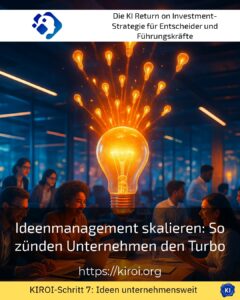
Imagine your teams develop brilliant concepts every day, yet hardly any of them ever reach implementation. Many managers know this situation all too well. The Departmental Innovation represents the decisive lever for systematically transforming creative thoughts into measurable success. Because between the initial idea and the finished result lie often invisible hurdles that can only be overcome with the right strategy. At the same time, many decision-makers report enormous potential lying dormant and unused within their organisations. This article shows you tried-and-tested ways in which you can systematically tap into this potential and initiate lasting change.
Why traditional approaches often fail
Numerous companies already have suggestion schemes and idea management systems in place. Nevertheless, many promising concepts get bogged down in bureaucratic loops. The reasons for this are multifaceted, ranging from a lack of prioritisation to a lack of resources for implementation. Clients frequently report that their employees lose motivation after repeated disappointments. This creates a vicious circle of frustration and stagnation.
For example, a medium-sized manufacturing company had operated a digital ideas portal for years. The submissions were numerous, but the implementation rate was below five per cent. The workforce increasingly reacted with resignation and stopped submitting proposals. Another example can be found in a large insurance company, whose innovation workshops delivered creative results, yet remained without clear responsibilities for further work. A technology corporation also struggled with similar challenges because the specialist departments could not spare the time to evaluate the submitted concepts.
Best practice with a AIROI customer
An internationally active logistics service provider approached us because the internal suggestion scheme had practically ground to a halt. Over the years, employees had experienced how their ideas were collected but rarely implemented. As part of our transruptions coaching support, we first analysed the existing structures and identified critical bottlenecks. It turned out that the decision-making channels were far too long and the criteria for pursuing ideas remained unclear. Together, we developed a three-stage evaluation model with clear timeframes for each phase. In addition, we introduced so-called innovation sprints, in which selected concepts were tested prototypically within four weeks. The result was impressive, as the implementation rate rose from under five to over thirty percent. Even more important, however, was the renewed enthusiasm of the workforce, who were now actively involved in the further development of the company.
The cornerstone of successful departmental innovation
Sustainable change is based on several pillars that must be carefully coordinated with one another. First, it requires a culture that allows experimentation and views mistakes as learning opportunities. In addition, clear processes are needed that create transparency and establish accountability. Finally, the right tools and methods also play a crucial role in success.
This is particularly evident in the banking sector with the introduction of new digital services. A regional credit institution established weekly department-level innovation meetings with a fixed time budget. The results of these meetings flowed directly into a central evaluation process. A pharmaceutical company took a different path and set up temporary innovation teams that worked across departments. These teams received dedicated resources and a direct line to executive management. An energy supplier also relied on new structures, creating the role of innovation officer in every department.
Cultural prerequisites for sustainable departmental innovation
The best process structure is of little use if the cultural framework is not right. Managers must lead by example to show that new approaches are welcome and that setbacks are also part of the process. Psychological Sicherheit forms the foundation for open exchange and constructive criticism. Teams that have no fear of making mistakes develop significantly more viable concepts.
A retail company introduced regular Failure Fridays, where employees spoke openly about failed projects. This practice led to a significantly more open approach to risks and new methods. In a telecommunications group, so-called safe-to-fail experiments with a limited budget were established. These experiments allowed rapid testing without major financial risks for the organisation. An automotive supplier, in turn, relied on innovation awards that recognised not only successful projects, but also courageous attempts.
Best practice with a AIROI customer
A major healthcare service provider came to us with a specific challenge. The management team wanted more initiative from the operational departments, but the employees held back. As part of our transruptions coaching support, we initially conducted confidential discussions with representatives from all hierarchy levels. This revealed that past initiatives had been cancelled without explanation, which had led to deep mistrust. Together, we developed a communication concept that guaranteed complete transparency regarding the status of every submitted idea. In addition, we introduced quarterly town hall meetings in which the management board reported personally on progress. After six months, the company recorded a significant increase in submissions and a measurably improved atmosphere within the teams. The employees felt heard and taken seriously again, which had a positive impact on the entire corporate culture.
Processes and structures for the transformation of ideas
Creative impulses need a clear framework to be able to unfold their impact. This framework should be lean enough to allow spontaneity and structured enough to create accountability. The right balance between freedom and guidance distinguishes successful from stagnating organisations. There is no one-size-fits-all solution here, but rather individual solutions depending on the corporate context.
An engineering company implemented a stage-gate process with clearly defined milestones and decision points. Each phase had a time limit, and responsibilities were unambiguously assigned. In the media sector, a publishing house relied on agile methods such as Kanban boards to visualise the flow of ideas. These boards made it visible to everyone where concepts currently stood and where bottlenecks were arising. A software developer, in turn, used internal hackathons to turn promising approaches into initial prototypes within 48 hours.
The role of leaders in departmental innovation
Leaders act as catalysts or brakes for change processes. Their attitude and behaviour set the tone for the entire organisation. Anyone who takes new paths seriously must demonstrate this through concrete actions. Lip service is quickly seen through by employees and leads to cynicism.
The managing director of a medium-sized chemical company reserved ten percent of his time for discussions with innovators. This personal appreciation motivated the workforce enormously and signalled genuine interest. In a consultancy, the partners introduced personal sponsorships for promising concepts. They supervised the development and cleared obstacles out of the way where necessary. A retail group also relied on management involvement, requiring branch managers to personally support at least one improvement project per month.
Methods and tools for practical implementation
The selection of the right methods depends heavily on the corporate culture and available resources. Not every tool suits every organisation, and sometimes less is more. The decisive factor is the consistent application of the chosen approaches over a longer period of time. Inconstancy in the choice of methods undermines credibility and confuses those involved.
A food manufacturer used design thinking workshops to look at customer problems from new perspectives. The results of these workshops led to several successful product adjustments within a few months. An auditing firm established an internal mentoring programme for innovators from all disciplines. Experienced partners shared their knowledge of successful implementation strategies with rising talent. A construction group, in turn, relied on digital collaboration platforms that enabled communication across locations and time zones.
Best practice with a AIROI customer
A financial services provider with several thousand employees was looking for ways to pool the innovative power of its decentralized units. As part of our transruptions coaching support, we developed a multi-stage programme that combined local autonomy with central coordination. Each branch received its own innovation budget and the freedom to use it at its own discretion. At the same time, we established a quarterly exchange format where the best approaches were presented and made available for adoption by other locations. This approach fostered both local initiative and organization-wide mutual learning. Particularly successful was the introduction of innovation scouts, who acted as contacts in each department. These scouts received special training and regularly networked with one another to exchange experiences. After a year, the company recorded a threefold increase in implemented suggestions for improvement and significantly higher employee satisfaction.
Recognising and systematically overcoming obstacles
On the way from idea to result, numerous pitfalls lurk that can bring the process to a standstill. Resource conflicts, political resistance and a lack of prioritisation are among the most common challenges. Those who are aware of these obstacles can take proactive counter-measures and secure progress. In this context, transparency about difficulties is more important than pretending that operations are running smoothly.
An electronics manufacturer established a dedicated escalation board that could intervene quickly in the event of roadblocks. This board met weekly and had the authority to reallocate resources and set priorities. In a public authority, innovation contracts were introduced that bindingly established responsibilities and timeframes. These contracts were signed by all participants, thereby creating genuine commitment. A consumer goods corporation relied on external facilitation during critical transitions between project phases in order to bypass political roadblocks.
The importance of measurement and feedback in departmental innovation
What is not measured cannot be improved, goes an old management saying. This applies particularly to change processes, because successes often only become visible with a delay. Suitable key performance indicators create orientation and enable continuous adjustments to the approach. In this context, both quantitative and qualitative indicators should be taken into account.
A textile company developed a dashboard that showed the status of all ongoing initiatives at a glance. This dashboard was accessible to all employees, promoting transparency and healthy competition. A hotel chain conducted regular pulse surveys to capture sentiment regarding the innovation culture. The results fed directly into the further development of the programmes and showed an impact. A transport company combined hard metrics such as implementation rates with soft factors like employee satisfaction into a holistic evaluation approach.
My AIROI Analysis
The successful transformation of ideas into measurable results requires far more than good intentions and creative minds. It takes a systematic approach that intelligently combines cultural, structural and methodical elements. In my work with numerous organisations across a wide range of industries, it has become clear that the greatest progress is achieved where leaders demonstrate genuine commitment and are prepared to address uncomfortable truths. transruptions coaching support can provide valuable impetus and accelerate the process by introducing external perspectives.
Particularly important to me seems the insight that sustainable change takes time and does not happen overnight. Organisations that expect results too quickly put themselves under unnecessary pressure and risk disappointment. At the same time, patience must not be confused with passivity, as consistent action is essential for success. The balance between a long-term perspective and a short-term focus on implementation represents one of the greatest challenges. Those who use this tension productively create the foundation for lasting competitive advantages. The examples presented show that different paths can lead to the goal and that there is no one-size-fits-all solution. The deciding factor is the willingness to experiment, learn and continuously improve. In this way, the dream of the innovative organisation becomes lived reality step by step.
Further links from the text above:
[1] Harvard Business Review: Innovation Management
[2] McKinsey Insights: Innovation Strategy
[3] Forbes Innovation Section
For more information and if you have any questions, please contact Contact us or read more blog posts on the topic Artificial intelligence here.









 Deutsch
 English (UK)