
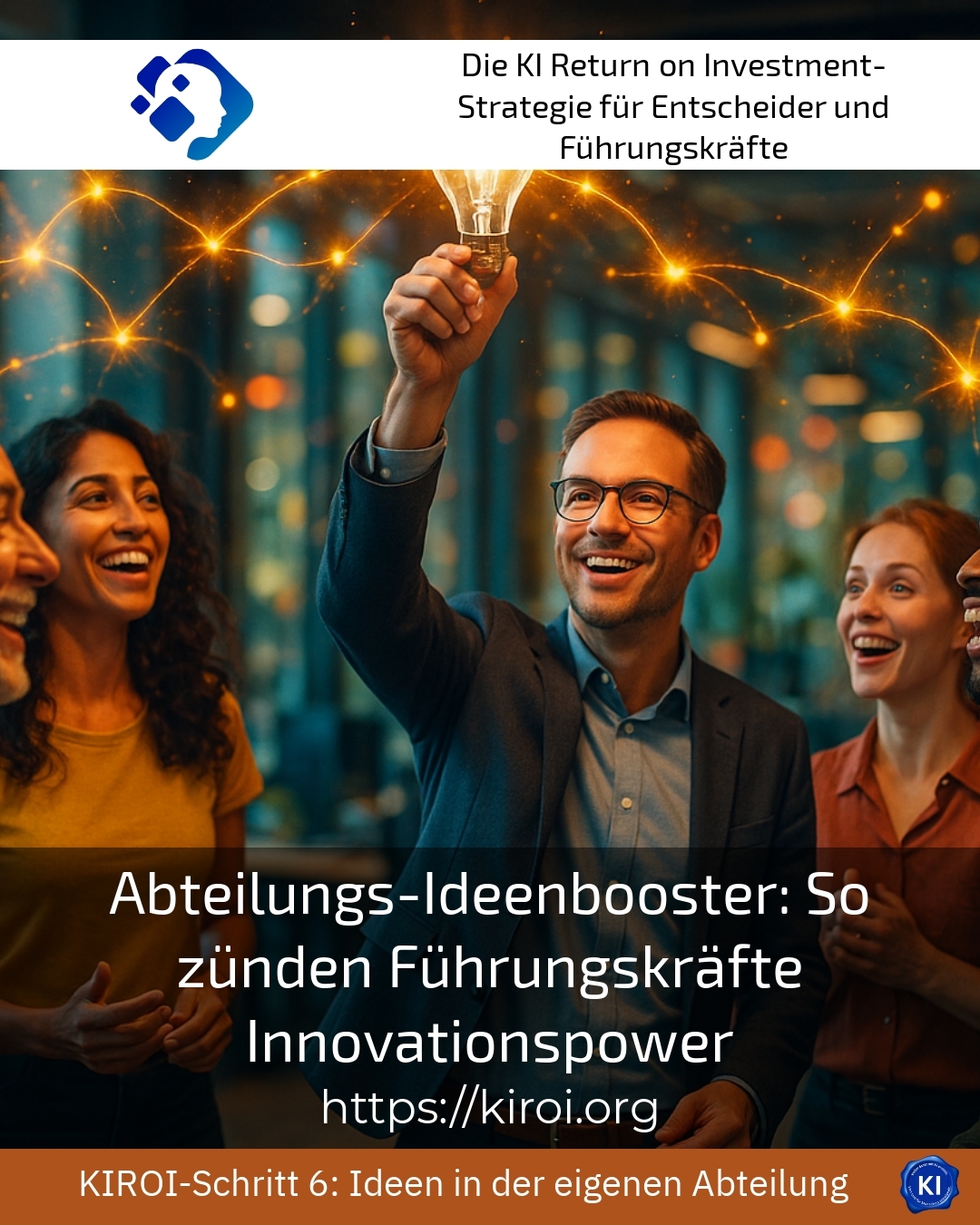
Imagine your department transforming into an ideas factory that continuously generates fresh impetus. The Departmental Idea Booster enables precisely this transformation. Today, leaders are looking for ways to unleash creative energy. They want to inspire employees and initiate sustainable change. This is not about revolutionary upheavals, but about systematic development. Many decision-makers come with the question of how they can specifically foster innovative strength. The answer lies in structured methods and an open corporate culture. Transruption coaching accompanies organisations in successfully shaping these processes.
The department idea booster as a strategic leadership tool
Modern leaders increasingly view their role as enablers of creative processes. They create frameworks in which employees can think and act independently. This is supported by the Departmental Idea Booster as a methodological approach, systematic ideation. In the financial services industry, for example, team leaders use weekly creative sessions to identify process improvements. Insurance companies establish digital platforms where employees can submit suggestions spontaneously. Banks organise cross-departmental workshops to foster silo-breaking thinking. These measures produce measurable results and demonstrably increase employee satisfaction.
However, the implementation of such programmes requires more than good intentions. Leaders need clear structures and reliable processes. They must create room to manoeuvre without compromising operational efficiency. Transruptive coaching helps those in charge to successfully master this balancing act. The support encompasses both strategic planning and practical implementation aids. Clients frequently report initial resistance within the team. These hurdles can be overcome with targeted communication and a transparent approach.
Best practice with a AIROI customer
A medium-sized insurance company was faced with the challenge of fundamentally modernising its claims processing. The executive board recognised that genuine improvements could only come from the workforce itself. Therefore, the company implemented a structured ideas programme in three selected departments. Employees were given two hours of dedicated time each week for creative reflection. A digital tool enabled the anonymous submission of suggestions for improvement. Within six months, over two hundred qualified suggestions were received. Particularly noteworthy was a proposal for automated document verification. This approach came from a claims handler with twenty years of professional experience. Their idea reduced the average processing time by thirty percent. Management rewarded successful suggestions with public recognition and bonus payments. This appreciation motivated further employees to take active part. The programme developed into an integral part of the corporate culture and is now being rolled out group-wide.
Psychological safety as the foundation for the departmental idea booster
Creative ideas only emerge in an environment of trust and openness. Employees must feel secure in expressing even unconventional thoughts. This psychological safety forms the foundation of every successful innovation culture [1]. Managers bear the responsibility of actively shaping the appropriate framework conditions. In the healthcare sector, this becomes particularly evident in interdisciplinary treatment teams. Nursing staff bring valuable perspectives there that doctors alone would not develop. Hospitals with a pronounced feedback culture demonstrably record better treatment outcomes. Pharmaceutical companies also benefit from open communication structures in their research departments.
Creating psychological safety requires continuous attention from leadership. Small, everyday gestures often have a greater impact than formal programmes. An appreciative response to mistakes signals to employees that experimentation is encouraged. Actively seeking out opinions shows a genuine interest in the perspectives of others. Transruptive coaching supports leaders in internalising these behaviours. The coaching process includes practical exercises and regular reflection sessions. This gradually creates a culture in which innovation potential can be fully realised.
Methods for activating the departmental ideas booster within the team
Various techniques have proven particularly effective in practice. Design Thinking enables user-centred solution development in structured steps [2]. This method is used as successfully in technology companies as it is in retail. Retail chains use Design Thinking to optimise customer experiences at the point of sale. E-commerce platforms use it to develop more intuitive user interfaces for their online shops. Logistics companies improve their delivery processes through systematic analysis of the customer journey. These examples illustrate the universal applicability of structured creative methods.
Brainstorming sessions remain a proven tool for generating ideas in teams. However, they only achieve optimal results if certain rules are observed. The temporal separation of idea generation and evaluation prevents premature criticism. Visualisation of all contributions encourages the picking up and further development of other people's thoughts. Clear facilitation ensures that all participants get a say. In the automotive sector, development teams use this technique for product innovations. Suppliers use it to identify potential cost reductions in their manufacturing processes. Car manufacturers develop new mobility concepts in cross-departmental workshops.
Best practice with a AIROI customer
A major retail chain wanted to systematically strengthen the innovative capability of its store teams. Management decided on a multi-stage programme for ideas activation. First, all store managers received two days of training in modern creative techniques. These managers then acted as multipliers at their respective locations. Monthly innovation meetings were firmly anchored in the calendar, bringing teams together to discuss current challenges and develop solutions. A digital ideas portal enabled the cross-location exchange of successful concepts. The introduction of experimentation zones in selected branches proved particularly effective. There, employees could test new concepts on a small scale before they were rolled out across the board. This approach considerably reduced the risk of misinvestment. At the same time, staff motivation increased because their ideas were actually put into practice. After one year, the company recorded a measurable increase in customer satisfaction across all stores.
Digital tools as amplifiers of creative processes
Modern technologies significantly expand the possibilities for idea generation and collaboration. Collaboration platforms enable asynchronous creative work across locations and time zones [3]. Virtual whiteboards visualise thoughts and connections in real time for all participants. Artificial intelligence can act as a catalyst and reveal unexpected connections. In the media industry, editorial teams use such tools for their daily topic planning. Advertising agencies develop campaign concepts in virtual creative spaces with international partners. Publishing houses deploy digital platforms to efficiently connect authors and editors.
The selection of suitable tools should always correspond to the specific needs of the organisation. Not every technology suits every corporate culture or team structure. Transruption coaching provides impulses for evaluating various options and their suitability. The accompaniment also includes support with the gradual introduction of new tools. Employees need sufficient time to familiarise themselves with new ways of working. Changes that are too rapid can generate resistance and jeopardise success. A cautious approach with clear communication increases acceptance lastingly.
Sustainable embedding of innovative ways of thinking
One-off workshops rarely create lasting changes in company culture. Sustainable innovation requires the systematic integration of creative practices into everyday work. Regular time slots for reflection and idea development must be scheduled as a binding commitment. In the construction industry, forward-thinking companies set aside weekly hours for process innovation. Architectural practices establish monthly design critiques for the joint development of projects. Construction companies systematically analyse completed projects to identify potential for improvement. These routines create a continuous flow of new ideas and optimisations.
Recognising innovative contributions plays a central role in motivating the workforce. Visible appreciation encourages employees to continue actively contributing. This can be achieved through the public presentation of successful projects. Financial incentives reinforce the message that creativity is valued within the company. At the same time, constructive failure should also be positively acknowledged. Not every idea leads to success, but the attempt always deserves recognition. This attitude fosters a culture of courageous experimentation.
Best practice with a AIROI customer
An international consulting firm wanted to fundamentally revamp its knowledge management processes. The executive board recognised that valuable insights from projects were often not systematically captured. Therefore, a comprehensive knowledge sharing and idea development programme was initiated. At the end of each project, every team documented their key learnings in a central database. Monthly knowledge days enabled exchange between different consulting teams and departments. External experts enriched these events with fresh perspectives from other industries. The introduction of an internal podcast format was particularly innovative. In it, experienced consultants shared their insights in compact episodes with the entire company. This format also reached employees who were unable to attend in-person events. The response exceeded all expectations, and the format quickly became an integral part of the corporate culture. The quality of the consulting services measurably improved through the systematic transfer of knowledge. At the same time, employee engagement increased as they were able to visibly contribute their expertise.
My AIROI Analysis
Activating innovation potential within departments represents one of the most important leadership tasks of our time. My analysis shows that successful companies consistently rely on structured promotion of creativity. The Departmental Idea Booster proves to be an effective concept for sustainable change. However, the crucial factor is the holistic consideration of all relevant factors and areas of influence.
Psychological safety forms the indispensable foundation of any innovative corporate culture. Without this basis, even the best methods and most modern tools remain ineffective. Leaders must actively model and foster this safety through their daily behaviour. The combination of clear structures and creative freedom creates optimal conditions.
Digital technologies significantly enhance creative processes, but do not replace personal encounters. The balance between virtual collaboration and direct exchange remains essential for teams. Transruption coaching guides organisations in finding and shaping this balance individually. The support encompasses strategic consultancy as well as practical implementation aids in everyday operations.
Sustainable embedding of innovative practices requires patience and continuous attention from the leadership team. Quick wins are possible, but lasting cultural change takes time and perseverance. Organisations that consistently follow this path sustainably secure their future viability. Investing in employees' creative potential always pays off in the long run.
Further links from the text above:
[1] Harvard Business Review – Psychological safety in teams
[2] Interaction Design Foundation – Design Thinking Foundations
[3] McKinsey – Digital collaboration tools for businesses
For more information and if you have any questions, please contact Contact us or read more blog posts on the topic Artificial intelligence here.











 Deutsch
 English (UK)