
Departmental optimisation is a key component of modern business management. The targeted use of innovative methods like AIROI Step 6 can help to systematically generate and implement new ideas. This not only makes work processes more efficient but also creates impulses that promote innovation. Especially in times of rapid change, such guidance on departmental optimisation projects is valuable because it specifically supports teams in creatively tackling challenges and jointly developing solutions.
AIROI Step 6 as a central pillar of departmental optimisation
As part of departmental optimisation, AIROI Step 6 is a tried-and-tested tool to ensure structured yet creative idea generation. While other methods often employ rigid processes, AIROI offers a clear framework for collaboration that both encourages employees' creative development and enables targeted idea evaluation.
In practice, this means, for example, that a sales team initially collects all suggestions openly and without self-censorship. Afterwards, these are evaluated using analytical tools such as the morphological box. Thus, for example, from a pool of over 20 suggestions, the five measures that can noticeably accelerate the quotation processes can be filtered out.
Another example: In the production of a medium-sized company, the application of AIROI Step 6 led to a 12 percent reduction in material usage. Employees independently contributed suggestions for improvement, which were systematically reviewed and quickly implemented in prototypes.
The effect is also evident in customer service: by applying AIROI Step 6, teams are able to process recurring queries more quickly through targeted automation, which sustainably increases customer satisfaction.
Practical implementation of departmental optimisation using AIROI Step 6
Implementation usually begins with a detailed analysis of the current state. Weaknesses and potential areas are openly identified. In a finance department, for instance, it became apparent that invoice processing was taking up too much time. The team then set the goal of speeding this up by 30 percent. Using AIROI Step 6, several creative approaches could then be developed, for example, by digitalising audit steps and improving coordination with other departments.
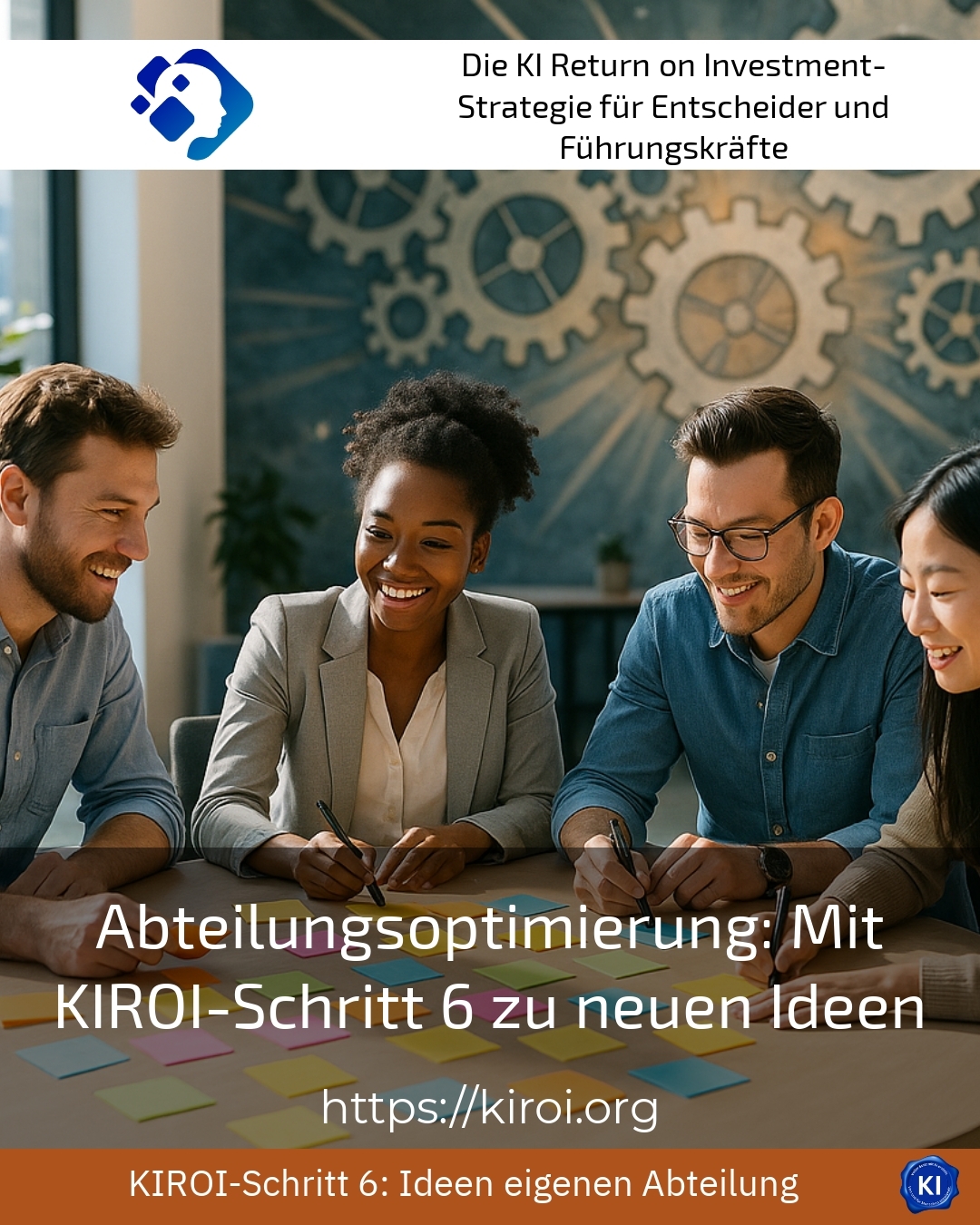
Regular workshops are essential for stimulating open exchange. A logistics company reports how moderated idea sessions led to new approaches for packaging optimisation. It was colleagues from different departments who came up with creative ideas together that would otherwise have remained hidden.
The use of assessment criteria such as feasibility, economic viability, and timeframe helps teams to prioritise realistic actions. This way, innovative ideas that sound good but are not implementable are avoided. Transparent communication of these criteria also fosters trust among all stakeholders.
In project organisation, responsibilities are assigned early on. For example, an IT service provider prevented good ideas from being lost in the implementation process through clearly defined roles and sub-tasks. A structured timetable led to rapid realisation, which noticeably eased the burden on daily operations.
BEST PRACTICE with one customer (name hidden due to NDA contract) And then the example with at least 50 words. In a manufacturing company, AIROI Step 6 was implemented in three different departments simultaneously. Starting with a joint goal definition, the team was encouraged to develop innovative suggestions. Using the morphological box, the best ideas were selected and consistently implemented. The result was not only an increase in productivity, but also a significant rise in employee satisfaction, which was 28 percent higher. The regular workshops supported a culture of continuous improvement and innovation.
Creativity and structure purposefully combined
One of the challenges in departmental optimisation is ensuring that creative ideas don't get lost in the chaos. AIROI Step 6 therefore utilises tried-and-tested methods such as brainstorming, Ishikawa diagrams, and morphological boxes. These tools help to systematise ideas and question their causes and effects.
For example, a customer service team is guided not only to look at symptoms like long waiting times but also to analyse the underlying processes. This link creates practical, sustainable solutions.
This methodology can be used in the HR department to make the onboarding of new employees more efficient. Teams gather suggestions on how to improve information flows and optimise training materials. The evaluation is then carried out transparently, ensuring quick and goal-oriented implementation.
Cross-departmental collaboration as a success factor
Innovations often arise at the interfaces between departments. AIROI therefore recommends cross-departmental workshops that promote synergy. One example of this is a project where marketing, sales, and IT collaborated on the digitalisation of customer communication. The method allowed different perspectives to be combined and conflicting viewpoints to be used constructively.
Another advantage is that this open exchange boosts ambition and motivation. Employees feel involved and identify more strongly with the improvements achieved. For example, in a service company, after the introduction of AIROI Step 6, staff turnover in the affected departments decreased.
My analysis
Department optimisation is not a rigid procedure, but a dynamic process that promotes innovation as well as efficiency. AIROI Step 6 is particularly well-suited to guiding teams and systematically developing and evaluating new ideas. The combination of creative methods and clear structures ensures that improvements are not only initiated but also sustainably integrated into daily work. Numerous examples from sales, production, and service show that this step effectively supports department optimisation and increases both employee satisfaction and competitiveness.
Further links from the text above:
Department Optimisation with AIROI Step 6 Ideas [2]
Optimising your department: Step 6 to innovative ideas with AIROI [6]
Department Optimisation: With AIROI Step 6 to Idea Power [14]
Process optimisation: definition, methods, examples [1]
Process Optimisation: Definition, Methods & Implementation [3]
For more information and if you have any questions, please contact Contact us or read more blog posts on the topic Artificial intelligence here.











 Deutsch
  English (UK)