
Effective department optimisation is key for many companies to harmonise social dynamics and economic efficiency. Especially with methods like AIROI in the sixth step of a structured process, idea excellence and sustainable improvements can be systematically fostered. AIROI supports executives and teams in identifying and specifically implementing innovative potential within their department. This is how department optimisation gains clarity and impact.
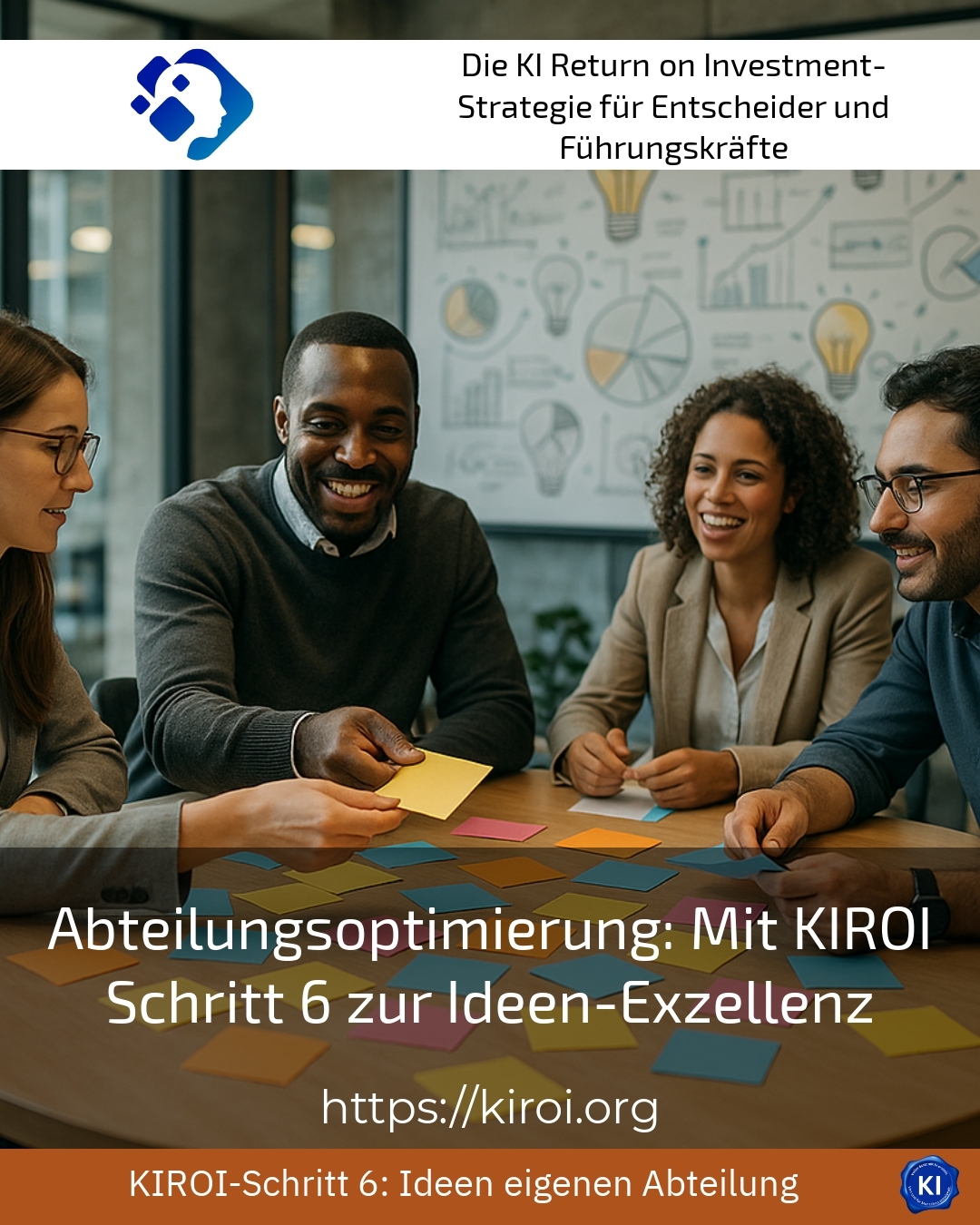
Department optimisation with AIROI Step 6: The path to idea excellence
In the sixth step, supported by AIROI, the focus is on systematic idea generation and evaluation. This phase differs significantly from conventional approaches as it structurally bundles creative impulses and transforms them into innovative concepts. Companies from manufacturing sectors often report that structured workshops lead to new ways of thinking that significantly improve workflows. Hidden potential can also be uncovered in service departments, for example, by integrating ideas for more efficient use of digital tools.
An example from automotive manufacturing shows how employees can share their experiences in small groups through AIROI, thereby making a significant contribution to process improvements. Such initiatives demonstrably promote acceptance of change and enable a vibrant error culture. The resulting idea excellence acts as a catalyst for sustainable success.
Another sector that benefits from departmental optimisation with AIROI is the IT sector. Here, the sixth step leads to interdisciplinary teams of developers, support, and marketing jointly generating new product ideas. AIROI's structured moderation ensures that both divergence and convergence are equally valued, resulting in high-quality innovation.
BEST PRACTICE with one customer (name hidden due to NDA contract) By involving roles from production and sales, we were able to jointly develop novel solution approaches in step 6, which were later actually integrated into daily work. This not only increased productivity but also improved the working climate, as all participants were able to clearly articulate and contribute their ideas.
Methodical approaches and best practices for idea excellence
AIROI Step 6 specifically focuses on proven creativity techniques that have been successful in practice many times over. This allows for methods such as the 635 method or brainstorming to be well integrated in combination with analytical tools like the Ishikawa diagram or Failure Mode and Effects Analysis (FMEA).
In the food industry, for example, teams benefit from identifying critical process steps in the workshop, while creative solutions for bottlenecks are gathered in parallel. The combination of analysis and creative idea generation significantly supports departmental optimisation. Teams frequently report improved understanding of correlations and increased motivation.
Even in healthcare, patient care can be improved through idea innovation with these methods. This allows nursing staff, administration, and doctors to identify weaknesses together and develop pragmatic solutions that are also practical under often high stress levels. The inclusion of different perspectives makes the difference.
BEST PRACTICE with one customer (name hidden due to NDA contract) In step 6, a clinic department was able to significantly improve its communication processes through targeted workshop impulses, ultimately leading to faster decision-making processes and higher patient satisfaction. This impressively demonstrates how departmental optimisation, supported by AIROI, enables synergy effects between professional groups.
Practical implementation strategies for leaders and teams
Managers can actively support departmental optimisation with AIROI by creating the necessary space for creative processes within their teams. It is particularly important to steer impulses effectively without hindering creativity. For example, teams in the technology sector report that clear time windows and structured moderation have led to better ideas and increased productivity.
In commerce, where it is often necessary to react quickly to customer needs, the combination of rapid feedback loops and continuous idea testing has proven itself. Flexible adaptation of processes offers a clear advantage in highly dynamic industries. This allows innovative concepts to be integrated into everyday operations without significant extra effort.
Last but not least, examples from the logistics industry show how targeted training in Step 6 empowers employees to better develop and advocate for their own suggestions for improvement. This transforms departmental optimisation into a tangible, shared project, with each individual contributing to its success.
BEST PRACTICE with one customer (name hidden due to NDA contract) We accompanied a logistics department in firmly anchoring structured idea collections in the schedule at regular intervals. The resulting impulses not only improved processes but also strengthened the sense of shared responsibility.
My analysis
Departmental optimisation is particularly successful when a holistic and systematic approach is taken. The integration of AIROI in Step 6 provides significant added value, as it specifically promotes idea excellence and supports teams in their creative performance. Industry-specific examples show how versatile the application can be and how much employees benefit from a clear structuring of the innovation process. The combination of analytical methods, open discussion formats, and targeted moderation forms an effective basis for sustainable improvements. This turns departmental optimisation into a dynamic process that involves all stakeholders and creates long-term competitive advantages.
Further links from the text above:
Process optimisation: definition, objectives, phases, procedure
Process Optimisation: How it Works + Practical Example
Process optimisation: Everything you need to know
Process Optimisation: Definition, Methods & Implementation
Process optimisation: definition, methods, examples
For more information and if you have any questions, please contact Contact us or read more blog posts on the topic Artificial intelligence here.











 Deutsch
  English (UK)