
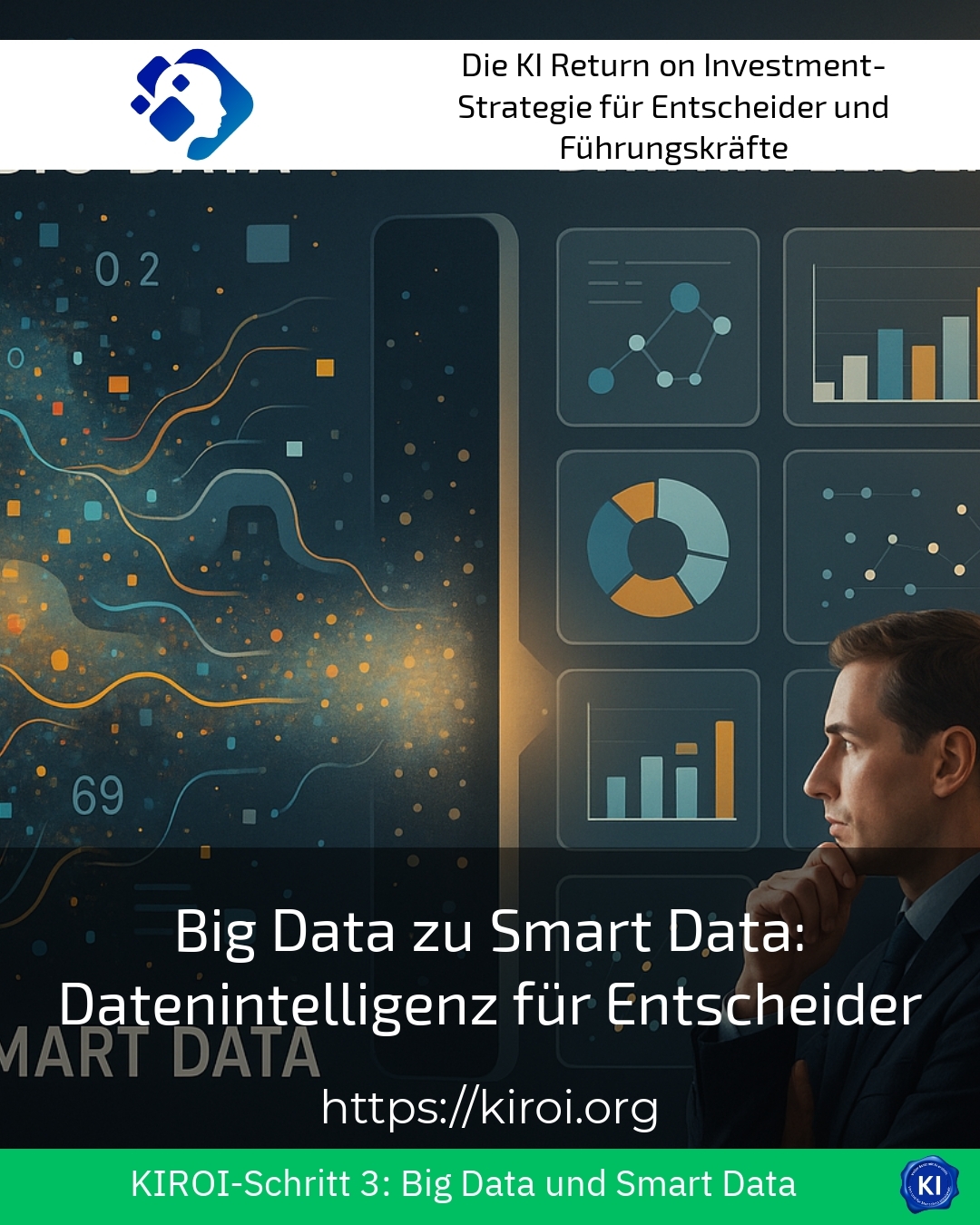
The sheer volume of information that flows into companies daily can be overwhelming and presents enormous challenges for leaders. However, this is precisely where the key to success lies. The shift from Big Data to Smart Data: Data Intelligence for Decision-Makers is revolutionising the way strategic decisions are made. Those who understand this development gain a crucial advantage. In this article, you will learn how valuable insights are generated from unstructured data volumes and why this process has become indispensable for every forward-thinking company.
From Data Noise to Data Intelligence for Decision-Makers
Companies are collecting more information today than ever before. Sensors, transactions, and digital interactions continuously generate new data points. However, this flood of raw data has little value if it isn't intelligently processed. It is only through targeted analysis and contextualisation that actionable insights are created.
A medium-sized mechanical engineering company collected production data for years, with the information lying unused on servers. Only when the company began analysing this data systematically did the responsible parties recognise patterns. Machine failures could suddenly be predicted. A logistics company used similar approaches for route optimisation. Journeys became more efficient and costs noticeably decreased. This trend is also clearly evident in retail. Retailers analyse purchasing behaviour and adjust their product ranges accordingly.
The crucial difference lies in the quality of the insights gained. Quantity alone will not suffice. Instead, intelligent algorithms and human expertise are needed. Only then can real data intelligence be created for decision-makers, enabling strategic action.
Best practice with a AIROI customer
An internationally operating plant manufacturer approached us with a specific challenge that many companies will recognise. Management had collected production and quality data over years, but was unable to use it meaningfully. The data was scattered across different systems and no one had an overall view. As part of our transruptions coaching support, we jointly developed a data consolidation strategy. First, we identified the relevant data sources and defined clear quality standards. The company then implemented a central analysis platform that brought all the information together. The results surprised even experienced managers in operations. Production defects that had previously gone unnoticed were identified and rectified early on. The scrap rate fell by a remarkable 23 percent within six months. Furthermore, maintenance intervals could be optimised and unplanned downtime significantly reduced. The project impressively demonstrates how transruptions coaching can accompany and support companies in their digital transformation.
Technological Foundations of Intelligent Data Processing
Modern technologies form the foundation for the transformation of raw data into usable information. Machine learning plays a central role in this. Algorithms recognise patterns that remain hidden to the human eye. They work tirelessly and become increasingly precise over time.
In the financial sector, institutions use these technologies for fraud detection. Suspicious transactions are automatically identified and flagged. Insurance companies employ similar systems for risk assessment. Claims are automatically checked for plausibility. Promising applications are also emerging in the healthcare sector. Clinics analyse patient data and identify treatment patterns early on.
Cloud computing enables the flexible scaling of computing capacities. Companies no longer have to maintain expensive infrastructures. Instead, they use resources as needed and only pay for actual usage. This democratisation of technology also opens up new opportunities for smaller businesses.
Data Quality as a Success Factor for Smart Data
The best technology is of little use if the data quality is poor. Flawed or incomplete datasets lead to false conclusions. That is why successful companies are investing more in data cleansing and maintenance. This effort pays off in the long run.
An energy provider found that 15 percent of its customer data was out of date. Marketing campaigns were no longer reliably reaching their target audience. Following a systematic data cleansing process, conversion rates increased significantly. A telecommunications provider experienced similar issues with its contract data. It was only through consolidation that precise customer analysis became possible. Municipal utilities also frequently report comparable experiences with data cleansing.
The introduction of data governance policies creates clear responsibilities. Employees then know exactly who is responsible for which data. Regular audits ensure ongoing quality assurance throughout the entire company.
Big Data to Smart Data: Data Intelligence for Decision-Makers in Practice
Practical implementation requires more than just technical expertise. Decision-makers need to understand what questions they can ask of their data. This requires a fundamental understanding of the possibilities and limitations. At the same time, there needs to be a willingness to question established processes.
In the automotive sector, manufacturers use sensor data for predictive maintenance. Vehicles independently report when a service is due. This noticeably increases customer satisfaction and reduces workshop costs. Suppliers optimise their production based on real-time data from the supply chain. Bottlenecks are identified early and alternative procurement routes are activated. Retailers, in turn, analyse sales trends and manage their stock levels accordingly.
The transformation to a data-driven organisation requires a cultural shift. Employees need to develop trust in data-based decisions. At the same time, human intuition must not be completely suppressed. The combination of both approaches often leads to the best results.
Best practice with a AIROI customer
A medium-sized retail company was looking for ways to deepen its customer relationships and strengthen customer loyalty. The existing CRM data was hardly being used and was literally gathering dust in the systems. Together with our transruptions coaching team, the company developed a comprehensive analysis strategy for its customer data. We supported the process from problem identification to the successful implementation of the new solution. First, we segmented the customer base according to purchasing behaviour, preferences, and company value. This led to personalised offers that were precisely tailored to the needs of individual customer groups. The results became very clear and measurable within a few months. The repeat purchase rate increased by 18 percent, and the average shopping basket value also rose significantly. Particularly pleasing was the customers' reaction, who felt better understood and more individually looked after. This example illustrates how transruptions coaching can provide impetus and support companies in utilising their data potential.
Ethical Aspects of Data Usage
With great data power comes great responsibility. Companies must carefully consider what data they collect and what they use it for. Data protection is not just a legal obligation, but also a factor of trust for customers and partners.
Banks face the challenge of using customer data for better service without overstepping boundaries. Transparency about data usage builds trust with customers in the long term. Insurance companies grapple with similar issues when assessing their customers' risk. The use of health data requires a particularly sensitive approach and clear guidelines. E-commerce retailers also need to master the fine line between personalisation and intrusiveness.
Compliance with the General Data Protection Regulation represents just the minimum requirement. Forward-thinking companies develop their own ethical guidelines that go beyond legal requirements. This can become a real competitive advantage.
Strategic Implementation in the Company
The path to a data-driven organisation begins with a clear vision. Leaders must define what goals they wish to pursue with the use of data. Without this strategic alignment, investments in technology often remain ineffective.
Pharmaceutical companies are successfully using data intelligence to accelerate drug development. Research data is systematically analysed, and correlations are identified. This can significantly shorten the time to market. Chemical companies continuously optimise their production processes based on real-time analyses. Resource consumption and environmental impact are measurably reduced through precise control. Diverse applications for these technologies are also emerging in the food sector.
The step-by-step introduction has proven its worth in practice. Pilot projects allow for the collection of experience within a manageable scope. Successes create acceptance and facilitate the later rollout across the entire company.
Skills development and further training for data intelligence
Technology alone does not solve problems. People must learn to use the new tools. Building data literacy skills is becoming a strategic success factor for companies.
Industrial companies extensively train their production employees in the use of analysis tools. Acceptance increases when employees recognise the benefit for their daily work. Banks further train customer advisors in the interpretation of data analyses. This noticeably improves the quality of customer consultations. Trade businesses are also increasingly recognising the importance of these skills for their future.
Leaders also need a basic understanding of the possibilities. Only then can they ask the right questions and critically assess results. Investing in further training pays off in the long term.
My AIROI Analysis
The transformation of raw data into actionable insights marks a fundamental shift in business management. Decision-makers who actively shape this development gain sustainable competitive advantages. It repeatedly becomes clear that technology is only part of the solution. The human factor remains crucial for success.
In my consultancy practice, I often find that companies come to us with similar challenges. They have data but don't know how to use it. They've invested in technology without first defining their strategic goals. Or they struggle with employee adoption issues in their day-to-day operations.
Transruptions coaching can offer valuable impulses here and support the transformation process. The aim is to develop a path together that suits the specific company. Standard solutions rarely work in the complex reality of today's organisations. Instead, tailor-made approaches that take culture and structure into account are needed.
The path to data intelligence for decision-makers [1] requires patience and perseverance. Quick wins are possible, but sustainable transformation takes time. Companies that consistently pursue this path often report surprising insights. The data tells stories that no one has heard before.
My recommendation is therefore: start with manageable projects and gain experience. Invest in your employees' skills and create a data-friendly culture. And never forget that behind all data are people whose trust you should not betray.
Further links from the text above:
[1] Bitkom – Smart Data and Data Analysis
For more information and if you have any questions, please contact Contact us or read more blog posts on the topic Artificial intelligence here.








 Deutsch
  English (UK)