
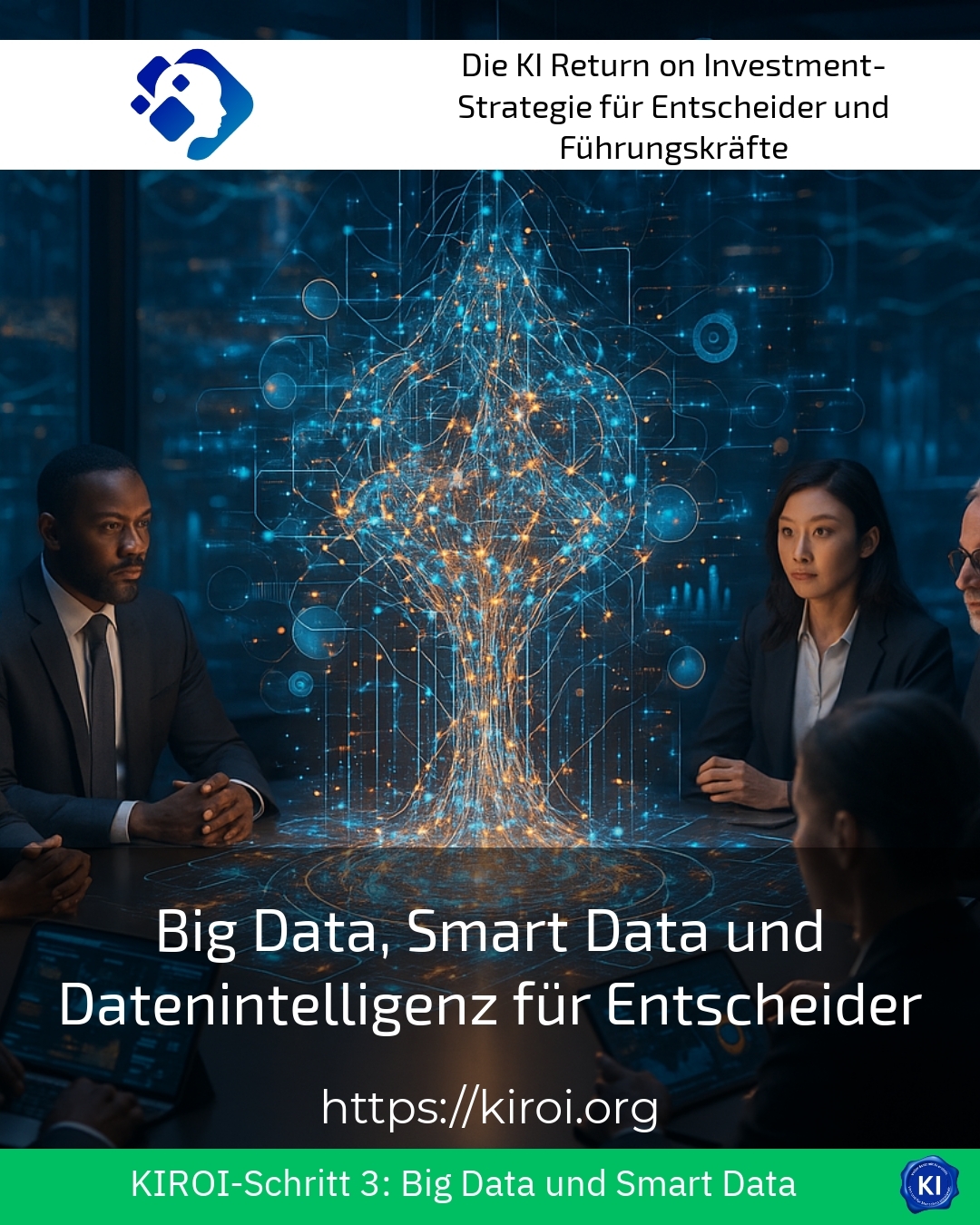
Imagine you stand before an ocean of information every morning. Millions of data points stream through your systems. But which of them truly deserve your attention? This is precisely where the wheat is separated from the chaff. Big Data, Smart Data and Data Intelligence form the foundation of modern decision-making. They enable leaders to filter clear signals from the noise. Transforming raw columns of numbers into strategic insights is what determines success and failure today. This article shows you how to use these tools effectively.
The Evolution of Data Usage in Business Management
The history of business data processing has changed dramatically. Previously, spreadsheets and simple reports were sufficient. Today, companies generate terabytes of structured and unstructured information daily. This flood completely overwhelms traditional analytical methods. Therefore, decision-makers need new approaches and tools.
The insurance industry is also a prime example here. Claims reports contain not only figures but also text and images. Customer interactions take place across various channels. Fraud patterns are hidden within complex relationships. For instance, a large insurer recognised that certain claims reports exhibited striking patterns. Analysing free-text fields revealed suspicious wording. This enabled fraud cases to be identified early on.
Intelligent data analysis is also revolutionising business in the field of risk assessment. Insurers today are using external data sources such as weather data and satellite imagery. This enables them to assess the risks of natural disasters with greater precision. Another example can be found in health insurance. There, analysis models help to detect chronic illnesses early. This allows preventive measures to be initiated in a timely manner.
Best practice with a AIROI customer
A medium-sized insurance group approached us with a specific challenge. The company possessed vast amounts of data from various sources. However, it lacked an overarching strategy for the meaningful utilisation of this information. Together, within the framework of transruption coaching, we developed a structured approach. First, we identified the relevant data sources and their quality. Subsequently, we defined clear use cases for senior management. Prioritisation was based on value creation potential and feasibility. Within six months, a functional dashboard for the executive board was created. This dashboard condensed complex key figures into understandable decision-making bases. Since then, managers have reported significantly faster response times. Strategic decisions are now based on reliable insights rather than intuition.
From Big Data to Smart Data: The Path to Data Intelligence
The mere collection of data does not create value. The key is transforming it into usable insights. Big Data initially describes only the volume and variety. Smart Data, on the other hand, focuses on relevance and quality. Data intelligence goes a step further. It combines analytical capabilities with contextual understanding.
This difference is evident daily in the insurance industry. For example, a property insurer collects millions of telematics data points from vehicles. Raw GPS coordinates and acceleration values alone are of little use. It is only through consolidation into driving profiles that usable information is created. Based on this, intelligent algorithms enable individual premium structures. Customers with careful driving behaviour can benefit from lower premiums.
Another example comes from the life insurance sector. There, modern systems analyse medical data and lifestyle factors. The integration of wearable data opens up entirely new possibilities. Insurers can thereby offer personalised health programmes. Customers often report that they feel better looked after by such offerings. This strengthens customer loyalty in the long term.
The benefits are also clearly evident in claims processing. Intelligent systems can automatically categorise damage reports. They recognise both routine cases and complex situations. This leads to more efficient use of resources. Claims handlers can concentrate on demanding cases.
Big Data, Smart Data and Data Intelligence in Practice
Practical implementation requires more than just technology. Organisational changes play an equally important role. Data silos must be broken down. Cross-departmental collaboration becomes a success factor. The company culture must support data-driven decisions.
A reinsurer demonstrates this impressively. The company linked internal claims data with external climate models. This resulted in more precise forecasts for natural disaster events. The findings were incorporated into product development and pricing. Additionally, primary insurers could be advised more effectively. This strengthened their position in the competitive reinsurance market.
Exciting applications are also emerging in the field of health insurance. Analysis models help to identify care gaps. Insurers can then develop targeted prevention programmes. For example, a health insurer uses anonymised billing data. From this, it recognises regional differences in healthcare provision. These findings are incorporated into contract negotiations with service providers.
Sales also benefit significantly from intelligent data analysis. Customer profiles are enriched by diverse information sources. This allows consultants to make more tailored offers. The probability of closing a deal increases because the recommendations better match the customer's needs.
Best practice with a AIROI customer
An insurance group was facing a strategic challenge in the area of customer churn. The cancellation rates were well above the industry average. Traditional methods of analysis did not provide sufficient explanations. As part of our support, we first analysed the existing data. In doing so, we realised that important information remained unused. Interactions from customer service, for example, were not systematically analysed. Together, we developed an early warning system for customers at risk of churning. The model takes into account various signals such as complaint frequency and payment behaviour. Information from social media is also incorporated in an anonymised form. The sales employees now receive timely indications of customer relationships at risk. They can proactively make contact and offer customised solutions. The cancellation rate has improved noticeably since then. The project shows how transruption coaching can support concrete business results.
Challenges and solutions for decision-makers
The path to a data-driven organisation is rarely straightforward. Technical hurdles are only part of the challenges. Cultural resistance often proves more persistent. Employees fear loss of control or job loss. Leaders must therefore actively build trust.
In the insurance industry, regulatory requirements are being added. Data protection regulations impose strict limits on data usage. Supervisory authorities demand transparency in algorithmic decisions. For example, an insurer must be able to explain why an application was rejected. Black-box models reach their limits here. Interpretable approaches are therefore gaining importance.
Data quality presents another significant challenge. Historically developed systems often contain inconsistent information. Duplicates and erroneous entries distort analysis results. Systematic data quality management is therefore indispensable. A large composite insurer invested heavily in cleaning up its existing data. Only after this was it possible to conduct meaningful analyses.
Integrating different data sources also proves to be complex. Insurers often work with various legacy systems. These speak different technical languages. Modern integration platforms can build bridges here. They enable a unified view of distributed data stocks.
The role of Big Data, Smart Data and Data Intelligence in strategic decision-making
Strategic decisions particularly benefit from intelligent data analysis. Market entry decisions can be secured through comprehensive analysis. Product development is based on identified customer needs. Pricing strategies are optimised through competitor analysis.
An example from cyber insurance illustrates this clearly. This still young market is developing dynamically. However, risk data is only available to a limited extent. Insurers therefore use alternative data sources such as security audits and threat analyses. From this, they develop innovative premium models. The combination of internal and external data enables a better risk assessment.
Similar developments are emerging in the field of commercial property insurance. Satellite imagery is helping to assess building risks. IoT sensors are providing real-time data from insured properties. Early warning systems can thus prevent damage. For example, an industrial insurer has developed a monitoring system for production facilities. Warnings are automatically triggered upon critical deviations.
Staff planning also benefits from data-driven analyses. Insurers can predict capacity requirements more precisely. Seasonal fluctuations in claims volume are anticipated. Resources can be managed flexibly accordingly. This improves both service quality and profitability.
Best practice with a AIROI customer
A regional insurer wanted to strengthen its market position through innovative services. The management recognised the potential of data-driven value-added services. However, a clear roadmap for implementation was lacking. Together, within the framework of transruptive coaching, we developed a strategic perspective. First, we analysed the existing data assets and technical capabilities. Then, we identified promising application areas with customer benefits. One focus was on preventative services for commercial customers. Sensors now monitor critical parameters in insured businesses. In the event of anomalies, automatic notifications are issued. The insurer is thus positioning itself as a risk partner rather than just a claims payer. Customer loyalty has demonstrably increased. At the same time, the claims ratio in the supported segments is falling. The project demonstrates how innovative data utilisation can create concrete competitive advantages.
My AIROI Analysis
The insurance industry is at a turning point in its development. Those companies that now invest in intelligent data utilisation are securing crucial competitive advantages. This is not about technology for its own sake. Rather, the focus is on concrete business benefits. Decision-makers must understand what questions they want to answer with data. Only then should they consider technical solutions.
My experience from numerous projects shows clear patterns of success. Successful companies begin with manageable pilot projects. They select use cases with measurable added value. Quick successes create acceptance and momentum. More complex projects can then be tackled on this basis. Building internal competencies deserves special attention.
Big Data, Smart Data and Data Intelligence also require a rethink in leadership. Decisions become more transparent and more comprehensible. Gut feeling loses importance compared to evidence-based findings. This can be a challenge for long-standing managers. At the same time, new design opportunities are opening up. The quality of strategic decisions can improve significantly.
Guidance from experienced partners can significantly accelerate the transformation process. External stimuli help to overcome ingrained ways of thinking. Best practice from other projects provides valuable orientation. At the same time, each company must find its own path. Standard solutions rarely work without adaptation. This is why individual advice is so valuable. Transruptions coaching offers precisely this guidance during digital transformation. It supports decision-makers in systematically unlocking the opportunities of data intelligence.
Further links from the text above:
[1] German Insurance Association – Data and Digitalisation
[2] McKinsey – Insurance Analytics Insights
[3] Bitkom – Big Data and Smart Data in Germany
[4] BaFin – Artificial Intelligence in the Financial Sector
For more information and if you have any questions, please contact Contact us or read more blog posts on the topic Artificial intelligence here.










 Deutsch
  English (UK)