
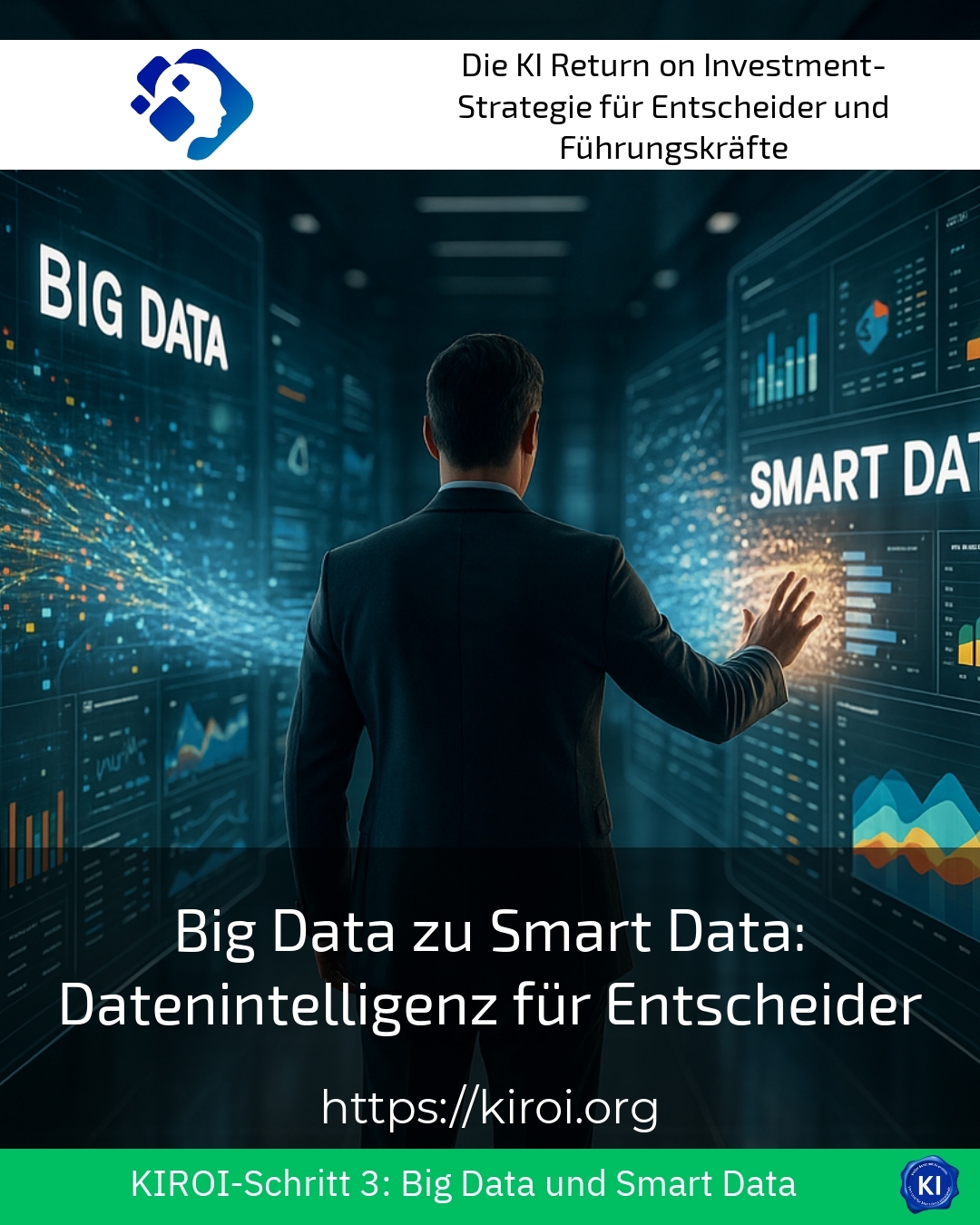
In a world producing billions of data points daily, leaders face a paradoxical challenge: drowning in information yet thirsting for actionable insights. The transformation of Big Data to Smart Data: Data Intelligence for Decision-Makers marks the decisive turning point at which pure data streams transform into genuine strategic action capability. Those who understand and actively shape this evolution gain a sustainable competitive advantage. At the same time, new horizons open up for innovation and increased efficiency. But how can this transformation be achieved in practice? And what steps lead from mere data collection to intelligent decision support? These are questions that concern decision-makers across all industries.
Understanding the evolution of data processing
Businesses today collect more information than ever before in the history of commerce. Sensors in production facilities capture temperatures, vibrations and flow rates. Customer interactions leave digital footprints in CRM systems. Supply chains continuously generate status reports and location data. This data explosion presents organisations with significant challenges, as the sheer volume of available information by no means guarantees better decisions. On the contrary, it can lead to overwhelm and analysis paralysis if intelligent processing does not occur.
A medium-sized mechanical engineering firm in southern Germany impressively illustrates this problem. The company had stored all production data for years. Several petabytes of information were located on servers, but no one could derive actionable recommendations from it. The breakthrough only came with the implementation of intelligent filter algorithms. Suddenly, quality problems could be predicted before they occurred. The scrap rate fell significantly because relevant patterns were recognised.
Logistics companies have similar experiences with route optimisation. They have historical traffic data, weather conditions and vehicle information. However, without intelligent linking, these data silos remain worthless. Only the combination creates real added value. A freight forwarder from the Ruhr area was able to significantly reduce fuel costs through this linking. Delivery time windows were adhered to more precisely. Customer satisfaction and efficiency increased simultaneously.
Best practice with a KIROI customer
An internationally operating trading company faced the challenge of fundamentally modernising its goods management. While the existing systems provided extensive reports, these always arrived too late for operational decisions. As part of a transruption coaching project, we supported the company in realigning its data architecture. First, together with the management team, we identified the key performance indicators that were truly relevant for decision-making. It turned out that out of several hundred available metrics, only about twenty were of real strategic importance. We then developed a dashboard concept that visualised these key indicators in real time. Implementation was carried out in stages over several months. Today, managers can access current stock levels, sales trends, and supplier performance within seconds. The speed of decision-making has noticeably increased, which represents an important advantage, especially in volatile market phases. The company reports significantly improved responsiveness to demand fluctuations.
Big Data to Smart Data: Data Intelligence for Decision-Makers in Transition
The transition from raw data stores to actionable intelligence requires more than technological investment. It demands a fundamental shift in thinking across the entire organisation. Leaders must learn to ask the right questions. This is because the quality of the answers depends directly on the precision of the questions asked. An insurance company that wanted to optimise its sales experienced this in an impressive way. Initially, the task was simply to generate more sales. After a structured analysis, the focus shifted. Instead, the aim was now to predict the probability of existing customers cancelling their policies. This reorientation proved to be significantly more valuable for the company's results.
The importance of intelligent data preparation is particularly evident in healthcare. Hospitals collect countless patient data, laboratory values, and treatment histories every day. The challenge lies in recognising relevant patterns and deriving recommendations for action from them. A hospital in northern Germany is now using predictive analysis for bed occupancy planning. The system takes into account seasonal fluctuations, historical admission rates, and current trends. This allows for better planning of personnel resources and the avoidance of bottlenecks. Patient care directly benefits from this forward-looking planning.
The energy sector also impressively illustrates this transformation. Grid operators must continuously balance supply and demand. The integration of renewable energy sources is making this task more complex than ever. Intelligent algorithms analyse weather data, consumption patterns and production forecasts. They enable more precise control of the power grid. A regional utility was able to significantly improve grid stability through this technology. At the same time, the costs for balancing energy dropped considerably. The investment in data intelligence quickly paid for itself.
Data intelligence for decision-makers: practical application areas
The practical implementation of data intelligence varies greatly depending on the industry and company size. Nevertheless, overarching success patterns can be identified. A central aspect relates to the democratisation of data access. If only a few specialists can create analyses, bottlenecks arise. Modern self-service solutions enable specialist departments to carry out their own evaluations. This accelerates decision-making processes and relieves IT departments. An automotive supplier has successfully implemented this approach. Production managers can now independently retrieve and analyse quality indicators. The time to identify problems has been drastically reduced [1].
In retail, data intelligence supports assortment planning and price optimisation. Retailers analyse purchasing behaviour, basket compositions and seasonal effects. This leads to personalised offers and optimised shelf placements. A drugstore chain uses these insights for its branch management. Each location receives an individually tailored assortment. This is based on local purchasing preferences and demographic data. Consequently, space productivity has been noticeably increased. Customers find what they are looking for faster, and customer loyalty is improved.
Financial services providers are using data intelligence for risk assessment and fraud detection. Patterns in transaction data often reveal suspicious activities within milliseconds. A credit card company was able to significantly reduce fraud losses through improved algorithms. At the same time, the number of incorrectly blocked transactions decreased. The balance between security and customer convenience was achieved better than before. Customers report smoother payment experiences alongside a higher level of protection [2].
Best practice with a KIROI customer
A medium-sized manufacturing company in the metal processing sector approached us with a specific challenge: machine downtimes were too high and unpredictable, leading to significant production delays. As part of our transruption coaching support, we jointly developed a strategy for predictive maintenance. We began by thoroughly analysing the existing sensor data from the production facilities. In doing so, we identified specific patterns that reliably indicated impending failures. We then implemented an alert system that informed the maintenance department early on. Technicians now had time to carry out maintenance as planned, rather than having to react to emergencies. The outcome far exceeded expectations: unplanned downtimes were reduced by more than half. Spare parts inventory was optimised, as needs could be identified earlier. The company reports a noticeable improvement in overall equipment effectiveness, which directly impacts competitiveness.
Cultural Transformation as a Success Factor for Smart Data
Technology alone does not create a data-driven organisation. Cultural change determines the success or failure of such initiatives. Employees must understand why data-based decisions are important. They need the necessary skills to handle new tools. Leaders must act as role models and argue data-based themselves. A pharmaceutical company experienced this when it changed its sales management. The technical solution worked perfectly, but the field sales staff initially ignored the recommendations. Only extensive training and a changed incentive system led to the desired utilisation.
The construction industry faces similar challenges when introducing Building Information Modelling. The technology promises significant efficiency gains through digital building models. However, without acceptance from architects, engineers, and tradespeople, the potential remains untapped. Consequently, a general contractor invested heavily in further training and change management. Today, all project participants work with a common data model. Planning errors are identified and corrected earlier. Project timelines have shortened while quality has increased [3].
In human resources, data intelligence supports talent acquisition and employee retention. Analysis tools identify successful applicant profiles and predict attrition risks. A technology company was able to noticeably improve its hiring rate for suitable candidates. At the same time, intentions to resign were identified earlier. Targeted measures for employee retention could be initiated in good time. The HR department now works more proactively instead of just reactively. This creates added value for employees and the company alike.
From Big Data to Smart Data: Successfully implementing data intelligence for decision-makers
The successful implementation of data intelligence follows proven principles. Firstly, a focused start with clearly defined use cases is recommended. Pilot projects deliver quick successes and create acceptance within the organisation. A food group began by optimising its production planning. The measurable success of this pilot convinced management to invest further. Subsequently, sales, procurement, and logistics were integrated step by step. Today, the company has a continuous data platform.
Data quality forms the foundation of any intelligent analysis. Inaccurate, incomplete, or outdated data lead to incorrect conclusions. A telecommunications provider had to learn this lesson the hard way. The initial analysis results contradicted the gut feelings of experienced managers. A review revealed significant quality defects in the source data. Only after extensive data cleansing did the models provide reliable insights. Since then, the company has continuously invested in data governance.
The choice of the right technology partner significantly influences project success. Standard solutions rarely fit individual requirements perfectly. A media company opted for a flexible cloud platform. This allows for rapid adjustments to changing business needs. New data sources can be integrated easily. Scalability guarantees growth without technical limitations. The initial investment was manageable, while the system can grow with the business [4].
My KIROI Analysis
The transformation of data volumes into decision-relevant intelligence represents one of the central management tasks of our time. From my experience in numerous consulting projects, it is clear that technological excellence alone is not enough. Rather, the ability of organisations to precisely formulate their questions and actually implement the insights gained into actions is crucial. At transruptions-coaching, we support companies with precisely this multifaceted challenge. We help leaders to set the right priorities and bring their teams along on the journey. Clients often report initial overwhelm in the face of the possibilities. This is where we provide impetus and structure the transformation process. The combination of strategic vision and operational implementation competence determines success. Companies that find this balance develop sustainable competitive advantages. They react more quickly to market changes and make better decisions. Investment in data intelligence pays off when it is embedded in a holistic change strategy. It is precisely this support for data intelligence projects that we offer our clients. The path from vision to reality requires perseverance, competence and the courage to question existing processes. Those who accept this challenge actively shape the future of their organisation.
Further links from the text above:
[1] McKinsey Digital Insights – Data-Driven Transformation
[2] Gartner Data Analytics Research
[3] Bitkom Digital Transformation
[4] Forbes Technology Council – Data Intelligence
For more information and if you have any questions, please contact Contact us or read more blog posts on the topic Artificial intelligence here.











 Deutsch
  English (UK)