
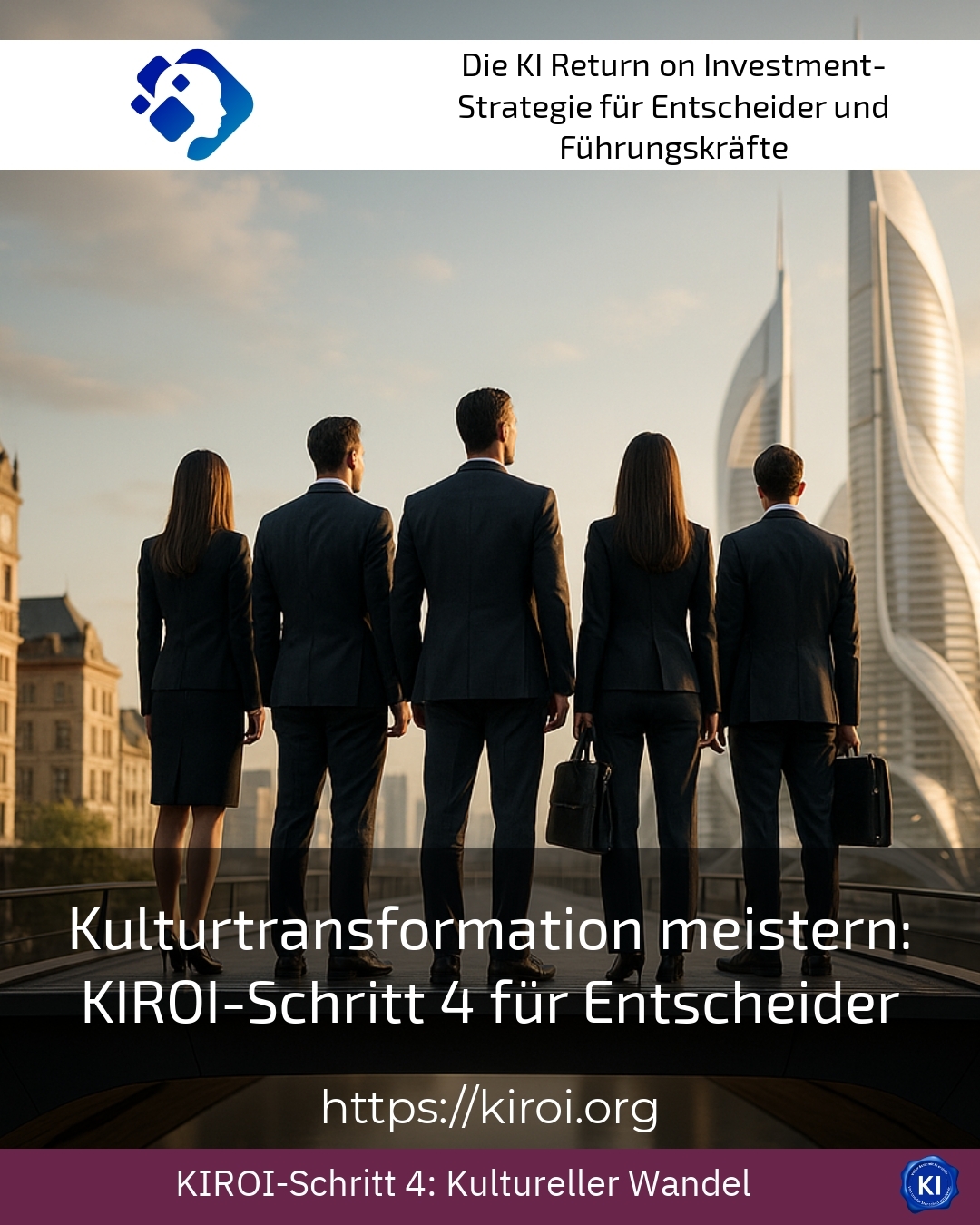
Cultural transformation represents one of the most significant challenges of our time for many companies. Decision-makers are faced with complex tasks that go far beyond superficial changes. The aim is to sustainably alter values, attitudes, and behaviours in order to secure the company's long-term success. In the fourth step of the AIROI model, which was specifically developed for leaders, anchoring the change is the focus. Only through consistent action can cultural innovations truly become effective.
The Importance of Cultural Transformation for Managers
Cultural transformation is not a short-term project but a continuous process. Leaders play a key role in this. They must not only act as role models but also create suitable frameworks for new values and behaviours to grow. Companies from a wide range of sectors frequently report on the importance of actively involving their employees. For instance, an international technology group fundamentally adapted its leadership approaches and was thus able to significantly increase the agility of its teams.
In the automotive industry, it was shown that trusting communication between leadership and employees creates the foundation for a successful cultural transformation. Decision-making was decentralised there to promote self-responsibility. This led to faster innovation cycles and improved market responsiveness.
In the healthcare sector too, leaders are experiencing how important the sustainable embedding of cultural changes is. For example, a clinic group has strengthened internal collaboration by fostering a culture of learning from mistakes, which demonstrably improved patient satisfaction.
AIROI Step 4: Embedding change sustainably
The fourth step in the AIROI process focuses on the permanent embedding of the newly established culture. Change should not merely be temporarily visible but must be deeply ingrained in the daily workflows and mindsets of employees. This is achieved through a series of concrete measures that support and stabilise the cultural shift.
1. Continuous communication: It is important to keep the target culture visible and engage in dialogue with employees. Communication should utilise various channels and openly discuss both successes and challenges.
2. Leadership Development: Leaders must be actively involved in the change process and regularly supported through coaching or workshops. This enables them to authentically embody and credibly communicate the new values.
3. Integration into processes and systems: New behaviours should be integrated into existing workflows, performance appraisals, and feedback systems. This makes cultural transformation part of everyday practice and prevents it from remaining abstract.
BEST PRACTICE with a client (name withheld due to NDA): As part of a medium-sized industrial company, an innovation day was specifically established in the fourth step, where employees could contribute their own ideas and teams collaborated across departments. This not only increased identification with the new culture but also noticeably promoted cross-departmental collaboration.
Practical examples from various industries
In the IT sector, one company reported on how it established an open feedback culture through regular feedback sessions and clearly defined culture workshops. This strengthened trust and led to a greater willingness to innovate. Another example from the energy sector shows that by establishing transparent communication structures, silos were broken down and employee motivation was increased.
In the retail sector, a corporation experienced that involving employees in the development of values not only strengthened their sense of belonging but also improved customer focus. This led to a tangible increase in customer satisfaction. Such measures demonstrate how cultural transformation can be lived and embedded step by step.
Tips for decision-makers on implementing cultural transformation
Decision-makers should consider the following points to successfully guide cultural transformation:
- Patience is key: Sustainable change takes time and consistent effort.
- Pay special attention to resistance: often resistance indicates necessary adjustments.
- Making successes visible: Small successes motivate and increase acceptance among employees.
- Promoting participation: Involvement fosters personal responsibility and trust.
- Utilise external support: Coaches and transformation facilitators assist with handling complex challenges.
BEST PRACTICE with a client (Name withheld due to NDA): An internationally active consulting firm purposefully implemented a mentoring system, where experienced colleagues supported new leaders. This facilitated the impartation of new cultural principles and accelerated integration within the company.
My analysis
Culture transformation is a complex and multi-faceted process that crucially depends on the commitment of senior leadership. Particularly in the fourth AIROI step, the importance of sustainable embedding becomes evident. Practical examples from industry, IT, retail, and healthcare demonstrate that transparent communication, active employee involvement, and integration into daily processes support success. Decision-makers who actively champion and drive culture transformation can thus secure and strengthen their organisation's long-term success.
Further links from the text above:
Cultural transformation as the basis for lasting success
The model process of a cultural transformation
4 Companies with Successfully Implemented Cultural Change
Mastering cultural transformation: AIROI Step 4 put to the test
For more information and if you have any questions, please contact Contact us or read more blog posts on the topic Artificial intelligence here.








 Deutsch
  English (UK)