
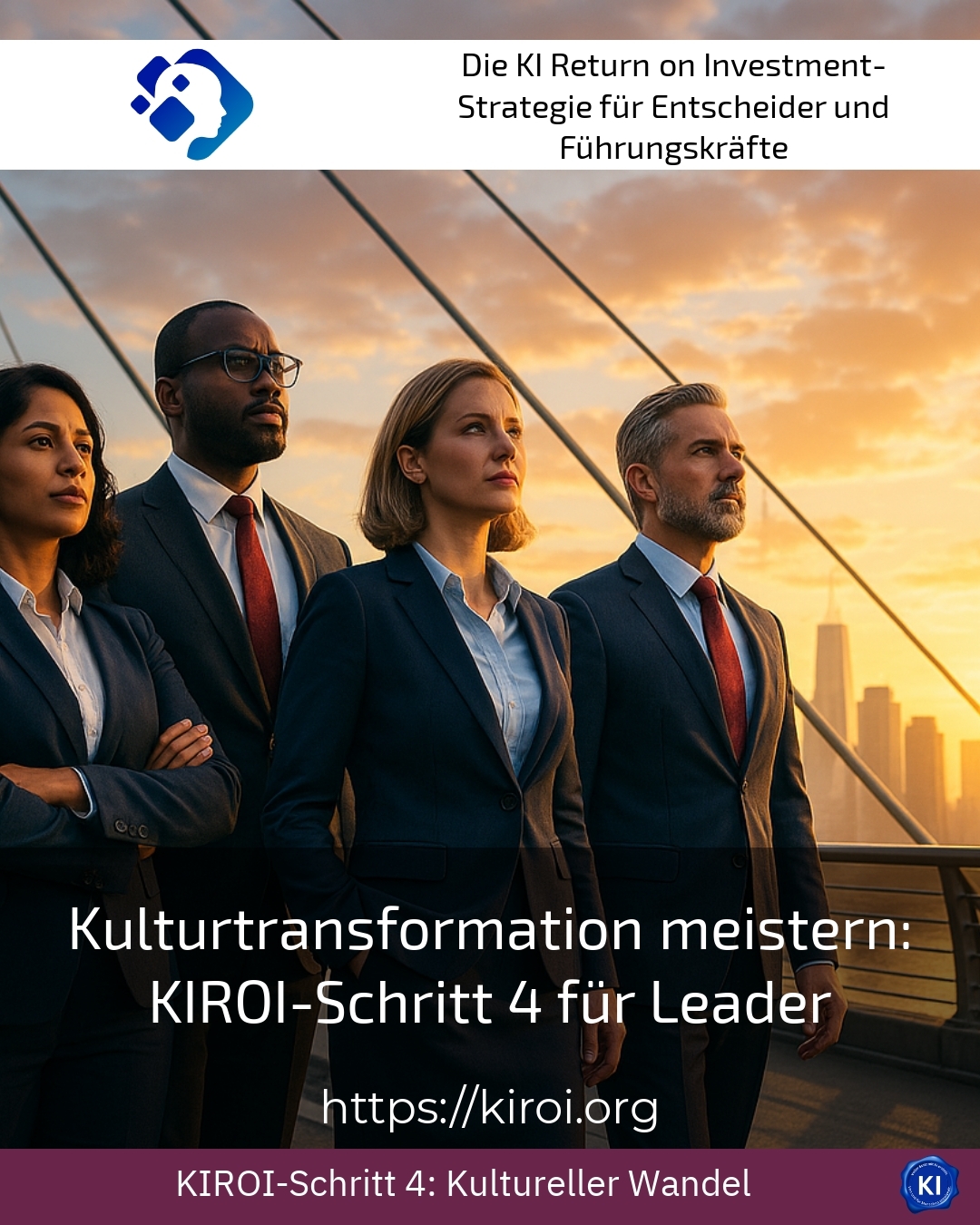
Cultural transformation within a company is a demanding but essential process. Leaders in particular play a central role by acting as catalysts and role models. The fourth step of the AIROI model clearly illustrates how leaders can effectively support cultural transformation to establish long-term, sustainable changes.
The Role of Leaders in Cultural Transformation
Leaders play a significant role in the success of a cultural transformation. They are more than just managers; they are architects and multipliers. Studies show that cultural transformations are particularly successful when leaders take personal responsibility and authentically embody the new values. For example, clients from the healthcare, manufacturing, and IT sectors frequently report that the role-modelling of their management is crucial for the success of cultural changes. This creates a ripple effect that impacts the entire company and accelerates the transformation.
In everyday life, this translates to managers reflecting on their own patterns of behaviour, showing openness, and mustering the courage to question old habits. This is exemplified by a municipal authority that, through intensive coaching, supported its management team in establishing a more open and trusting communication culture. Or by a medium-sized industrial company that, with regular team workshops, broke down resistance and brought new values of innovation to life.
A further practical example is an international IT service provider, where managers clarified their values and strengthened their role as cultural catalysts through targeted individual coaching. This enabled them to bring about a sustainable cultural transformation throughout the entire organisation.
Integrating new values into daily leadership behaviour
Cultural transformation doesn't just mean formulating values, but anchoring them in leadership behaviour. Leaders must integrate these values into decision-making processes and workflows. In practice, regular coaching and further training help to foster the necessary ability for reflection and openness. For example, a leading energy provider reports that team coaching within the management circle has led to a shared attitude that is reflected in all operational units.
Similarly, a public research institute has created „resonance“ across its entire leadership team through continuous leadership development, which in turn strengthens a culture of mutual appreciation. Such a culture helps employees feel like part of the company and identify with its goals. It sustainably increases engagement and performance.
BEST PRACTICE with a client (name withheld due to NDA agreement): The leadership team of an international logistics company learned in a six-week coaching process how to set cultural impulses, reduce resistance, and foster a spirit of innovation. The leaders now regularly use joint reflection sessions, actively shaping the cultural transformation.
Practical tips for leaders to guide culture transformation
To successfully support the cultural change, leaders should consider a few essential steps:
- Authentic role modelling of values It is essential that leaders set a good example and demonstrate the desired values daily.
- Creating spaces for reflection: Regular exchange formats and coaching help leaders to question and adapt their behaviour.
- Promote communication: Open and appreciative communication builds trust and involves employees in change.
- Enable participation: Leaders should actively involve employees in shaping the new culture to increase acceptance.
- Ensure measurability Progress in cultural transformation can be made traceable through measurable criteria. This way, successes can be made visible.
These practices are found in many sectors, such as finance, where leadership teams have successfully established flexible working models. Or in the retail sector, where customer centricity has been sustainably anchored in the corporate culture through targeted coaching. In the manufacturing sector too, innovative strength and internal collaboration have been significantly improved through participative change processes.
Shaping cultural transformation together with transruption coaching
Transruptions-Coaching offers tailored support for leaders navigating cultural transformation. It helps to identify internal and external resistance and develop strategies to overcome it. Clients often report that this support enables them to discover new ways of acting and to embody their role model function more consciously.
An example from the education sector shows how transruption coaching helped school leadership teams adapt their leadership behaviour to new challenges, thereby establishing an agile, learning-conducive culture. Similarly, a software company supported its leaders in introducing a feedback culture that strengthens openness and trust.
BEST PRACTICE with a client (name withheld due to NDA agreement): In a global consulting firm, coaching helped leaders align their personal values with the new corporate values. This created a coherent culture supported by all levels, releasing energy for change.
My analysis
Cultural transformation presents leaders with diverse challenges, but also offers significant opportunities. Actively integrating new values into leadership behaviour and acting as authentic catalysts are key success factors. Practical support through coaching and targeted training measures helps leaders to use their influence effectively. This turns cultural transformation into a dynamic process that makes the entire company fit for the future and motivates employees. Companies from various sectors demonstrate that this path is rewarding and successfully accompanies change.
Further links from the text above:
Successful culture transformation for businesses
Mastering cultural transformation: AIROI step 4 for leaders
Culture transformation – 4 steps and 4 interconnections
Leaders as catalysts for co-creative transformation
Cultural Transformation – Definition, Approach, Example
Cultural Transformation: Management's Responsibilities
For more information and if you have any questions, please contact Contact us or read more blog posts on the topic Artificial intelligence here.









 Deutsch
  English (UK)