
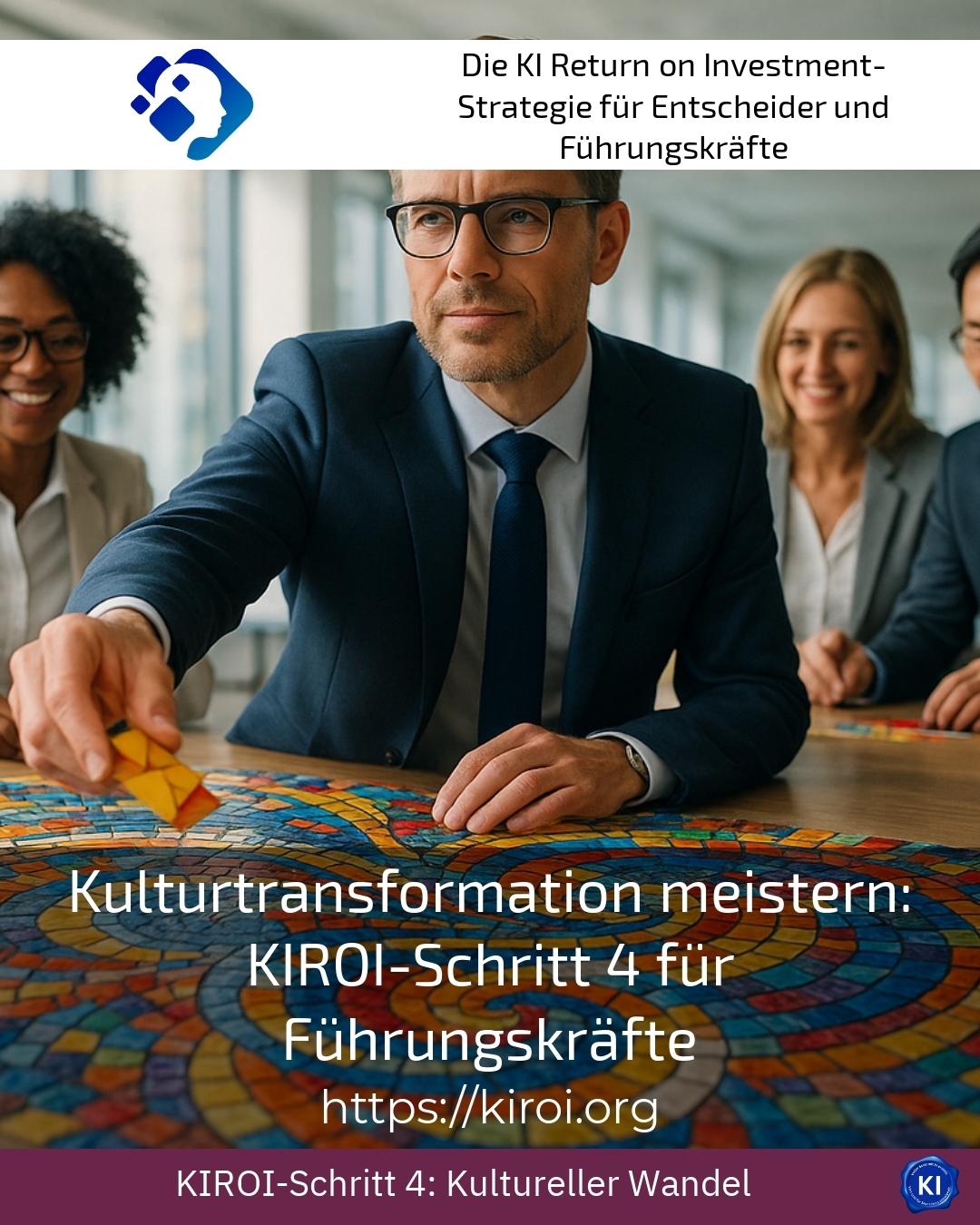
Cultural transformation is crucial for organisations aiming to remain competitive in the long term. Leaders are tasked with actively shaping values, behaviours, and collaboration, thereby catalysing sustainable change. The AIROI model offers a structured framework for this, tailored to the needs of the digital working world. The focus here is on Step 4, which specifically holds leaders accountable and demonstrates how transformation leads to concrete success.
Understanding and Shaping Cultural Transformation
Cultural transformation means breaking down existing patterns and establishing a new, future-proof culture. This process affects all levels of an organisation – from top management to teams. It begins with the question of how previous behaviour hinders success and what new values are needed to promote innovation, agility and collaboration [3]. Especially in medium-sized businesses, there are numerous examples where rigid hierarchies, a lack of transparency or insufficient networking block innovation potential.
Leaders often approach with the desire to delegate more responsibility to teams, strengthen digital competencies, and embed agile methods. Typical questions revolve around trust, communication, and appreciation, as these factors significantly determine the success of a cultural transformation[4]. However, genuine change only succeeds when the focus is not only on processes but also on people. Transruptive coaching supports companies in designing these processes individually and according to their needs.
Examples from practice
In a mechanical engineering company, management wanted to promote greater collaboration across departmental boundaries. Through targeted coaching and the development of internal change agents, an open feedback culture was established, which accelerated innovation.
A bank focused on cultural transformation to keep pace with digitalisation. Leaders participated in workshops on agile leadership, thereby creating space for a culture of experimentation and learning from mistakes.
In the automotive industry, a company introduced structured values dialogues to strengthen values such as respect and resilience. The teams jointly developed new mission statements, which became visible in everyday work.
AIROI Step 4: Leaders as Impetus Providers
The fourth step of the AIROI model specifically focuses on leaders. They are crucial for the success of cultural transformation because they are role models, architects, and multipliers all at once. Studies show that when leaders take responsibility themselves, a seed of the new culture is created, which radiates to other areas[1]. It is important that they demonstrate how new values are lived out not just in theory, but in their concrete behaviour. This requires a willingness to reflect, openness, and the courage to let go of old habits.
The focus is on integrating the new cultural elements into personal behaviour, decision-making and the company's processes. This means: managers should regularly attend coaching and further training to strengthen their role model function. Individual coaching helps to clarify personal values and recognise blind spots. Team coaching supports the entire management team in developing a shared understanding of the desired way of interacting with each other. In just a few months, this creates a group that exemplifies the new culture and serves as an inspiration for others.
Operational measures for success
Leaders should actively involve their employees in change and regularly seek feedback. Appreciative communication and honest dialogue are key to building trust and overcoming resistance[4]. HR processes such as recruitment, compensation, and promotion should be adapted to the new values to support the desired change[1]. It is important: the integration of new cultural elements only works through the interplay of awareness building, behavioural change, and structural adjustments.
BEST PRACTICE with one customer (name hidden due to NDA contract) The culture transformation at an international logistics company was supported by the leadership team introducing monthly walk-arounds at the various sites. During these, they provided feedback, asked for suggestions for improvement, and stimulated collaboration. Their regular presence and genuine listening led to a noticeable change in how people interacted and a greater sense of identification with the company. Open communication was perceived throughout the company as a positive signal, which accelerated the change process and significantly boosted employee motivation. Transruption coaching supported the leaders in actively shaping this new role and embedding the changes sustainably.
Further impulses for practice
Leaders can cascade multipliers who carry their knowledge into the teams. The principle „He who teaches, learns the most himself“ ensures that new content remains vibrant and that change competence within the company increases. Additionally, it is advisable to conduct regular status checks to make successes visible and to identify any need for adjustment early on.
Another example: an industrial conglomerate deliberately focused on interdisciplinary project teams to drive innovation. Managers fostered exchange and knowledge transfer by creating formal and informal communication channels.
Rituals such as the weekly town hall meeting were introduced in the service industry to increase transparency and strengthen the „team spirit“. This gave teams regular opportunities to provide feedback and contribute their perspectives.
Opportunities and challenges of cultural transformation
A successful cultural transformation offers numerous opportunities: it increases adaptability, fosters innovation, and enhances employee identification with the company. At the same time, the process remains challenging because it requires time and patience[2]. Even though initial results are often visible within a few months, real change usually takes several years to become embedded throughout the entire organisation[3].
Clients often report uncertainties and resistance because old patterns are difficult to break. Especially in traditionally oriented companies, it is important to celebrate small successes and communicate success stories to maintain motivation. For leaders, this means being consistent on the one hand, but also reacting flexibly to new developments on the other.
My analysis
Cultural transformation is not an abstract concept, but a vibrant, continuous process that must be supported by everyone. Leaders play a central role in this, as they embody change and create momentum for sustainable transformation[1]. Transruption coaching specifically supports companies in this step by creating spaces for reflection, imparting methods, and fostering learning processes. Experience shows that those who understand cultural transformation as a shared task lay the foundation for genuine change. The integration of new values, structures, and behaviours remains one of the most important tasks for leaders who want to make their organisations fit for the future.
Further links from the text above:
Cultural Transformation – 4 Steps and 4 Interconnections – AGITANO
Conscious Cultural Transformation – Conscious Leadership Academy
The path to successful cultural transformation – and associates
Organisational Culture Transformation – Dr Andrea Maria Bokler
For more information and if you have any questions, please contact Contact us or read more blog posts on the topic Artificial intelligence here.









 Deutsch
  English (UK)