
In modern organisations, cultural transformation plays a crucial role in effectively responding to the constant changes in the market and society. Leaders, in particular, face the challenge of shaping, managing, and successfully guiding this profound change. Cultural transformation offers a systematic framework for adapting values, beliefs, and behaviours to make the organisation more agile, innovative, and resilient.
Culture Transformation: The Key to Sustainable Leadership Behaviour
In the course of cultural transformation, leaders must not only initiate change processes but also act as role models themselves. Through their behaviour, they significantly shape the new culture and provide impetus for collaborative coexistence. In practice, leaders often encounter issues such as building trust, transparency, and fostering personal responsibility.
An example from industry shows how a manufacturing company was able to create a climate of trust by introducing regular feedback rounds and open communication formats, which significantly strengthened collaboration. In the banking sector, on the other hand, executives often report the challenge of breaking down traditional hierarchies in favour of an agile corporate culture. Here, training management teams in agile methods has proven helpful.
In the IT sector, cultural transformation is a response to the need for rapid innovation cycles. Leaders facilitate this change by promoting interdisciplinary teams and introducing retrospectives that enable continuous learning processes and strengthen a culture of openness.
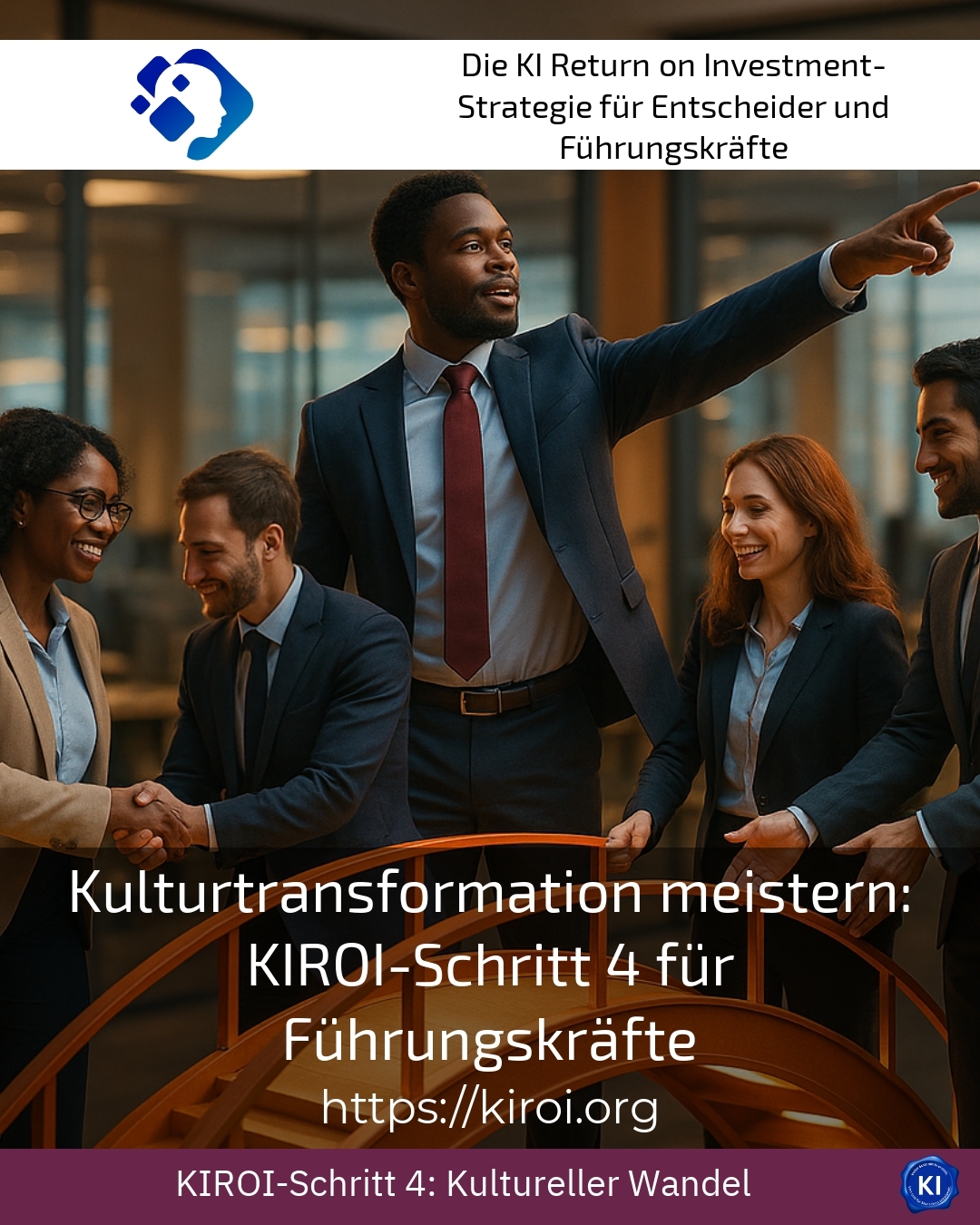
AIROI Step 4: Making cultural transformation tangible for leadership
In the fourth step of the AIROI model, the focus is on the active implementation and embedding of the new culture by leaders. They emphatically shape how values are lived out in everyday life. This includes, among other things, making cultural guiding principles visible and integrating them into decision-making processes. In practice, this means that leaders not only communicate but also systematically align their behaviour with the cultural objectives.
In practice, for example, a medium-sized service provider has shown that managers were able to strengthen their role as culture drivers through targeted workshops and coaching. This led to a sustainably improved working atmosphere and greater employee engagement.
Even in automotive corporations, divisional managers report on successful pilot projects where on-site leaders have introduced cultural change through daily rituals, such as short team meetings or appreciation rounds. Such measures support cultural transformation because they keep awareness of the change alive.
BEST PRACTICE with a client (name withheld due to NDA): Within an international technology group, we supported managers in taking on their role as culture ambassadors. By introducing a „Culture Ambassador“ programme, they created a bridge to all employees, fostered identification with the new values, and strengthened mutual support within the team.
How leaders overcome typical culture transformation challenges
A common obstacle is the natural resistance to change. Leaders can mitigate this resistance by addressing fears and involving employees in the process early on. Regular feedback loops help to make the transformation process transparent and to develop solutions together.
Practical examples from the healthcare sector demonstrate how participatory workshops have helped to alleviate uncertainty whilst enabling staff to embrace new values. Another example from the retail sector illustrates how managers, through targeted skills development, have empowered staff to take on responsibility and play an active part in the change process.
In the educational sector, school leadership was able to strengthen the culture of cooperation by promoting respectful and open dialogue, which had a long-term positive effect on the quality of teaching.
Tips for leaders on the path to culture transformation
Firstly, develop a clear understanding of what values are to be strengthened in your organisation in the future. To do this, use tried-and-tested methods such as workshops or culture assessments.
Secondly: Communicate the vision of a new corporate culture authentically and consistently. As a manager, it is important to lead by example and demonstrate the desired behaviours.
Thirdly: Use agile practices to shape cultural transformation as an iterative process. This allows for flexible adjustments to be made along the way.
Fourthly: Focus on developing leadership skills in the area of emotional intelligence, as these skills are crucial for the success of cultural transformation.
My analysis
Cultural transformation is a complex but essential process for organisations that wish to remain competitive in the long term. Managers, in particular, bear a great deal of responsibility, acting as drivers of change and embedding the new culture in day-to-day operations. Step 4 of the AIROI model clearly shows that it is not enough simply to formulate a vision; rather, it is about transforming the organisation into a place of collaboration and growth through concrete action and continuous support.
Practical examples from various sectors make it clear that cultural transformation can be successful in many ways, often focusing on employee participation, open communication, and the development of leadership skills. Thus, cultural transformations help organisations not only to react to external changes but also to actively shape their future.
Further links from the text above:
Successful cultural transformation for businesses [1]
Cultural transformation – 4 steps and 4 networks [2]
Cultural change in organisations: Your path to the future [3]
Business Transformation: Culture, Processes & AI [4]
Conscious Cultural Transformation [5]
Cultural transformation in the company [6]
Company Culture & Cultural Change [7]
For more information and if you have any questions, please contact Contact us or read more blog posts on the topic Artificial intelligence here.











 Deutsch
  English (UK)