
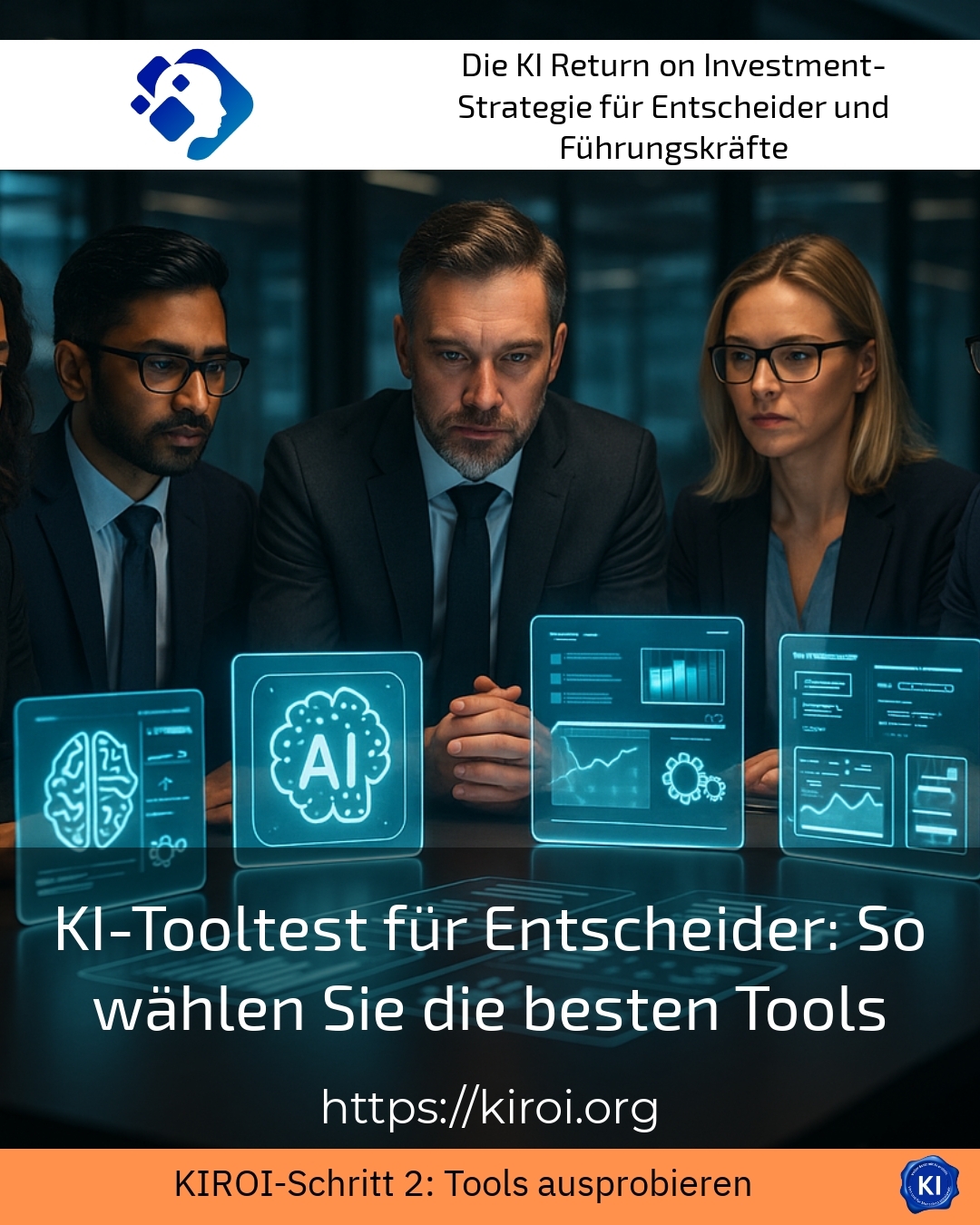
Have you ever wondered why some companies take off with intelligent solutions, while others stand still despite heavy investments? The answer often lies not in the technology itself, but in the way decision-makers make their selection while conducting a structured AI tool test for decision-makers. At a time when new applications flood the market every day and vendors advertise with grand promises, systematic evaluation is becoming a crucial competence for leaders across all industries. This article shows you how you can separate the wheat from the chaff through a methodical approach while taking your organisation's specific characteristics into account.
Why traditional valuation methods are no longer sufficient today
Traditional corporate procurement processes are designed for standardised software and fail to adequately take into account the dynamic nature of modern technologies, which is why many organisations face significant challenges when implementing intelligent systems. For example, a mechanical engineering company recently evaluated a predictive maintenance solution by applying traditional criteria such as price, range of functions and references. The result was sobering because, although the chosen application met all formal requirements, it failed due to the company's specific data structures. A logistics service provider had a similar experience when introducing route optimisation that delivered excellent results in the test environment, but could not cope with incomplete address data under real-world conditions. A medium-sized retailer also reported difficulties when its demand forecasting system worked for stable markets, but failed during sudden trend shifts. These examples illustrate that when testing an AI tool for decision-makers, you need to go beyond traditional criteria.
The hidden cost factors in system selection
Many leaders underestimate the total cost of an implementation because they focus on the obvious licence fees and overlook downstream expenses. For example, a financial services provider invested substantial sums in a compliance solution, only to discover later that integration into existing systems devoured three times the original purchase price. A healthcare provider experienced something similar when adapting a diagnostic support tool to local documentation standards required months of development work. Even an energy supplier implementing a grid management system was faced with unexpected training costs because the user interface was designed to be too complex for technical staff without an academic background. The true costs often only reveal themselves during ongoing operations.
Systematic criteria for a successful AI tool test for decision-makers
To make well-founded decisions, you need a structured catalogue of criteria that takes into account both technical and organisational aspects while incorporating the specific requirements of your industry. Data quality and data availability form the foundation of any successful implementation, which is why you should first check whether the existing information assets meet the requirements of the respective solution. A retail company analysed its customer data and found that years of inconsistencies in the recording of contact information made a personalised approach impossible. An insurance company recognised similar problems when historical claim data was available in various formats and first had to be laboriously harmonised. A manufacturing company, on the other hand, had extensive machine data at its disposal, but the sensors delivered measured values at different intervals, which complicated the analysis.
Best practice with a AIROI customer
An international company operating in the component manufacturing sector faced the challenge of choosing the right option from a multitude of available quality control solutions. Together, within the framework of transruptions coaching, we developed a multi-stage evaluation process that first determined the actual requirements of the various production sites and matched them against the capabilities of the different providers. It turned out that the solution originally favored was technically superior, but integrating it into the company's heterogeneous machine landscape would have required considerable adjustments. We supported the project team in defining test scenarios that reflected real production situations rather than simply simulating idealized laboratory conditions. Following a three-month pilot phase in a selected plant, the company was able to make an informed decision that took both technical performance and economic sustainability into account. Implementation subsequently ran much more smoothly than in previous projects because potential stumbling blocks had already been identified during the evaluation phase. Clients from similar projects frequently report that this structured approach helped them to avoid costly missteps.
Technical integration capability as a key criterion
The best solution is of little use if it cannot be seamlessly integrated into your existing system landscape, which is why the inspection of interfaces and integration options should occupy a central place in any evaluation process. A pharmaceutical company evaluated a document analysis solution that delivered impressive results in extracting information from study reports. Upon closer inspection, however, it became apparent that the connection to the existing document management system would have required a complete re-development. A telecommunications provider had a comparable experience when trying to test a customer service automation that could not communicate with the established ticketing system. A logistics company, in turn, had to discover that the promised real-time integration with fleet management systems only worked under certain conditions and collapsed under high load.
The human dimension in AI tool testing for decision-makers
Technology alone does not generate added value; it is only the people who use it and integrate it into their work processes that do, which is why staff acceptance is a crucial success factor that receives too little attention in many evaluation processes. A construction company introduced a project planning solution that calculated mathematically optimal resource allocations, but ignored the implicit preferences of experienced site managers. The result was massive resistance to the system because the employees felt that their decades of experience were being devalued. A hospital implemented a diagnostic support tool that the doctors perceived as patronising because the recommendations were issued without any comprehensible justification. A retailer, in turn, failed with a sales support tool because the sales staff perceived the technology as a monitoring instrument and actively sabotaged it.
Plan training and change management from the very beginning
Successful implementations are characterised by the fact that they do not view the qualification of employees as a downstream measure, but rather incorporate it into the selection process right from the start while taking the different levels of competence into account. A chemical company involved its laboratory assistants in the evaluation of an analysis platform from the outset and received valuable feedback on user-friendliness and practical suitability. A media company had editors test various text generation solutions and gained insights that no technical test could have provided. A personnel service provider had positive experiences when it involved recruiters in the evaluation of matching algorithms and systematically analysed their assessments regarding the quality of the suggestions.
Best practice with a AIROI customer
A building services company approached us with the question of how to choose the right solution from the wealth of available scheduling systems. Previous attempts to introduce intelligent deployment planning had failed several times because the technicians on site ignored the system's recommendations and fell back on their tried-and-tested routines. As part of our transruption coaching, we developed a participatory evaluation approach together with the company that involved the technicians from the very beginning and valued their expertise. We organised workshops in which employees could articulate their requirements while simultaneously developing an understanding of the capabilities of modern systems. The subsequent piloting took place in an area whose technicians had volunteered and acted as ambassadors for the project. This procedure led to significantly higher acceptance during the company-wide rollout and considerably supported the long-term success of the project. Experience shows that technological excellence alone is not enough and that the human dimension is crucial for project success.
Develop and execute practical test scenarios
A meaningful test requires scenarios that reflect real business situations rather than simply demonstrating the strengths of the respective solution, which is why you should take a particularly critical approach when developing test cases [1]. An automotive supplier tested an image recognition solution for quality inspection and deliberately also had defective parts analysed that had led to customer complaints in the past. A food manufacturer tested a demand forecast not only with historical data from stable periods, but also with time periods in which special promotions or supply bottlenecks had distorted the patterns. A real estate company tested a valuation solution with properties from various market segments and regions to check its ability to generalise.
Setting up meaningful pilot projects in a structured way
The piloting of a solution should be designed in such a way that it delivers reliable insights while limiting the risk for the organisation, which is why the selection of the pilot area and the definition of success criteria deserve special attention [2]. An insurance company deliberately chose an area of medium complexity for testing claims processing in order to obtain meaningful results without jeopardising its core business. A mechanical engineering company initially piloted design support in a product area with manageable variety and expanded its use step-by-step. A textile company began testing a trend analysis in a season whose results only became relevant later, thus leaving sufficient time for adjustments.
Consider long-term perspectives in decision-making
The technology landscape is evolving rapidly, which is why when making your choice you should not only evaluate the current range of functions, but also include the future viability and the development direction of the provider in your considerations [3]. One transport company opted for a solution from an established provider with a comprehensive roadmap, even though a start-up offered more powerful functions in the short term. When evaluating documentation support, a medical technology company explicitly took into account the regulatory requirements of the coming years and chose a solution that was prepared for compliance adjustments. When selecting a grid optimisation system, a utility company ensured that the system would be able to cope with future decentralised feed-in structures.
Flexibility and customisability as strategic factors
The ability of a solution to adapt to changing requirements becomes increasingly important as the duration of use increases, which is why you should also examine the possibilities for modification and expansion during the evaluation. A retail company deliberately chose a price optimisation tool with open interfaces that allowed it to integrate its own algorithms and continuously improve the system. A manufacturing company opted for a quality control system whose models could be retrained with its own data in order to adapt them to new product variants. When selecting a resource planning system, a service company ensured that business rules could be adjusted without any programming effort.
My AIROI Analysis
The systematic evaluation of intelligent solutions presents decision-makers with challenges that go beyond traditional procurement processes and require an expanded perspective. The AI tool test for decision-makers must consider technical performance, organisational fit and human factors equally in order to lead to sustainable results. My experience from numerous accompanying projects shows that successful companies adhere to three principles: they invest sufficient time in requirements analysis, involve future users at an early stage and design pilot projects in such a way that they deliver robust insights. Technological development offers enormous opportunities, but also considerable risks for organisations that enter implementation projects unprepared or with unrealistic expectations. Transruptions coaching can help you to develop a structured approach that suits your organisation and takes into account the specific requirements of your industry. Accompanying projects in this area requires both technical understanding and sensitivity to organisational dynamics and human factors. Clients frequently report that the external perspective helped them to identify blind spots and base decisions on a broader foundation. The key is not to choose the most technologically advanced solution, but the one that offers the greatest added value for your specific situation and is accepted by your employees.
Further links from the text above:
[1] Bitkom – Guidelines for the evaluation of AI solutions
[2] Plattform Lernende Systeme – Practical Guides for Businesses
[3] Accenture – Studies on the future of intelligent systems
For more information and if you have any questions, please contact Contact us or read more blog posts on the topic Artificial intelligence here.










 Deutsch
 English (UK)