
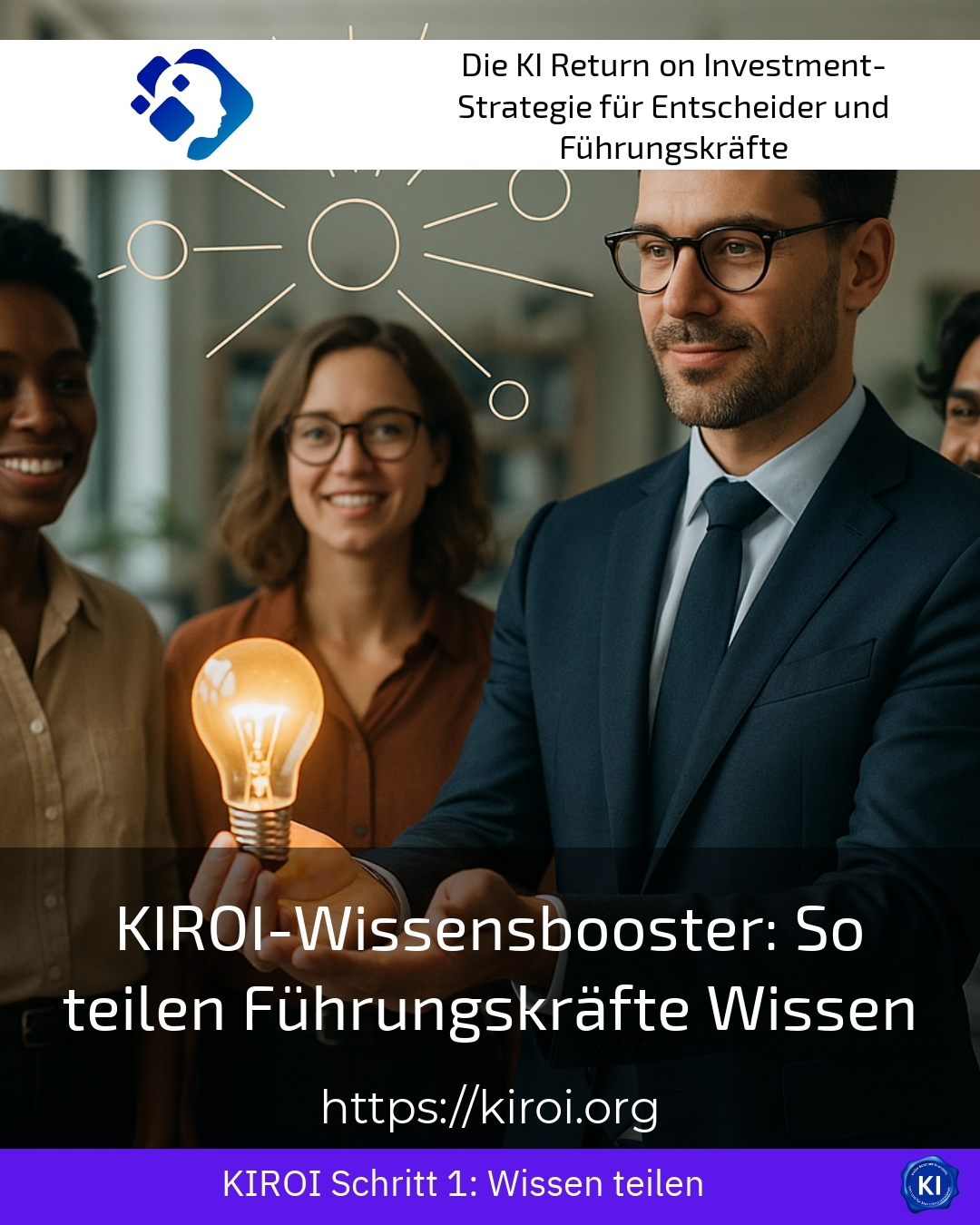
Have you ever wondered why some companies seemingly effortlessly benefit from the insights of their best minds, while others, despite highly skilled leadership teams, remain stuck in the knowledge silo and waste valuable expertise? AIROI Knowledge Booster offers a systematic approach here that enables leaders to pass on their knowledge in a structured and sustainable way, so that organizations as a whole benefit and a vibrant learning culture is created.
Why traditional knowledge transfer often fails
Most executives carry an enormous wealth of experience with them. However, this knowledge often remains invisible. It resides in their minds and disappears with their departure. In the automotive industry, for example, companies regularly witness retired engineers taking decades of know-how with them. A plant manager who has optimized production processes for twenty years often leaves no usable documentation behind. His successor has to start from scratch and repeat the same mistakes.
It is similar in the chemical industry, where complex formulations and process adjustments are rarely fully captured. A laboratory manager recently reported that his predecessor always adjusted certain catalyst quantities at will. This intuitive expertise could not be captured in manuals. The AIROI Knowledge Booster It starts right here and creates structures for implicit knowledge. This phenomenon is also evident in the pharmaceutical industry, where experienced quality managers are unable to formalize their sense of deviations.
The AIROI-Knowledge Booster as a systematic framework
The AIROI-model offers a well-thought-out framework for structured knowledge dissemination. It distinguishes between different types of knowledge and their optimal transmission. Explicit knowledge can be documented, while implicit knowledge requires other transfer methods. In the financial sector, investment banks are already successfully using this approach. Senior traders mentor younger colleagues and verbally communicate their decision-making processes. They not only explain what, but also why they act.
The insurance industry has also recognized that claims adjusters possess invaluable experience. An experienced adjuster often recognizes fraud patterns intuitively and immediately. This pattern recognition is difficult to translate into algorithms. Structured mentoring programs and regular case discussions make the transfer more successful. In corporate consulting, partners use so-called knowledge sessions to systematically share project insights.
Best practice with a AIROI customer A medium-sized machine manufacturing company from southern Germany faced the challenge that seven experienced masters would retire within three years. These masters had unique knowledge of fine-tuning complex manufacturing systems that was not documented anywhere. Together with transruptive coaching, the company developed a structured knowledge program in which each master received two younger colleagues as a tandem partner. In weekly sessions of two hours each, the experienced masters verbally communicated their decision-making processes live on the machine. These sessions were recorded with the consent of all involved and later prepared into learnable units. Additionally, so-called error trees were created that documented typical fault patterns and their solutions. After eighteen months, the production manager reported that the younger colleagues had already mastered eighty percent of critical situations independently. The company saved estimated costs for production failures and external consultants. This project impressively demonstrates how the AIROI knowledge booster can be practically implemented when systematic guidance and clear structures come together.
Methods for effective knowledge transfer in leadership
Executives need concrete methods to effectively share their knowledge. The mere writing of documents is rarely enough. In the logistics industry, freight forwarders have made good use of so-called learning lunches. Experienced dispatchers share their route optimization tricks with the younger generation. These informal settings encourage dialogue and allow for questions. In the aviation industry, airlines have long been using structured debriefings after each flight.
The energy sector is increasingly relying on digital knowledge platforms with video tutorials. Experienced power plant engineers create short explanatory videos on specific maintenance procedures. These videos complement classic manuals and demonstrate practical techniques. In the telecommunications sector, community-of-practice groups have proven effective. Here, experts from different locations regularly exchange virtual information and benefit from each other.
The role of leadership culture in AIROI the knowledge booster
A knowledge-based culture must be nurtured from the top down. Leaders who hoard their knowledge as a tool of power block organizational learning. In the media industry, this is particularly evident in editorial boards. Editor-in-chiefs who share their contact networks sustainably strengthen the entire editorial team. They enable younger journalists to access important sources and interlocutors. In the advertising industry, however, a competitive mindset often still prevails.
Creative directors sometimes fear being replaced by the dissemination of knowledge. However, this fear is unfounded, as examples from the fashion industry show. Successful designers like Karl Lagerfeld were known for their openness towards young talent. They understood that passing on their legacy ensured their success and multiplied its impact. In retail, we observe similar patterns in store managers. Those who systematically develop their teams are promoted rather than replaced.
Best practice with a AIROI customer An international logistics company headquartered in the Benelux countries wanted to improve knowledge sharing among its European branches. Previously, the country-based subsidiaries worked largely in isolation from each other and developed their own solutions for similar problems. As part of a transruptions coaching project, the knowledge leaders in each country were first identified and their areas of expertise mapped. Subsequently, cross-country expert groups were formed on topics such as customs clearance, dangerous goods transport, and temperature chains. These groups met monthly virtually and semi-annually in different locations. Each group maintained a shared wiki documenting best practices and lessons learned. A particularly effective element was the introduction of so-called reverse mentoring tandems, where younger digital-savvy employees trained older colleagues in new technologies. In return, the experienced logistics professionals shared their industry expertise and customer relationship expertise. After two years, the company had achieved measurable improvements in lead time and customer satisfaction. The employee survey also showed a significantly higher level of identification with the overall company.
Digital tools to support knowledge dissemination
Modern technologies can significantly facilitate and accelerate the dissemination of knowledge [1]. In the construction industry, project managers increasingly use Building Information Modeling as a knowledge platform. Experiences from past projects are integrated into new planning processes. The real estate industry relies on customer relationship systems that not only store customer data; these systems also document successful negotiation strategies and handling of objections by experienced real estate agents.
In the healthcare industry, clinical knowledge databases are revolutionizing medical practice. Chief physicians document complex case histories and their therapeutic decisions systematically [2]. Assistant physicians can study these documents and benefit from the experience. The hotel industry uses similar approaches for guest profiles and service protocols. Experienced concierge staff store preferences of returning guests and successful problem-solving solutions for colleagues.
Overcoming barriers and creating incentives
Knowledge dissemination often fails due to a lack of incentives or active barriers. In the legal sector, for example, some partners hesitate to share their client network. They fear a loss of revenue if younger lawyers take on clients on their own. Advanced law firms address this problem with adapted remuneration models. Those who share knowledge and develop it for others are rewarded financially for doing so.
In the technology industry, software companies have established code review cultures that institutionalize knowledge sharing. Experienced developers provide detailed and instructive comments on their colleagues’ code. The restaurant industry relies on mise-en-place training, where chefs demonstrate their preparation techniques. Finally, in event management, project managers document their lessons learned in standardized formats after each event.
My AIROI Analysis
The systematic transfer of management knowledge is developing into a crucial competitive factor for organizations of all sizes. AIROI Knowledge Booster offers a practical framework that takes into account both structural and cultural aspects, thus going beyond mere documentation solutions. My experience from numerous mentoring projects shows that success depends significantly on the attitude of the top management level. Where executives and managers actively lead and demand knowledge sharing, vibrant learning organizations with remarkable results emerge.
At the same time, I observe that many companies are still at the beginning of this development. They recognize the need, but struggle with the practical implementation and the necessary cultural changes. External support through transruptive coaching can provide valuable impulses and act as a neutral catalyst here. The described industry examples illustrate that successful knowledge transfer requires industry-specific adaptations. What works in the automotive industry must be modified for the financial sector or the healthcare sector.
What is particularly encouraging is the increasing willingness of younger leaders to actively shape a culture of knowledge sharing. They intuitively understand that collaborative working and open knowledge exchange benefit all involved in the long term. This generation will lead the way in the future. AIROI Knowledge Booster likely to establish itself as an indispensable management tool. For organizations that today begin with systematic knowledge dissemination, I predict significant advantages in the competition for talent and innovation [3].
Further links from the text above:
[1] McKinsey – Unlocking the Potential of Knowledge Management
[2] Harvard Business Review – Knowledge Management Insights
[3] Gartner – Knowledge Management Research
For more information and if you have any questions, please contact Contact us or read more blog posts on the topic Artificial intelligence here.










 Deutsch
  English (UK)