
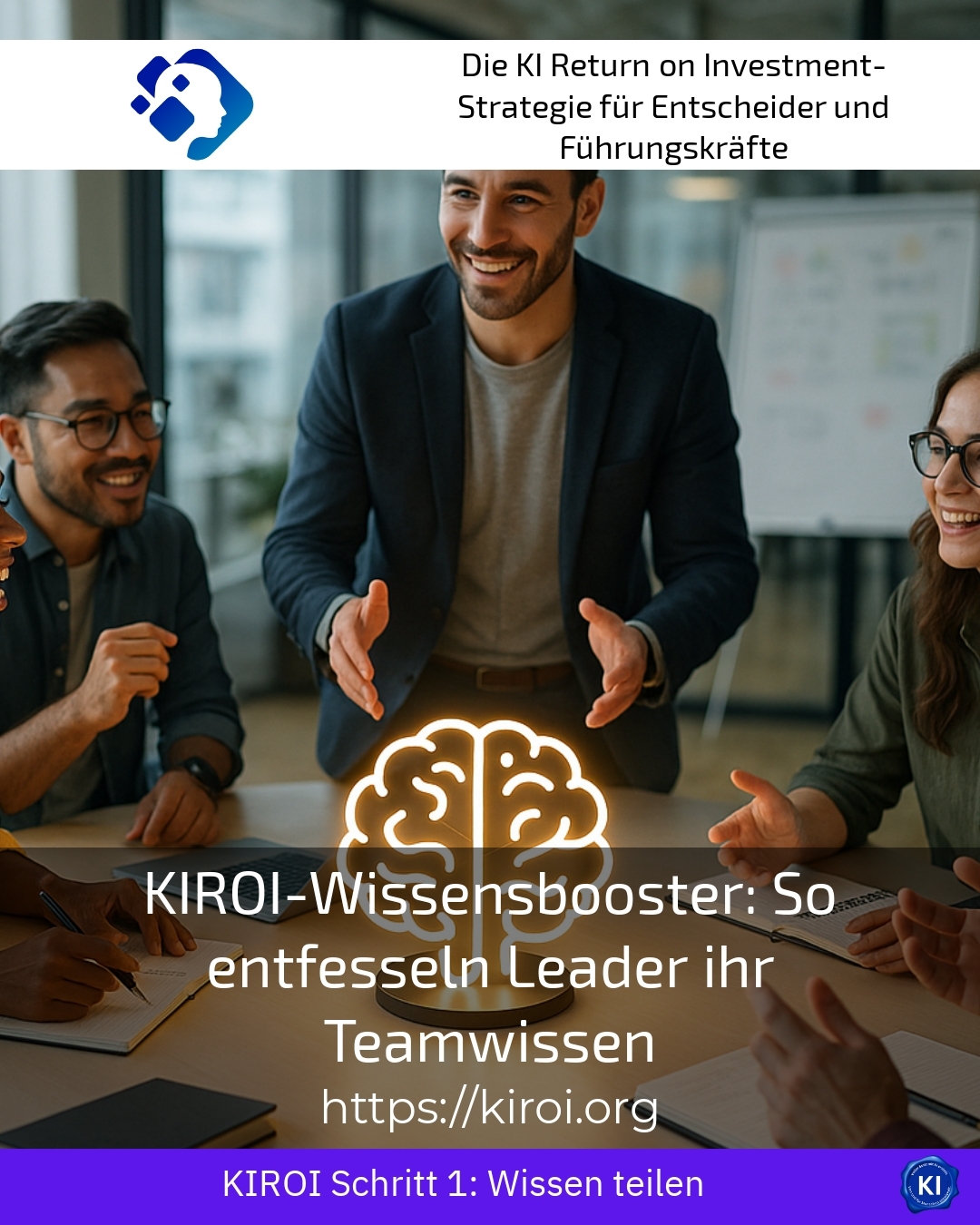
Imagine the entire knowledge of your team lies hidden like an unmined treasure, and you finally possess the key to systematically unlock these hidden resources. The AIROI Knowledge Booster offers precisely this approach, as it enables leaders to activate the collective potential of their employees in a structured and sustainable way. At a time when knowledge has become the most valuable currency, the ability to share and network this knowledge determines the success of entire organisations. Many leaders come to us with the challenge that their team indeed possesses enormous expertise, but this slumbers isolated in individual heads and never unfolds its full potential.
The challenge: bridging knowledge silos and creating synergies
In almost every organisation there are so-called knowledge islands that operate in isolation from one another and thereby leave valuable synergies unused. This fragmentation is frequently caused by departmental boundaries, hierarchical structures or simply by a lack of communication channels. The AIROI Knowledge Booster begins precisely at this point and supports leaders in systematically breaking down these barriers. For example, many clients report that their sales staff possess deep market knowledge that nevertheless never reaches product development. Similarly, service teams have direct customer feedback that is urgently needed in the strategy department. This discrepancy between existing and utilised knowledge costs companies not only innovation potential, but also tangible competitive advantages.
Another typical scenario is the lack of documentation of experiential knowledge that long-standing employees have accumulated over the years. When these experts leave the company, irreplaceable knowledge is often lost. In addition, many managers struggle with the challenge that younger team members have up-to-date specialist knowledge, but this is not combined with the practical experience of older colleagues. This generation gap in knowledge transfer represents one of the most pressing challenges of modern leadership and requires targeted initiatives to bridge it.
Best practice with a AIROI customer
A medium-sized engineering company faced the challenge that three of its most experienced engineers were due to retire within the next two years. These experts possessed decades of experience in fault diagnosis for complex machinery, and this knowledge existed exclusively in their heads. As part of the transruption coaching, we supported the management team in setting up a structured knowledge-transfer programme. The experienced engineers were paired with younger colleagues in tandems, with regular documentation sessions gradually making the implicit knowledge explicit. In addition, video documentations of typical problem-solving processes were created to serve as training material for future employees. Clients frequently report after such processes that they have not only secured their knowledge, but also established a new culture of knowledge sharing. The younger employees felt valued because their fresh perspectives were also incorporated into the documentation.
The AIROI Knowledge Booster as a catalyst for collective intelligence
Unleashing team knowledge requires more than just good intentions and sporadic meetings. Rather, leaders need a systematic approach that triggers both structural and cultural changes. The AIROI Knowledge Booster provides a proven framework for this that can be tailored to the individual needs of each team. A central element of this is the creation of psychological safety, because people are only willing to share their knowledge in an atmosphere of trust. For example, experience from consulting practice shows that employees often withhold knowledge because they are afraid of making themselves vulnerable or losing their expert status. Breaking this dynamic requires targeted leadership coaching and a deliberate redesign of the team culture.
Another important aspect concerns the establishment of suitable formats for knowledge exchange that enable both synchronous and asynchronous communication. While traditional meetings remain indispensable for direct exchange, digital knowledge bases and collaborative platforms are gaining increasing importance. The art lies in finding the right balance between personal interaction and technology-supported documentation. Furthermore, it has been shown that regular retrospectives and lessons-learned sessions are particularly effective in making project experiences usable for future ventures. These structured reflection processes transform individual experiences into collective organisational knowledge.
Practical tools and methods in the AIROI knowledge booster
The implementation of effective knowledge management requires concrete tools and methods that have proven successful in everyday work. A particularly effective method is so-called knowledge mapping, in which the existing knowledge within the team is systematically recorded and visualised. This knowledge map shows not only who possesses which expert knowledge, but also where critical knowledge gaps exist. Another proven instrument is so-called expert debriefings, in which employees pass on their experiential knowledge in a structured way after completed projects. These debriefings follow a standardised process that ensures both successes and failures are documented.
In addition, the establishment of communities of practice has proved extremely effective in connecting knowledge across departmental boundaries. In these voluntary interest groups, employees with similar areas of expertise regularly exchange ideas and learn from each other. For example, a community of practice on the subject of project management could bring together representatives from various departments who share their best practices and challenges. This horizontal networking complements the vertical communication channels and creates new channels for the flow of knowledge [1].
Best practice with a AIROI customer
A financial service provider with multiple locations struggled with the issue that identical challenges were repeatedly solved afresh at different locations, even though proven approaches already existed. As part of our support, we implemented a cross-site knowledge network based on regular virtual exchange formats. Monthly themed cafés provided a space for informal knowledge sharing, whilst quarterly best-practice conferences ensured structured documentation. The introduction of so-called knowledge sponsorships proved particularly effective, whereby experienced employees from one location acted as contact persons for colleagues at other locations regarding specific topics. After six months, the managers reported a significantly improved collaboration and a noticeable reduction in duplication of effort. In addition, employee satisfaction increased because the feeling of isolation at smaller locations decreased.
The role of the leader as a knowledge architect
In the context of knowledge management, managers play a crucial dual role, as they act as both role models and enablers of knowledge sharing. As role models, they demonstrate through their own behaviour that sharing knowledge is encouraged and valued. This means, for example, that they regularly provide insight into their decision-making processes and discuss their own mistakes as learning opportunities. As enablers, they create the structural framework that makes effective knowledge exchange possible in the first place. This includes allocating time budgets, establishing suitable communication channels, and recognising knowledge sharing as a valuable achievement.
A common topic leaders come to us with concerns how they can share their own expertise without undermining their authority in the process. However, this concern is based on an outdated understanding of leadership that views an advantage in knowledge as the primary source of power. Modern leadership, on the other hand, derives its authority from the ability to enable and develop others. Leaders who generously share their knowledge thereby gain respect and influence because they allow their team members to grow [2].
Overcoming obstacles and transforming resistance
The implementation of a knowledge culture frequently encounters resistance, which can be of both a rational and emotional nature. Some employees fear becoming replaceable by sharing their knowledge. Others experience documentation requirements as an additional burden in an already strained working day. Still others have had negative experiences in the past when their shared knowledge was adopted without recognition. Understanding this resistance and addressing it respectfully is an essential component of transruption coaching. We support leaders in taking the individual concerns of their team members seriously and developing tailor-made solutions.
An effective approach to overcoming these barriers involves the gradual introduction of knowledge-sharing practices, starting with small and manageable formats. Rather than immediately building a comprehensive knowledge base, one could, for example, begin with a weekly five-minute session in which team members share a useful tip from their current work. Such low-threshold formats enable positive experiences and build trust. As routine increases, more complex sharing formats can then be introduced [3].
Best practice with a AIROI customer
A software development technology company experienced massive resistance to the introduction of a central knowledge base because previous initiatives of this kind had failed and led to frustration. As part of our support, we initially conducted detailed discussions with the employees concerned in order to understand their concerns and experiences. It became apparent that the previous systems were too complicated and the documentation requirements disrupted the workflow. Based on these insights, we worked with the team to develop a leaner system that integrated seamlessly into existing work processes. The introduction of a recognition system that made it visible who had contributed valuable knowledge was particularly important. The employees reported that, for the first time, they felt valued for their contribution to the collective knowledge. Within a year, the knowledge base grew into an indispensable resource that was actively used and maintained.
Securing sustainability through continuous maintenance
Building a culture of knowledge is not a one-off project, but an ongoing process that requires continuous attention and maintenance. Many organisations make the mistake of scaling back activities after a successful implementation, which causes the established structures to slowly erode. To prevent this, we recommend appointing knowledge managers who actively promote sharing and ensure the quality of documented content. This role can be rotated to distribute engagement broadly across the team.
Furthermore, it is important to regularly measure the success of the knowledge initiative and make it visible. This can be achieved through qualitative feedback discussions as well as quantitative metrics, such as the number of contributions to the knowledge base or the frequency of use of exchange formats. The insights gained should be communicated transparently to emphasise the value of our shared commitment. Managers can also share success stories that demonstrate how shared knowledge has solved specific problems or enabled innovations [4].
My AIROI Analysis
The systematic unleashing of team knowledge represents one of the most powerful levers leaders have today to make their organisations fit for the future. The AIROI Knowledge Booster provides a proven framework for this that combines theoretical foundation with practical applicability. From my experience in coaching numerous managers, it repeatedly becomes clear that success depends less on technical solutions than on the willingness to initiate and sustain cultural changes. The biggest breakthroughs are experienced by teams whose managers themselves act as role models for knowledge sharing and treat psychological safety as a top priority.
At the same time, I would like to emphasise that there is no one-size-fits-all solution that works equally well for all organisations. The specific industry, team composition, existing culture and available resources largely determine which approaches are most suitable. This is why we clearly position transruptions coaching as individual guidance for projects relating to the development of a knowledge culture. We provide inspiration, ask questions and support implementation, but the managers develop the concrete solutions themselves together with their teams. This personal responsibility is crucial for the sustainability of the change, because only what has been developed together will be supported and maintained in the long term.
Further links from the text above:
[1] Knowledge Management Magazine: Successfully establishing Communities of Practice
[2] Harvard Business Review: Insights on Leadership
[3] Society for Knowledge Management: Practical Guidelines and Resources
[4] ManagerSeminare: Current trends in knowledge management
For more information and if you have any questions, please contact Contact us or read more blog posts on the topic Artificial intelligence here.










 Deutsch
  English (UK)