
Why do so many digital transformation projects fail, even though the technology has long been mature and all prerequisites for success seem to be in place? This question preoccupies leaders in numerous organisations who have to witness carefully planned initiatives shatter against the resistance of their own workforce and even the most promising innovations peter out in practical implementation. The core of the problem often lies not in the technology itself, but in a fundamental deficit of acceptance that arises when people Accept AI should have, in whose development and design they were never involved and whose introduction was decided upon without their knowledge. The AIROI-Masterplan model offers a pioneering approach here that targets precisely this sensitive point and systematically turns those affected into active co-creators of their digital future, rather than simply presenting them with a fait accompli and hoping for passive acceptance.
The traditional approach: When decisions are made without involvement
In the vast majority of organisations, the introduction of new technological systems follows a classic top-down pattern that has been practised for decades, yet whose weaknesses are persistently overlooked. Management makes strategic decisions based on market analysis, competitive pressure and business metrics. External consultants are then hired, systems purchased and implementation plans drawn up. Employees only learn about the changes once the fundamental course has already been set. They receive training designed to teach them how to operate the new tools. In the process, one crucial dimension is completely ignored.
For example, a manufacturing company in the precision engineering sector implemented an automated quality assurance system. The management team had spent months negotiating with suppliers and had selected an impressive solution. The quality inspectors on the production lines only learned about the system three weeks before its rollout. They were sent on two-day training courses and were expected to work productively with the new system straight afterwards. The result was sobering because the experienced specialists perceived the system as a threat to their expertise. They found creative ways to bypass the automation or to question its results.
A logistics company introduced intelligent route optimisation for its vehicle fleet and experienced similar resistance. The dispatchers, who brought decades of experience in efficient route planning, felt bypassed and devalued. They began to systematically ignore the system's suggestions or manually correct them afterwards. The hoped-for efficiency gains failed to materialise because the human component had not been involved. A third example can be found in a financial services provider that introduced automated risk assessment without including the experienced analysts in the development process. They responded with silent sabotage and meticulously documented every misjudgement by the system.
Why people Accept AI must and not merely tolerate
The difference between acceptance and mere tolerance is fundamental to the sustainable success of any digital transformation and is nevertheless systematically underestimated in many organisations. Tolerance merely means that people endure something because they have no other choice and fear the consequences of open refusal. Acceptance, on the other hand, implies inner agreement, an understanding of the purpose and benefit of a change, and the willingness to actively contribute to its success. If employees only tolerate new systems, they will find workarounds and meet minimum requirements. However, they will never exploit the full potential of the technology or discover creative possible applications.
An intelligent scheduling system was introduced in a hospital to help optimise waiting times. The nursing staff initially tolerated the system reluctantly and quickly found its weaknesses. They documented every malfunction and every impractical requirement with a thoroughness they would never have mustered when improving the system. A retail company implemented automated inventory management and experienced store managers tolerating the system while simultaneously keeping manual lists. They trusted their experience more than the algorithm. An energy supplier introduced predictive maintenance for its network, but the technicians ignored many of the system's maintenance recommendations because they felt their technical expertise was being called into question.
The psychological dimension of technology acceptance
People need a sense of control and self-efficacy in order to perceive change not as a threat, but as an opportunity, and to overcome their natural defence mechanisms against the new. When decisions are made over their heads, it creates a feeling of powerlessness that can have profound psychological effects. This feeling triggers resistance mechanisms that are deeply rooted in evolution and originally served to protect against unknown dangers. The amygdala, our fear centre, responds to perceived losses of control with stress reactions. These reactions manifest themselves in behaviours that can directly counteract the organisational goal.
Following the introduction of automated claims processing, an insurance company noticed a significant rise in sick leave within the affected department. The employees felt devalued and responded with psychosomatic symptoms. A telecommunications provider implemented intelligent customer service and found that experienced service agents increasingly handed in their notice. They saw no future in a company that appeared to replace their expertise with algorithms. A mechanical engineering company introduced predictive quality control and witnessed a measurable drop in the workforce's willingness to innovate, because employees felt their ideas were not being listened to anyway.
The AIROI approach: Humans as trainers of their digital colleagues
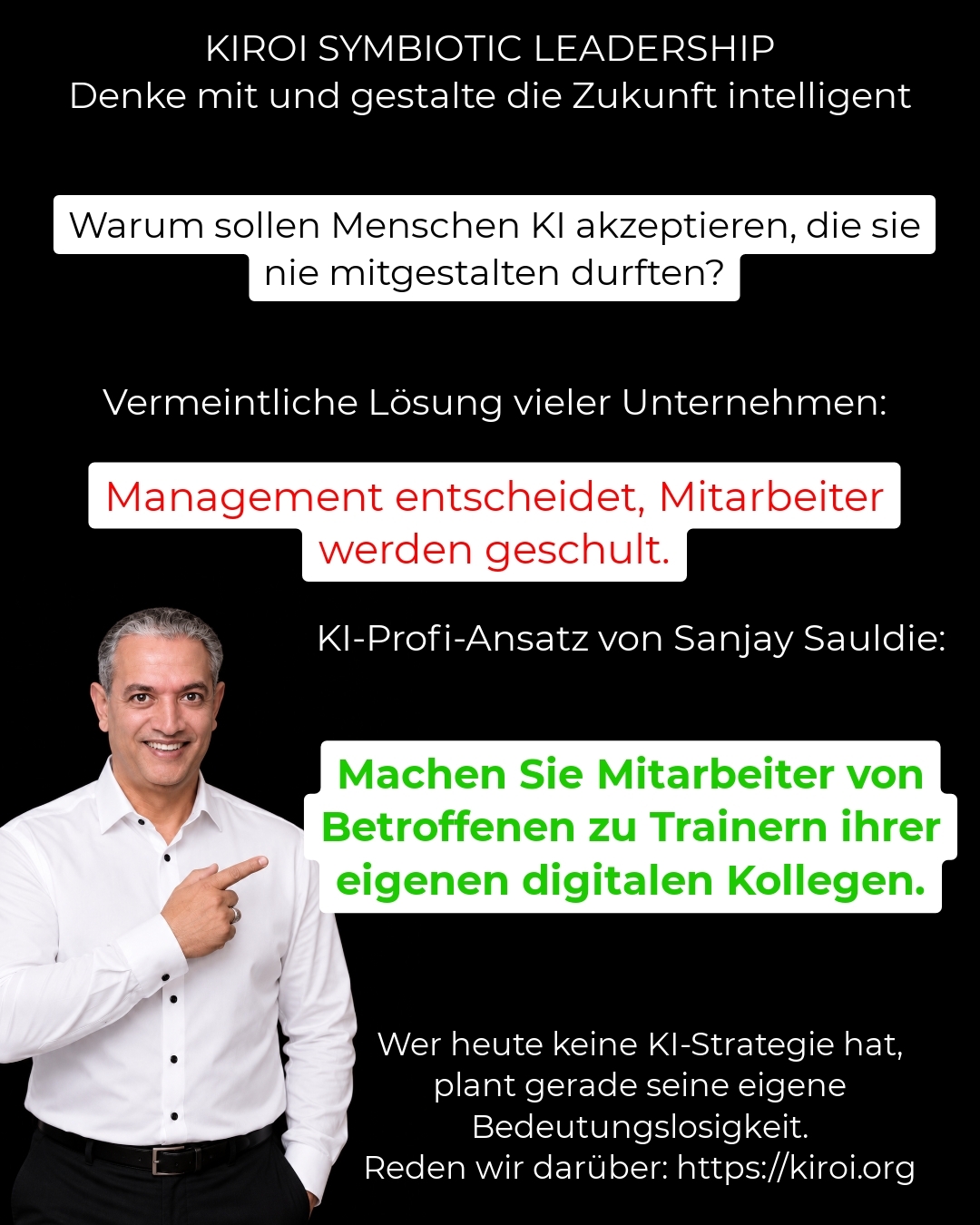
The AIROI master plan model takes a radically different approach that turns the basic assumptions of the traditional implementation paradigm on their head, viewing people not as recipients of technology, but as its active creators. Instead of merely training employees to operate finished systems, they are involved in the development and adaptation process from the very beginning. They are not trained to understand a foreign system, but rather they train this system to understand their working reality. This shift in perspective is fundamental and has far-reaching consequences for the acceptance and long-term success of digital transformation projects.
In practical terms, this means that subject-matter experts from all relevant areas are actively involved in defining requirements, validating results and continuous improvement. A pharmaceutical company that adopted this approach involved laboratory technicians in the development of automated analysis procedures right from the start. The laboratory technicians defined quality criteria, identified special cases and trained the system with their expert knowledge. The result was a system that not only functioned technically, but also enjoyed the trust of the professionals. A construction company integrated site managers into the development of project planning tools and benefited from their practical experience in defining relevant parameters.
Best practice with a AIROI customer
A medium-sized company in the industrial manufacturing sector faced the challenge of introducing a smart production control system designed to increase the efficiency of its production lines by at least fifteen per cent, whilst making the best possible use of the machine operators’ existing expertise. As part of the AIROI support programme, a completely new approach was adopted, in which the most experienced machine operators were to act not only as users but also as trainers for the system, systematically incorporating their decades of practical experience into it. Together with the development team, these skilled workers defined which parameters are crucial for optimal production runs and which exceptional situations require special attention. They identified noises, vibrations and visual indicators that point to quality issues, and helped to interpret the corresponding sensor data. The result exceeded all expectations, as the system not only achieved the targeted increase in efficiency but was also perceived by staff as a valuable aid to their own work. Machine operators frequently reported that they were proud to have contributed their knowledge to the system and that they viewed the system as an extension of their own capabilities, not as a replacement for them. Staff turnover in the department fell by forty per cent, and the willingness to put forward suggestions for improvement increased measurably. This success impressively illustrates how important it is that people Accept AI can, because they were actively involved in its design and can consider themselves co-authors of the digital transformation.
The nine dimensions of the AIROI model in practice
The AIROI master plan model structures digital transformation across nine dimensions that must be systematically addressed to achieve sustainable success and avoid the typical pitfalls of traditional implementation approaches. Each of these dimensions addresses specific aspects of the change process, ensuring that technical, organisational and human factors are taken into account equally. The dimensions range from strategic alignment and operational implementation to the cultural embedding of new ways of working, together forming a coherent framework for successful transformation.
A healthcare provider used the AIROI model to introduce a system supporting medical diagnostics while ensuring the acceptance of medical staff from the outset. The doctors were involved not just as users, but as medical experts whose knowledge is what makes the system valuable in the first place. A mobility provider implemented intelligent fleet management solutions using the AIROI approach and actively involved drivers, dispatchers and workshop staff in the system design. A retail company introduced personalised customer communication and had experienced sales advisors define which recommendations are helpful in which situations and what limits the system must respect.
The paradigm shift: From training object to active creator
The fundamental difference between traditional approaches and the AIROI model lies in the role assigned to people in the transformation process and which they can actively fulfil themselves if given the opportunity. In the traditional model, employees are passive recipients of technology developed by others, the functioning of which they must learn. In the AIROI model, they are active designers whose expertise is indispensable for developing systems that work in practice. This shift in perspective has profound implications for motivation, engagement and ultimately the success of the entire transformation.
A media company that introduced editorial support systems experienced this difference very clearly in a direct comparison between two departments. One department received the system according to the traditional model with training and manuals. The other department was involved using the AIROI approach and was able to help shape the system. After six months, only thirty per cent of employees in the first department were using the system regularly. In the second department, it was over eighty per cent, and suggestions for improvement came from the team continuously. A financial services provider observed similar differences when introducing automated advisory support in various branches. The branches whose advisors were involved in the system design achieved significantly better results.
Practical implementation steps for managers
For managers wishing to implement the AIROI approach in their organisation, there are concrete steps that pave the way from traditional to participatory implementation models while maintaining the balance between efficiency and participation [2]. The first step is to identify subject matter experts early whose knowledge is crucial to the success of the system. These experts should be selected not by hierarchy, but by practical experience and reputation among the workforce. They must be relieved of operational duties so that they can fulfil their role as trainers of their digital colleagues.
A chemical company took this path and discovered that the process engineers, who usually worked in the background, brought the most valuable knowledge for system design. A transport company realised that experienced dispatchers who were close to retirement possessed a wealth of knowledge that urgently needed to be incorporated into the new system. A utility company involved field service technicians whose practical experience with power outages and their resolution was documented nowhere. These examples show how valuable hidden expert knowledge can be when it is systematically tapped and people Accept AI learn, because they are their co-creators.
My AIROI Analysis
An analysis of numerous transformation projects across various sectors reveals a clear pattern that is of considerable significance for the strategic planning of digital initiatives and calls into question the basic assumptions of many senior managers. Organisations that merely train their staff to use new systems typically realise only a fraction of the potential benefits, whilst organisations that adopt the AIROI approach regularly achieve results that exceed their original targets, whilst at the same time increasing staff satisfaction.
The root cause of this difference does not lie in technical factors, but in the psychological dynamics of experiencing control and self-efficacy, which fundamentally shape every change process and the neglect of which can cause even technically brilliant solutions to fail. People who experience themselves as shapers of their work environment develop intrinsic motivation to get the best out of new tools and discover creative possible applications. People who experience themselves as victims of others' decisions will at best do the minimum and, in the worst case, put up active or passive resistance that jeopardises the entire transformation process.
For managers, this results in a clear recommendation for action: invest at least as much attention and resources into the involvement of your employees as into the technical implementation itself, because without genuine acceptance, even the best technical solutions will never be able to unfold their full potential. The AIROI-Masterplan-Modell offers a structured framework for this that is theoretically sound and tried and tested in practice. It supports organisations in taking the path from traditional to participatory approaches to transformation while turning frequently reported resistance into constructive contributions. Transruption coaching accompanies managers through this process and provides impetus for practical implementation in their specific context.
Further links from the text above:
[1] AIROI Masterplan Model – Strategic framework for human-centred digital transformation
[2] Transruption coaching for executives in digital transformation projects
Are you a leader and would you like to learn how you can genuinely introduce AI into your company in a valuable and sustainable way, away from the hype? Take part Contact us or read more blog posts on the topic Artificial intelligence here.











 Deutsch
  English (UK)