
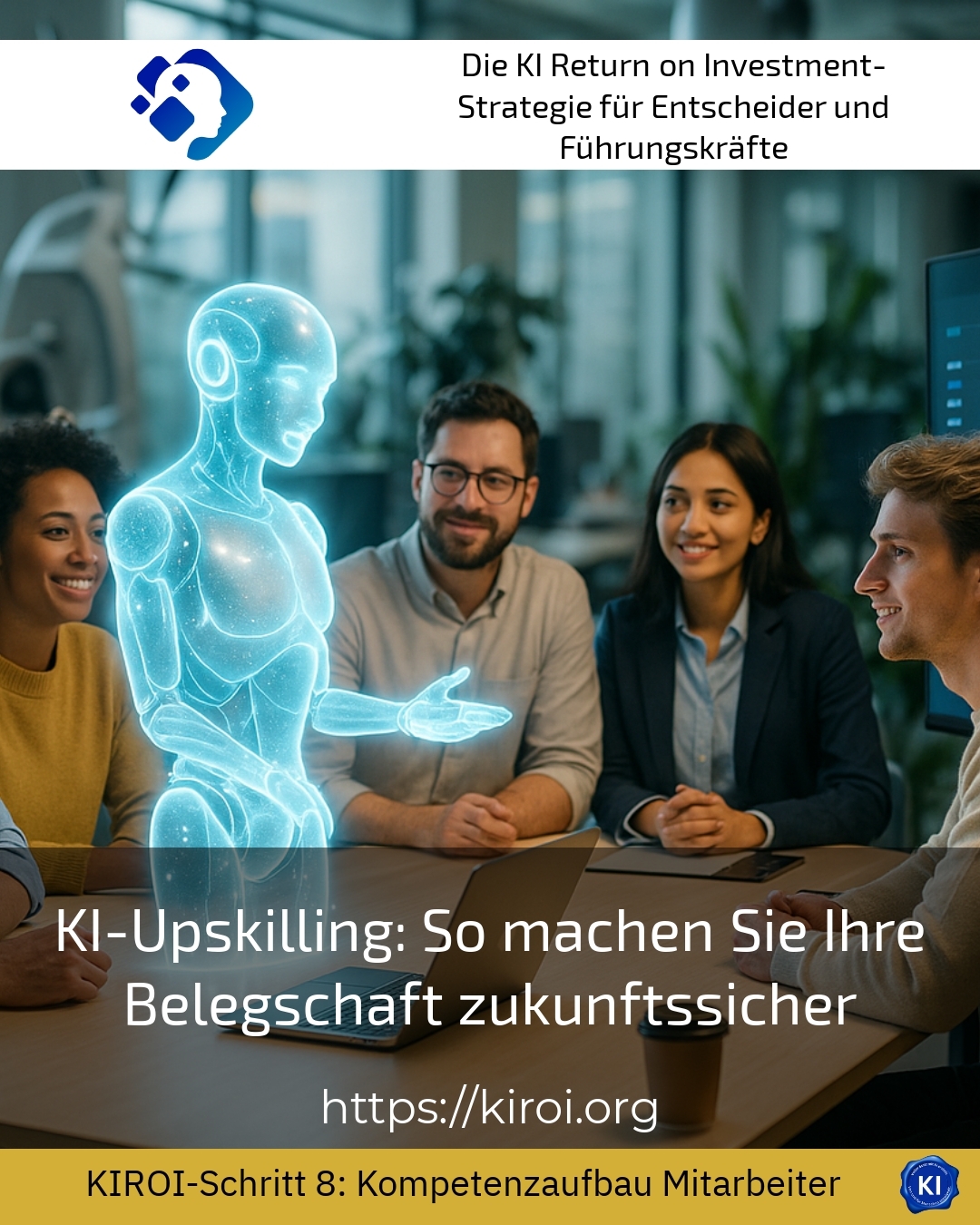
Digital transformation is fundamentally changing workplaces and presenting companies with enormous challenges. Employees who were indispensable only yesterday now need completely new skills. AI Upskilling thereby evolves into a decisive success factor for organisations that want to remain competitive. Anyone who fails to act now risks losing touch. But how do you succeed in making an entire workforce fit for the future? Which strategies have proven themselves in practice? And why do so many further training initiatives fail right from the start? This article provides answers and points out concrete ways forward.
Why traditional further education is no longer sufficient
The world of work is undergoing fundamental change. Traditional training concepts often fall short. They impart isolated knowledge without practical relevance. Employees return from seminars not knowing how to apply what they have learned. This problem is particularly evident when new technologies are introduced. A one-off workshop is not enough to bring about lasting behavioural change. Instead, continuous support and practical application opportunities are needed.
This problem is particularly striking in the manufacturing industry. Today, production workers have to operate intelligent machine controls. They analyse data from networked sensor systems. At the same time, they are expected to understand and implement predictive maintenance concepts. For example, an automotive supplier introduced predictive quality control. Employees initially felt overwhelmed. The transformation was only successful through a phased introduction with intensive support. A mechanical engineering company relied on workplace study groups. Experienced colleagues supported others in building skills. These peer-learning approaches proved particularly effective [1].
Recognising AI upskilling as a strategic necessity
Managers frequently underestimate the scale of necessary changes. They view competence development as a cost factor rather than an investment. This perspective leads to half-hearted measures without a lasting impact. AI Upskilling must therefore be understood as a strategic priority. It is not just about technical knowledge. Critical thinking and adaptability are at least as important. Employees must learn to work alongside intelligent systems. They need to understand where automation makes sense and where human judgement remains necessary.
The retail sector provides clear examples of this development. Sales staff now use demand forecasting systems. They work with personalised recommendation algorithms. Warehouse staff coordinate their work with autonomous transport systems. A large drugstore chain trained its branch employees in the use of intelligent ordering systems. Acceptance rose significantly once the employees recognised the benefit for their daily work. A furniture store integrated virtual interior design consultants into the consultation process. The sales staff learned to use these tools as support. A grocery retailer introduced automated freshness checks and closely supported its teams through the transition [2].
Best practice with a AIROI customer
A medium-sized retail company with several hundred branches faced the challenge of preparing its workforce for new digital tools. The company management recognised that isolated training measures in the past had shown little effect. As part of the transruption coaching, we jointly developed a comprehensive concept to accompany the transformation process. First, we analysed the existing competencies and identified the key areas for development. Then, we established a network of internal multipliers in each branch. These individuals received intensive training and subsequently supported their colleagues on site. The close integration of learning and practical application in daily business operations was particularly important. Employees tried out new functions directly and received immediate feedback. Regular exchange formats enabled the sharing of experiences between the branches. After six months, most participants reported a significantly increased level of self-confidence in dealing with the new systems. The acceptance of the digital tools had visibly improved, and productivity showed positive developments.
Designing individual learning paths for different target groups
Not all employees have the same prerequisites and needs. A uniform training session for everyone therefore usually misses its mark. Successful competency development takes different starting levels and learning styles into account. It offers flexible formats and adapts to the individual pace. Younger employees often bring basic digital skills. Older staff possess valuable experience and process knowledge. The art lies in bringing both groups together and letting them learn from each other.
In the healthcare sector, the need for differentiated approaches is particularly evident. Doctors use intelligent diagnostic support. Nursing staff work with networked patient monitoring systems. Administrative staff implement automated billing processes. A large hospital introduced imaging analysis systems for radiology. The rollout succeeded through intensive support for specialist doctors over several months. A care home trained its staff in the use of fall sensors and intelligent alarm systems. A medical care centre automated scheduling and supported employees through coaching during the transition [3].
Fostering AI upskilling through practical learning formats
Theoretical knowledge alone is not enough for sustainable competence development. Employees must be able to try out new skills in a safe environment. Simulations and practice scenarios offer this opportunity without real risk. At the same time, rapid application in everyday working life is needed. The transfer from the learning context to practice determines success. Regular feedback and continuous reflection support this process.
The logistics industry has developed and tested innovative learning formats. Warehouse workers train on the operation of autonomous industrial trucks using virtual reality systems. Dispatchers practise collaboration with route optimisation algorithms using simulations. Drivers learn how to use assistance systems in a protected environment. A parcel delivery company set up learning workshops in its distribution centres. There, employees can try out new technologies before they are used productively. A freight forwarder introduced virtual coaching for its decentralised teams. A port logistics company closely supported its crane operators during the introduction of semi-automated systems [4].
The role of leaders in transformation
Leaders play a decisive role in whether change processes succeed or fail. They must lead by example and demonstrate a willingness to learn. At the same time, they create the framework conditions for development. These include sufficient time, appropriate resources and psychological safety. Employees must be allowed to make mistakes without fearing negative consequences. Only in this way can a genuine learning culture emerge.
In the financial sector, leaders face unique challenges. They have to balance regulatory requirements with the pressure to innovate. At the same time, customer expectations and business models are changing rapidly. A regional bank first trained its managers to understand automated credit decisions. Only then did the branch employees follow. An insurer established leadership circles for the exchange of experiences on digital transformation topics. An asset management firm supported its partners in integrating algorithmic investment recommendations [5].
Best practice with a AIROI customer
A financial services provider with several thousand employees approached us with a specific question. The company wanted to prepare its client advisors for the use of intelligent analysis tools. Previous training attempts had led to frustration and resistance. As part of transruption coaching, we developed a completely new approach. We began with intensive discussions to understand the employees' concerns and fears. Many worried about being replaced by the new systems. We took these worries seriously and addressed them openly in workshops. Together, we worked out which tasks the technology could take on and where human advisory competence remains indispensable. The employees increasingly recognised the opportunities for their work. They were able to devote more time to complex client enquiries. Routine tasks were automated, and the quality of advice improved noticeably. The transformation process lasted a total of eighteen months and was accompanied by regular reflection loops.
Understanding and constructively addressing resistance
Change almost always provokes resistance. This is not a sign of incompetence or ill intent. It signals legitimate concerns and needs of those affected. Successful transformation takes this resistance seriously. It creates spaces for dialogue and joint problem-solving. Employees must have opportunities to shape processes and be able to contribute their expertise.
In the media sector, many employees are experiencing fundamental uncertainty. Journalists are wondering what role they still play alongside automated text generation. Graphic designers see image generation tools as a threat. Editors have to learn how to deal with algorithmic recommendation systems. One publishing house held open dialogues about the future of journalistic work. The employees jointly developed new working formats and quality standards. An advertising agency established experimental spaces for creative collaboration with generative systems. A television broadcaster supported its editorial teams in integrating automated analysis and research tools [6].
Establish and maintain a sustainable learning culture
AI Upskilling is not a one-off project, but a continuous process. Technological development is advancing relentlessly. What is up to date today may already be obsolete tomorrow. Organisations therefore need a culture of lifelong learning. Employees must develop curiosity and a willingness to experiment. They need access to up-to-date information and learning resources.
The public sector faces special challenges when it comes to cultural development. Traditional structures and rigid processes make agile learning difficult. At the same time, pressure to digitalise administrative services is growing. One city administration set up an internal competence centre for digital transformation. There, employees from all areas receive support with new technologies. A federal agency introduced regular learning sprints on current developments. A state ministry established mentoring programmes between tech-savvy and experienced employees [7].
Measure success and make it visible
Competence development must be measurable to receive sustainable support. This is not just about quantitative key performance indicators. Qualitative changes in working methods and collaboration are just as important. Success stories should be shared and celebrated. They motivate others and create positive momentum. At the same time, transparent results help in the further development of the programmes.
Transformation successes are easy to trace in the energy industry. Grid operators measure efficiency gains through smart grid control. Energy suppliers document improved forecasting accuracy through learning systems. Municipal utilities record customer satisfaction with automated services. A wind farm operator trained its technicians in predictive maintenance and significantly reduced downtime. An electricity supplier supported its customer service agents with the integration of intelligent chatbots. A gas grid operator introduced automated leak detection and documented the safety improvements [8].
My AIROI Analysis
The future viability of organisations depends significantly on how well they prepare their employees for technological changes. AI Upskilling is far more than technical training. It is about a comprehensive shift in mindsets, ways of working and organisational culture. My experience from numerous accompanying projects shows: the key lies in combining strategic clarity with empathetic implementation.
Organisations that successfully transform share several commonalities. They invest early and sufficiently in the development of their people. They create psychological safety and encourage experimentation. They actively involve employees in design processes. They measure progress and continuously adapt their approaches.
At the same time, I frequently observe avoidable mistakes. Too many organisations rely on one-off training sessions without sustained support. They underestimate the emotional aspect of change. They communicate unclearly about goals and impacts. transruptions coaching addresses precisely this point and accompanies companies in avoiding these pitfalls.
The coming years will show which organisations have set the right course. Demographic change is further exacerbating the skills shortage. Those who do not develop their existing employees will hardly be able to attract new ones. That is why now is the right time to act. Technology does not wait. But with the right guidance, any organisation can successfully navigate change.
Further links from the text above:
[1] McKinsey: Upskilling your workforce for the age of AI
[2] World Economic Forum: AI skills training for the workforce
[3] Harvard: AI and workplace learning
[4] BCG: Upskilling and reskilling the workforce for AI
[5] Harvard Business Review: Reskilling in the age of AI
[6] PwC: Artificial intelligence upskilling
[7] OECD: AI and the future of skills
[8] Deloitte: AI workforce transformation
For more information and if you have any questions, please contact Contact us or read more blog posts on the topic Artificial intelligence here.










 Deutsch
  English (UK)