
Have you ever wondered why your employees simply won't adopt new technologies despite extensive training and clear guidelines?
This question is currently occupying countless managers in companies of all sizes, because the introduction of intelligent systems often fails not because of the technology itself, but due to a fundamental lack of AI trust within the workforce [1]. The challenge lies in the fact that acceptance cannot be mandated, even though many organisations pursue this exact approach and regularly run up against invisible barriers in the process. Companies invest considerable sums in implementation projects, yet the expected efficiency gains fail to materialise because people resist changes that they do not understand or trust.
The traditional approach: guidelines and training as the supposed solution
Average companies typically respond to the challenge of a lack of buy-in with a tried-and-tested pattern that at first glance seems entirely sensible: they develop extensive policy documents, organise mandatory training sessions and hope that information automatically leads to acceptance. In the manufacturing industry, for example, production staff are invited to multi-hour workshops in which they are supposed to learn the theoretical foundations of automated quality control systems. Logistics companies distribute detailed manuals on the functioning of predictive maintenance systems to their technicians. Retailers train their purchasing departments in the use of demand forecasting tools, with the primary focus being on technical operation.
This approach is based on the assumption that knowledge inevitably generates trust, but practice paints a sobering picture. In hospitals, experienced diagnosticians contradict the recommendations of intelligent analysis systems, even though they learned how they work during training. Financial advisers bypass automated risk assessments by resorting to manual methods. Law firms only use document analysis tools superficially because lawyers do not trust machine judgement [2]. While training imparts technical knowledge, it fails to address the emotional and psychological barriers that prevent people from actually embracing new tools.
Another example can be found in the banking sector, where customer advisors regularly ignore the recommendations of investment advisory systems despite intensive training. They argue that they know their clients better than any machine, and this conviction cannot be shaken by PowerPoint presentations. The situation is similar in the HR industry, where recruiters perceive automated pre-selections as a restriction on their professional judgment. Insurance companies report claims handlers who systematically review and correct automatically generated damage assessments simply because they do not trust the system.
Why the policy approach to AI trust is failing
The fundamental problem of the traditional approach lies in a misunderstanding of the nature of human trust, which cannot be forced through instructions. Trust is an emotional phenomenon that is nourished by repeated positive experiences, not from theoretical knowledge. In the aviation industry, this becomes particularly clear when pilots only fully trust autopilot systems after hundreds of flight hours, even though they understand how they work from the very beginning. Surgeons only fully accept robot-assisted surgical systems once they have personally experienced that these systems function reliably in critical moments [3].
Furthermore, prescribed guidelines frequently generate resistance instead of acceptance because people feel patronised. Production managers in the automotive industry report passive resistance when quality inspectors are forced to accept machine assessments. Marketing departments in consumer goods companies develop creative strategies to bypass automated campaign optimisations. Sales teams in the software industry manipulate input data to adapt the results of lead-scoring systems to their own assessments.
The AIROI philosophy: Building AI trust through positive experiences
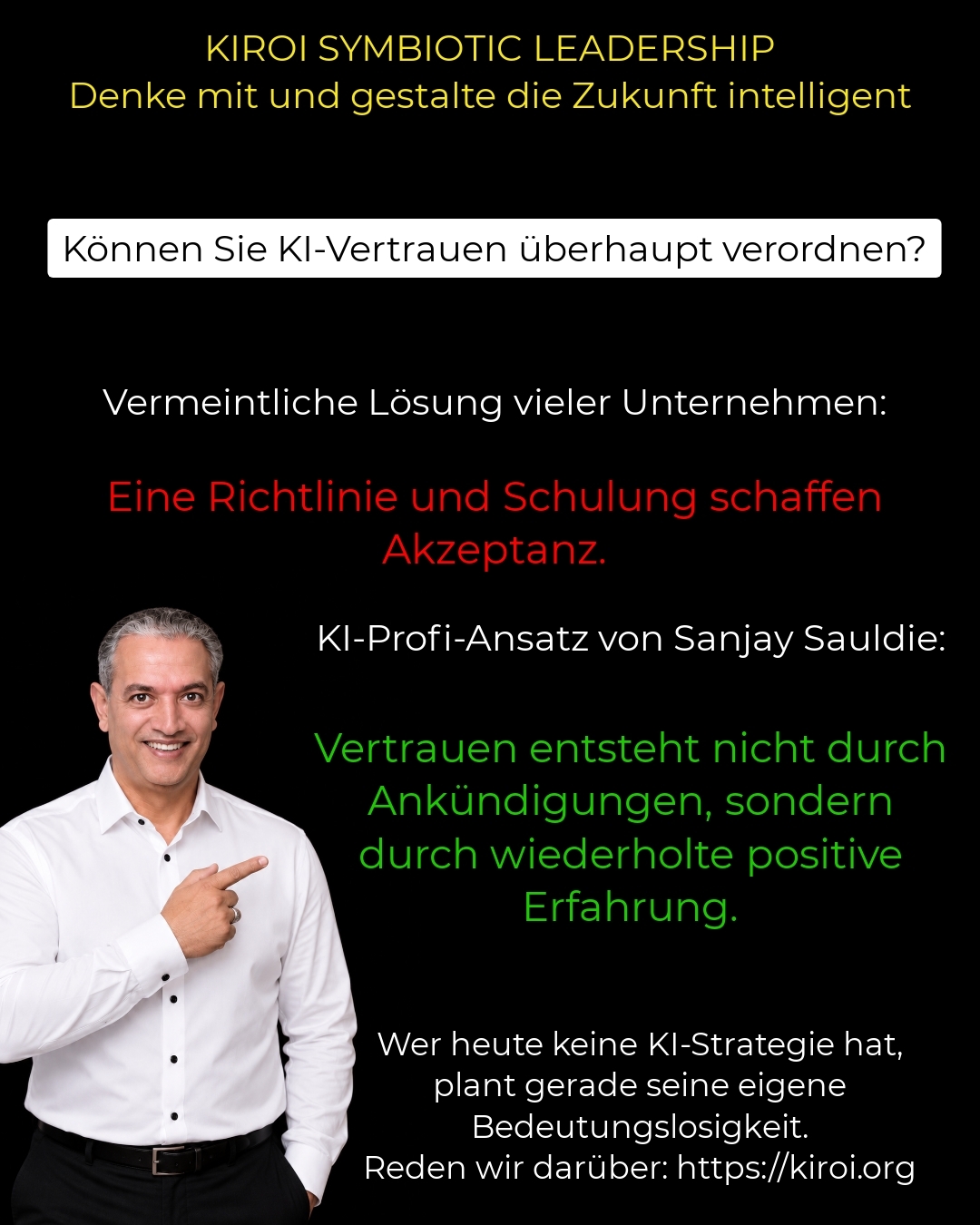
The AIROI approach differs fundamentally from traditional methods because it respects the psychological foundations of human trust and places them at the centre of the implementation strategy. Trust is not built through announcements, but through repeated positive experience – this insight forms the foundation of a successful transformation. Instead of showering employees with information and demanding compliance, this approach guides people through a step-by-step process in which they experience for themselves how intelligent systems can support and improve their work.
In the pharmaceutical industry, for example, this means that researchers initially start with low-threshold applications that bring them visible benefits, such as in literature research or the analysis of test series [4]. In the energy sector, grid operators start with predictive maintenance advice for non-critical components before relying on recommendations for system-relevant infrastructure. Agricultural businesses first experiment with harvest time forecasts for minor crops before planning main harvests on the basis of intelligent predictions.
Best practice with a AIROI customer
A medium-sized enterprise in the industrial manufacturing sector was faced with the challenge of introducing an intelligent production planning system after two previous attempts had failed due to resistance from the workforce. The shift supervisors had decades of experience and regarded any form of machine-generated recommendation as an attack on their expertise. The transruptions coaching accompanied the company over a period of nine months and implemented a radically different approach from the previous attempts. Instead of rolling out the system company-wide and mandating usage, we first identified three particularly open-minded shift supervisors who acted as pilot users and were able to test the system in a protected environment. Rather than mandatory training, they received individual support where they could ask their own questions and openly articulate their scepticism. After six weeks, they reported initial positive experiences, such as in the optimisation of setup times, and these accounts spread organically within the company. The colleagues of the pilot users became curious and asked for access to the system of their own accord, whereby acceptance grew without pressure. After nine months, 87 per cent of the shift supervisors were using the system regularly and voluntarily, a result that could never have been achieved through directives.
Practical strategies for sustainable AI trust
The implementation of the experience-based approach requires a fundamental realignment of the deployment strategy, which demands patience and tact. In healthcare, successful projects begin with administrative applications, such as automated scheduling, before moving on to clinical decision support systems [5]. Architecture firms first introduce generative design tools for conceptual sketches, not final drafts. Media companies initially use content recommendation systems only for inspiration, not for final curation.
A central element is the creation of safe spaces for experimentation in which errors do not have serious consequences. Investment firms have analysts work with paper-money portfolios to test automated trade recommendations. Advertising agencies first test AI-generated campaign concepts in internal competitions before they are presented to clients. Engineering consultancies use simulation environments in which designers can evaluate machine-driven optimisation proposals without time pressure.
Equally important is transparency regarding the limits and errors of intelligent systems, because inflated expectations inevitably lead to disappointment. In the telecommunications industry, successful teams communicate openly that customer churn forecasts have a hit rate of around 75 percent, no more and no less. Transport companies explain to their dispatchers under which conditions route optimizations are less reliable. Consulting firms document cases where automated market analyses have overlooked essential factors in order to foster realistic expectations.
The role of leaders in the trust-building process
Leaders bear a special responsibility in building organisational trust, because their behaviour sends strong signals to the entire workforce. When board members in the chemical industry publicly admit that they themselves were initially sceptical about predictive analytics systems, this normalises doubt as a legitimate reaction. Department heads in the fashion industry who share their own learning curves with trend forecasting tools create psychological safety for their teams. Managing directors of medium-sized mechanical engineering companies who personally take part in pilot projects demonstrate serious commitment.
At the same time, leaders must create and maintain spaces for critical discussions. In the food industry, forward-thinking companies organise regular feedback sessions where quality managers can voice their concerns regarding automated control systems. Publishing houses are establishing forums where editors can discuss their experiences with manuscript analysis systems. Automotive suppliers are setting up ombudsman offices that employees can turn to if they feel they have been treated unfairly by algorithmic decisions.
Long-term support rather than one-off implementation
The AIROI model does not view the introduction of intelligent systems as a project with a defined end, but rather as a continuous accompaniment process that can span years. In the construction industry, it is evident that trust in planning optimisation systems becomes more stable after about 18 months, provided consistent positive experiences have been gathered up to that point. Tax advisory firms report that their employees only fully trust automated review tools after two to three tax seasons. Logistics service providers observe that warehouse workers follow picking recommendations without thinking only after thousands of successful picks.
These time horizons stand in stark contrast to typical project plans, which expect complete acceptance after just a few weeks. The transruptions coaching approach takes this reality into account and provides impulses for the long-term accompaniment of organisational change processes. The point here is not to overcome scepticism, but to acknowledge it as a natural and healthy reaction that gradually transforms into trust through positive experiences.
My AIROI Analysis
After my intensive examination of this subject area, I come to the conclusion that the question of the prescription of AI trust fundamentally flawed because it is based on a mechanistic view of humanity that does not do justice to the complex reality of organisational change processes. Companies that try to force acceptance through policies and training treat their employees like programmable systems that only need the right inputs to produce the desired outputs, yet people function fundamentally differently from how machines do.
The AIROI philosophy offers a humanistic alternative that takes the emotional and psychological dimensions of building trust seriously and places them at the heart of the strategy. Trust is built through repeated positive experiences, not through announcements or instructions, and this insight must form the foundation of any implementation strategy. Leaders who internalise this approach understand that they cannot demand compliance, but must create conditions in which people can gather positive experiences and develop their own trust.
Often, clients in transruptions coaching report that it was only the acknowledgment of the emotional dimension of their employees that brought about a breakthrough. The technical implementation is usually the easier part; the true challenge lies in guiding human change processes, which require patience, empathy and strategic finesse. Organisations that embark on this path are investing not just in technology, but in the future viability of their entire corporate culture, and precisely therein lies the sustainable competitive advantage that no rival can copy.
Further links from the text above:
[1] McKinsey: The State of AI
[2] Harvard Business Review: Artificial Intelligence
[3] Forbes Tech Council: Building AI Trust
[4] MIT Research: Artificial Intelligence
[5] Gartner: Artificial Intelligence Insights
Are you a leader and would you like to learn how you can genuinely introduce AI into your company in a valuable and sustainable way, away from the hype? Take part Contact us or read more blog posts on the topic Artificial intelligence here.







 Deutsch
 English (UK)