
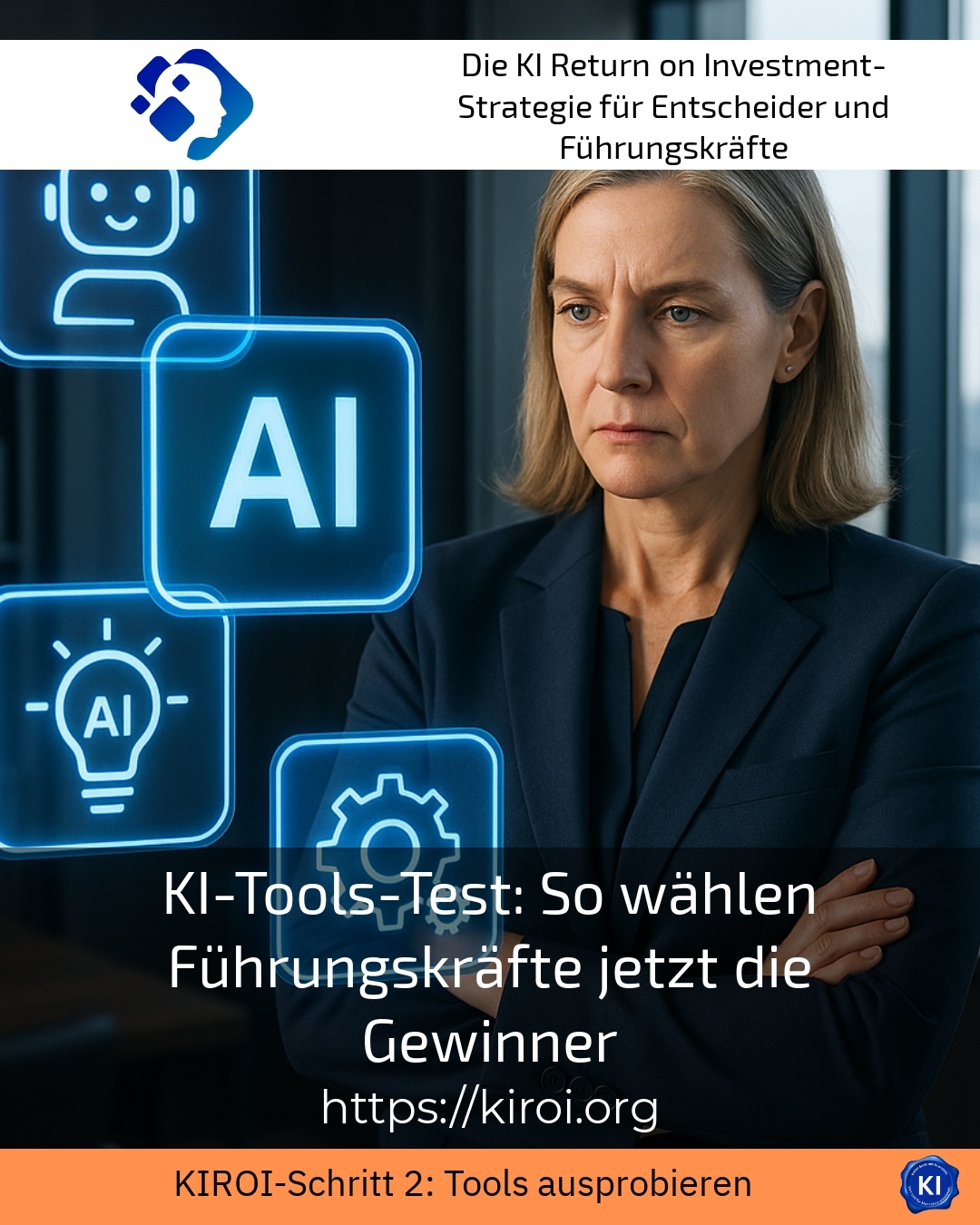
In a world where technological innovations are increasingly permeating everyday business, decision-makers face a formidable challenge that they can no longer put on the back burner. The AI Tools Test thereby develops into the crucial compass that helps leaders to filter out the true winners from the flood of available solutions. But how do you navigate this jungle of possibilities without wasting valuable resources or falling for empty promises? Clients frequently report a paralysing sense of overwhelm in the face of the sheer volume of options. The following lines offer you profound insights and field-tested strategies that will permanently transform your decision-making.
The basics of systematic AI tool testing in a corporate context
Before leaders plunge into operational evaluation, they must first establish a solid foundation. This foundation consists of clearly defined requirements, measurable goals and a structured evaluation framework. Many companies make the mistake of selecting technology solutions based on superficial criteria. They allow themselves to be blinded by marketing promises. Instead, a methodical approach is recommended.
A medium-sized manufacturing company recently faced the challenge of optimising its quality control. The management evaluated various image-based analysis systems over a period of three months. It became apparent that the cheapest solution would have been the most expensive in the long run. A logistics service provider from southern Germany implemented route optimisation after a comprehensive review. The results significantly exceeded the initial expectations. A retail company also benefited from a structured selection process when introducing inventory management systems.
Decision criteria for the successful AI tools test
The selection of suitable criteria forms the heart of every well-founded evaluation process. In doing so, managers should consider both quantitative and qualitative factors. Among the most important aspects are integration capability, scalability and user-friendliness. However, the provider's long-term development roadmap also plays an essential role. Data quality and security aspects must under no circumstances be neglected.
A financial services provider from Frankfurt recently evaluated several document processing solutions. The compliance requirements proved to be a particularly critical factor. An insurance company evaluated chatbot systems for customer service using a points system. The weighting of the criteria was agreed upon in advance with all stakeholders. An energy supplier analysed various forecasting systems for electricity demand very thoroughly [1].
Best practice with a AIROI customer
An internationally active mechanical engineering company came to us with the challenge that it had already experienced several failed technology projects and now urgently needed a sound strategy for selecting suitable solutions. The executive team reported significant investment losses amounting to several hundred thousand euros, which had arisen from hasty decisions because no one had established a structured evaluation process. Together, as part of transruptions coaching, we developed a tailored evaluation framework that took into account the specific requirements of the industry while remaining flexible enough to respond to future developments. The project team learned to conduct systematic pilot phases, evaluating both technical and human factors, which ultimately led to a well-founded decision. After six months of intensive support, the company had not only found the right solution, but had also built up the internal competence to make future technology decisions independently and methodically, so that the investment in the coaching paid for itself within a year.
Practical implementation and pitfalls in technology assessment
The practical implementation of a comprehensive evaluation requires time, resources and, above all, the right skills within the team. Many companies significantly underestimate the effort involved. They plan too optimistically. Therefore, projects often fail due to unrealistic timeframes. A carefully planned process, on the other hand, saves considerable costs in the long run and avoids frustrating poor decisions.
A pharmaceutical company from the Rhineland relied on a three-month pilot phase when introducing an analytical system for research data. The results showed clear differences between the tested providers. An automotive supplier evaluated predictive maintenance solutions in several plants in parallel [2]. The cross-site tests revealed important insights into practical suitability. A food manufacturer thoroughly tested systems for quality forecasting under real production conditions.
The role of employees in the selection process
Leaders rarely make the best decision alone. Involving future users is crucial. Employees from different departments bring valuable perspectives. They know the daily challenges first-hand. Their buy-in largely determines the subsequent success of the implementation. Therefore, the selection team should be diverse in composition.
A management consultancy actively involved all consultants in the selection of a knowledge management system. The feedback led to a different weighting of the selection criteria. A hospital had doctors and nursing staff test various documentation systems. User-friendliness turned out to be more important than originally assumed. A telecommunications company organised workshops with customer service employees to evaluate assistance systems.
Best practice with a AIROI customer
A medium-sized retailer with over fifty branches across Germany approached us because previous attempts to introduce technological solutions had failed due to staff resistance, and the management team did not know how to better involve employees in the process. As part of our transruptions coaching support, we jointly developed a participation model that involved branch managers and sales staff in the evaluation from the very beginning, thereby gaining valuable practical insights that would have remained hidden from management alone. We conducted structured feedback sessions in which employees could share their experiences with various test solutions, and these findings fed directly into the evaluation matrix so that the final decision was based on a broad foundation. The result was not only the selection of a suitable solution for inventory management and customer analytics, but also a significantly higher level of acceptance during rollout, because employees felt heard and able to actively help shape the process. As a result, implementation ran much more smoothly than in previous projects, and the usage rate of the new systems was well above the industry average.
Strategic evaluation frameworks for sustainable decisions
A well-thought-out framework forms the backbone of any successful technology selection. It creates comparability and transparency. Various approaches have proven themselves in practice. Some companies prefer quantitative scoring models. Others rely on qualitative expert assessments. Combining both approaches often yields the best results [3].
A chemical company developed a five-stage assessment model for process automation. The various phases successively filtered out unsuitable vendors. A construction company used a scoring system with weighted criteria for project management solutions. The objective assessment considerably facilitated communication with the supervisory board. A media company implemented an agile evaluation process for content analysis tools with iterative assessment loops.
The AI tools test as a continuous improvement process
Choosing a solution is not a one-off event. Markets evolve. New vendors enter the arena. Existing solutions are improved or discontinued. Therefore, leaders should establish a continuous review process. Regular reviews ensure that deployed systems still fit requirements optimally.
A travel company conducts quarterly technology reviews, comparing existing solutions with new market developments. An industrial company has established an annual benchmarking process for its analysis systems, with the results feeding into strategic planning. A retail group runs an internal centre of excellence that continuously monitors and evaluates new solutions.
The human dimension of technological decisions
Technology is never an end in itself. It must serve people and create added value. Unfortunately, this perspective often fades into the background during the evaluation process. Leaders focus too heavily on technical specifications. Yet, human acceptance determines success or failure. Change management should be considered from the very beginning.
A bank implemented a comprehensive training concept in parallel with the technology selection. The employees were prepared for the changes at an early stage. A logistics company conducted workshops to identify fears and concerns [4]. The insights gained positively influenced the final selection decision. A healthcare provider developed communication strategies for various professional groups within the company.
Best practice with a AIROI customer
A traditional family-owned manufacturing company approached us because the organisation's digital transformation was provoking massive resistance and the management feared that well-intentioned modernisation projects would fail due to the human factor, as had already happened at other companies in the sector. Our transruption coaching approach specifically addressed the emotional and cultural aspects of change, initially conducting intensive discussions with employees at all levels of hierarchy to understand their actual concerns and hopes, which went far beyond superficial rejection. Together with the human resources department, we developed an accompanying programme combining training, mentoring and open dialogue formats, enabling employees to experience themselves as active shapers of change rather than passive subjects. The technology selection was embedded in this overall process, with user-friendliness and the learning curve being weighted more heavily than originally planned, leading to a decision that was perhaps not the most technologically advanced, but the most suitable for this company. The project became a model for further modernisation initiatives within the group, and the initially sceptical employees developed into enthusiastic ambassadors for the new way of working.
Cost-benefit analyses and return on investment considerations
Every technology investment must pay off. Leaders are obliged to provide economic justifications. However, calculating the return on investment for innovative solutions is complex. Many benefits are difficult to quantify. Nevertheless, proven methods exist to produce reliable forecasts.
An insurance group developed a multidimensional ROI model for automation projects. It takes into account both direct savings and indirect benefits such as employee satisfaction. A retailer thoroughly calculated various scenarios for the introduction of forecasting systems. The pessimistic variant served as the basis for decision-making for the management board. A service company systematically calculated break-even points for several alternative solution approaches [5].
My AIROI Analysis
Selecting suitable technology solutions is among the most demanding tasks facing leaders today, and the consequences of poor decisions can burden a company for years. From my many years of experience supporting organisations through this process, I can confirm that success depends significantly on the quality of the preparation and the depth of the analysis. Companies that take the time for a structured AI tools test make better decisions. They avoid costly missteps. They create the basis for a sustainable competitive advantage.
Of particular importance to me is the integration of the human dimension into every step of the process. Technology alone does not solve problems. It only unfolds its potential through the people who use it. Therefore, I recommend that managers invest sufficient time and resources in engaging the workforce. The resistance that arises from hasty implementations ultimately costs more than thorough preparation.
The transruptions coaching support has proven to be a valuable aid in numerous projects. It helps to uncover blind spots. It brings in external perspectives. It creates a structured framework for complex decisions. Clients frequently report that it is only through this support that the true requirements and challenges become visible, which would have been overlooked internally. The investment in professional support usually pays for itself several times over, as it prevents poor decisions and accelerates the implementation process.
Further links from the text above:
[1] Bitkom – Artificial Intelligence in Business
[2] Fraunhofer-Gesellschaft – AI Research and Application
[3] Gartner – AI Research and Insights
[4] McKinsey – AI and Analytics Insights
[5] Institute for Innovation and Technology – AI Studies
For more information and if you have any questions, please contact Contact us or read more blog posts on the topic Artificial intelligence here.








 Deutsch
  English (UK)