
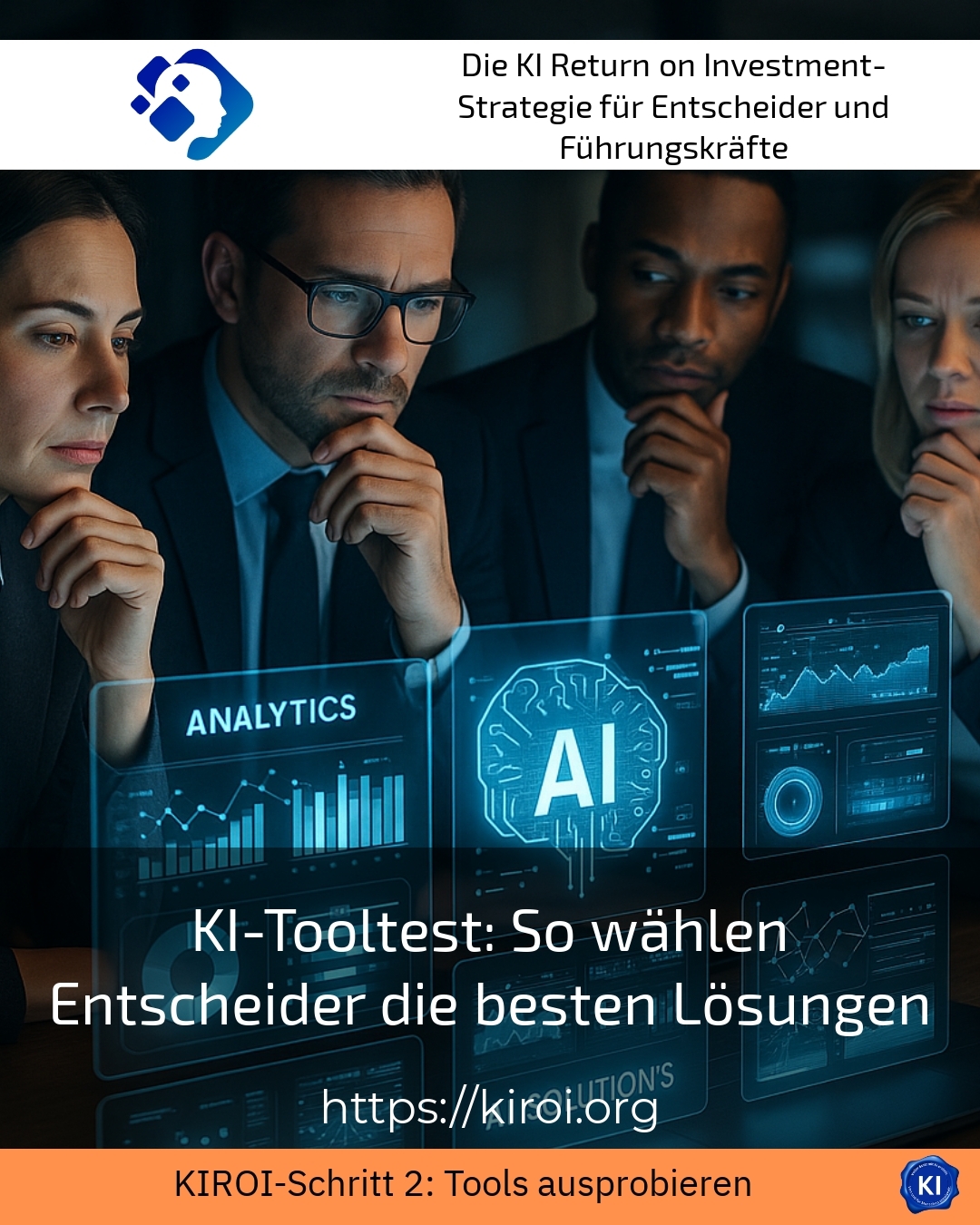
Imagine standing in front of a shelf with hundreds of identically looking tools, and each one promises to solve your most complex challenges. That is exactly what the current market for intelligent software solutions feels like. The AI Tool Test thereby becoming a crucial competency for leaders who want to avoid expensive misinvestments. But how do you separate the wheat from the chaff when even experts disagree? This question concerns decision-makers across all industries and deserves a well-founded answer.
The strategic dimension in the selection of intelligent systems
Managers frequently report a certain feeling of being overwhelmed in view of the abundance of options. The market for intelligent automation solutions is growing exponentially. In the process, new providers are emerging every day with tempting promises. A structured AI Tool Test helps to manage this complexity. Decision-makers should first define their specific requirements. Which processes are to be optimised? Which interfaces need to be served? These questions form the foundation of any meaningful evaluation [1].
In the financial sector, for instance, institutions are increasingly relying on fraud detection systems. These analyse transaction patterns in real time. At the same time, insurance companies use intelligent claims assessment. Banks, in turn, are optimising their lending processes through data-driven decision support tools. In healthcare, diagnostic systems assist medical professionals. Hospitals are significantly improving their treatment planning as a result. The logistics sector is also benefiting through intelligent route optimisation.
Best practice with a AIROI customer
A medium-sized company in the precision manufacturing sector faced the challenge of modernising its quality control, as its previous manual inspection processes appeared neither scalable nor economically viable. As part of a transruption coaching programme, we accompanied the management in the systematic evaluation of various image recognition systems, paying particular attention to their integration into existing production workflows. First, we jointly defined clear success criteria that took into account both technical requirements and economic framework conditions. The subsequent trial run with three pre-selected solutions revealed significant differences in recognition accuracy under varying lighting conditions. Following intensive analysis, the company opted for a solution that could be seamlessly integrated into the existing machine control system. The error rate in production fell by over forty percent within a few months. This success illustrates how important structured guidance can be in such transformation projects. Employees were involved from the very beginning, which meant they accepted the new system much more quickly.
Criteria for a meaningful AI tool test in practice
A well-founded evaluation process comprises several clearly defined dimensions. Technical performance often takes centre stage in this regard. However, factors such as user-friendliness deserve equal attention. The vendor's support significantly influences long-term success. Data security also plays a central role. Added to this are aspects such as scalability and adaptability [2].
These criteria are particularly evident in retail. Personalisation systems must be able to process large volumes of data. At the same time, customers expect fast response times. For example, a fashion retailer is testing various recommendation algorithms in parallel. Grocery retail is optimising order forecasting using intelligent systems. Pricing can also be improved on a data-driven basis. These examples illustrate the range of possible applications.
Industry uses intelligent maintenance systems for failure prevention. Production plants are continuously monitored and analysed. Chemical companies optimise formulations through data-driven simulation. The automotive sector relies on quality forecasting in manufacturing. Energy suppliers improve their grid stability through predictive analytics. Each of these use cases requires specific evaluation criteria.
The structured AI tool test as a basis for decision-making
Decision-makers should establish a multi-stage process. The first phase comprises thorough market research. Industry reports and analyst reports help serve as orientation here. Recommendations from partners and customers offer valuable insights. The second phase involves a pre-selection of suitable candidates. Reference projects and case studies play an important role here [3].
In the construction industry, project developers rely on planning software with intelligent components. Architects use generative design tools for innovative designs. Construction companies optimise material procurement through predictive analytics. The real estate sector is improving valuation models with data-driven methods. Facility management companies use intelligent building control systems. This variety requires tailored test scenarios in each case.
Best practice with a AIROI customer
An internationally operating logistics service provider was looking for a solution to optimise its route planning, as its existing software was no longer meeting increased demands. transruptions coaching accompanied the project team over several months in the systematic evaluation of five different providers, each with different strengths and weaknesses. Together, we developed a scoring model that combined technical criteria with economic factors and employee buy-in. The testing phase included realistic scenarios using actual operational order data. This revealed that the supposedly most powerful solution had significant integration deficits. An alternative that was initially less favoured proved convincing due to its seamless connection to existing systems. The client ultimately chose this pragmatic solution. As a result, implementation ran significantly smoother than in comparable projects. Today, the company benefits from an increase in efficiency that far exceeds the original expectations.
Typical pitfalls in evaluation and how to avoid them
Many companies underestimate the effort required for a thorough evaluation. Time pressure frequently dominates decision-making. This leads to superficial comparisons and later disappointments. Another common mistake lies in unrealistic expectations. Clients often report exaggerated promises from providers. A critical look at actually verifiable successes helps here.
The media sector faces specific challenges when selecting tools. Publishers are intensively testing automated text generation systems. Broadcasters are evaluating intelligent archiving solutions. Advertising agencies are examining creative assistance systems for their practical suitability. Streaming services are continuously optimising recommendation algorithms. The gaming industry is also increasingly relying on intelligent opponent control [4].
Further fields of application are emerging in the professional services sector. Law firms use document analysis for contract evaluation. Tax advisors rely on intelligent receipt capture. Management consultancies optimise analysis processes through data-driven tools. Auditors improve anomaly detection in financial data. These examples illustrate the cross-industry relevance.
Developing realistic expectations when testing AI tools
Decision-makers benefit from a sober assessment of the possibilities. Intelligent systems can support and accelerate processes. However, they rarely replace human expertise entirely. This realization helps in making a realistic assessment. Clients frequently report initial euphoria. This later gives way to a more differentiated perspective.
The education sector illustrates this development impressively. Universities are evaluating adaptive learning systems for individualised educational pathways. Schools are testing support systems for lesson preparation. Further education providers are using intelligent course compilation. Language schools are relying on conversational practice systems. Libraries are also modernising their research tools accordingly.
Best practice with a AIROI customer
A hospital chain with multiple locations wanted to optimise its workforce planning, as the previous methodology frequently led to over- and understaffing, which negatively impacted both staff satisfaction and patient care. As part of the transruptions coaching, we supported the IT management and HR department in a structured selection process involving various forecasting systems. It was particularly important to take into account regulatory requirements in the healthcare sector, which are often neglected in generic solutions. We organised workshops with ward managers to capture their practical requirements. This involvement proved crucial for subsequent acceptance. The selected provider had specific industry experience and was able to present relevant references. Implementation took place gradually at a pilot site. Following a successful testing phase, the rollout to other hospitals followed. HR managers now report a significantly reduced planning effort coupled with improved shift schedule quality.
The human component in the decision-making process
Technical evaluations alone rarely lead to sustainable decisions. Involving affected employees significantly increases the chances of success. Change management aspects therefore deserve special attention. Training effort and learning curves influence the return on investment. Cultural factors also play an important role.
These aspects are particularly evident in the hospitality industry. Hotels regularly evaluate intelligent revenue management systems. Restaurant chains test ordering forecasts for optimised inventory management. Tour operators use dynamic pricing. Airlines optimise crew planning with intelligent algorithms. Cruise lines also rely on personalised guest experiences [5].
Agriculture is adopting smart technologies at an increasingly faster pace. Precision farming uses sensor data for optimised management. Livestock farming improves health monitoring through continuous analysis. Viticulture relies on harvest forecasts based on weather data. Forestry uses drone imagery for stock analyses. Each of these applications requires specific evaluation approaches.
My AIROI Analysis
The systematic evaluation of intelligent tools has established itself as a core management task. Decision-makers who approach this process in a structured manner avoid costly misjudgements. The market now offers suitable solutions for almost every use case. The challenge lies in identifying the truly appropriate option.
From my consultancy practice, I can confirm that successful projects consistently exhibit several commonalities. Firstly, they define clear success criteria before the evaluation begins. Secondly, they involve relevant stakeholders at an early stage. Thirdly, they schedule sufficient time for realistic testing. Fourthly, they take integration aspects into account from the very beginning.
Transruption coaching offers valuable momentum precisely during such transformation projects. It guides companies in bringing technology and people into harmony. The technical side alone rarely decides success or failure. Rather, it is the organisational and cultural factors that make the difference.
For the coming years, I expect further differentiation of the market. Specialised industry solutions will increasingly displace generic approaches. At the same time, demands for transparency and traceability are rising. Decision-makers should take these developments into account in their strategic planning.
Further links from the text above:
[1] Gartner – IT Research and Advisory
[2] McKinsey Digital – Insights into Digital Transformation
[3] Forrester Research – Technology Analytics
[4] Bitkom – Digital transformation in Germany
[5] IDC – International Data Corporation Research
For more information and if you have any questions, please contact Contact us or read more blog posts on the topic Artificial intelligence here.










 Deutsch
 English (UK)