
Have you ever wondered why some companies seem to effortlessly find the right tools for their digital transformation, while others barely make any progress despite massive investments?
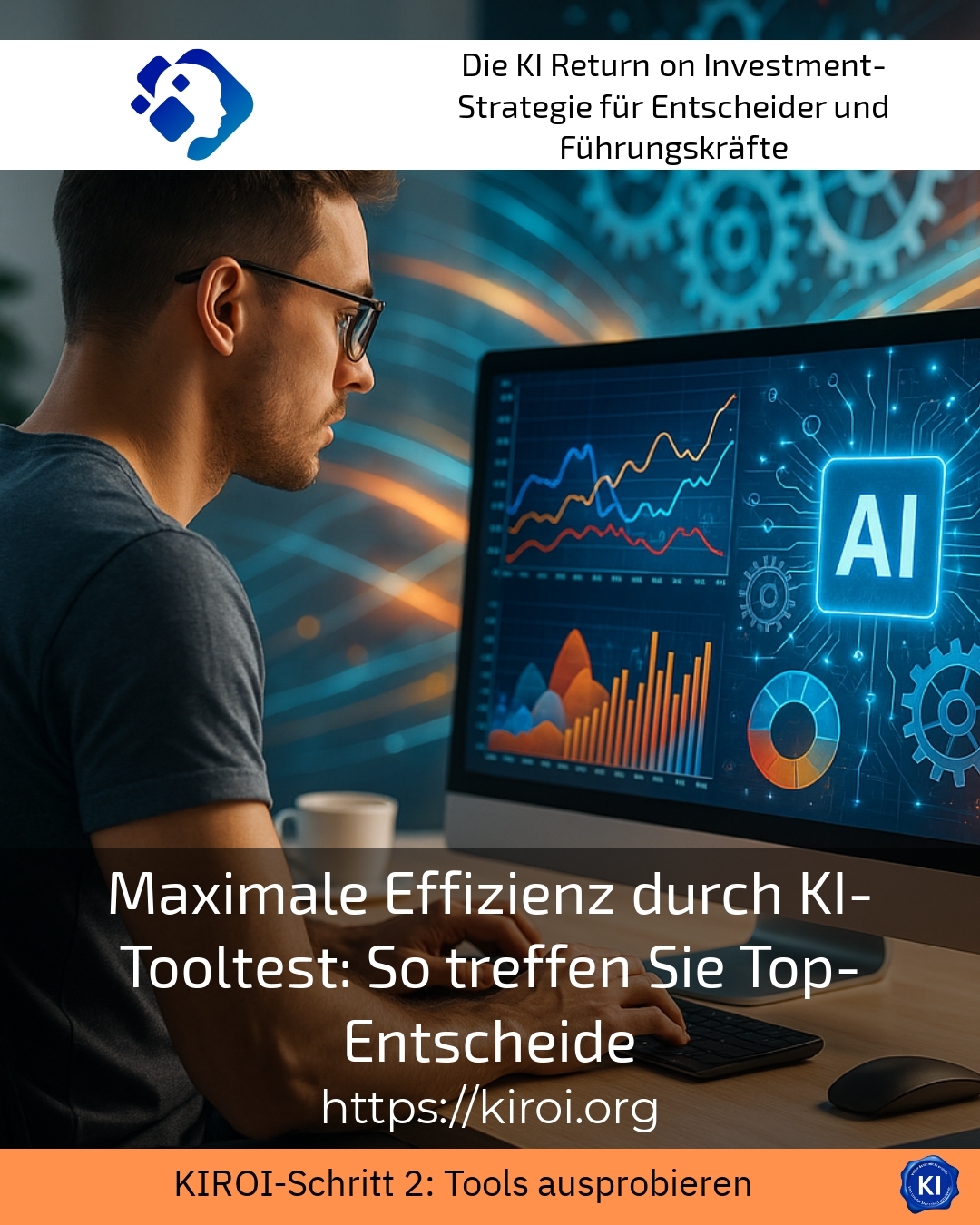
The answer often lies in the systematic evaluation of available solutions. Today, maximum efficiency through AI tool testing is achieved by organisations that take a structured approach and apply proven methodologies. At a time when the choice of intelligent software solutions has become almost overwhelming, decision-makers need reliable criteria and proven procedures to make informed decisions. This article accompanies you on the path to well-thought-out selection processes and shows you the impetus that transruptions coaching can provide for such projects.
The challenge of tool selection in the modern business world
Organisations are facing a flood of opportunities. The market offers hundreds of applications for automated text generation, image analysis or process optimisation. At the same time, pressure is growing to act quickly and not miss out on competitive advantages. Many leaders report feeling overwhelmed by the sheer volume of options. This overwhelm frequently leads to poor decision-making or paralysing inaction. Both reactions can have significant long-term economic consequences.
In the financial sector, for example, institutions have to weigh up different solutions for fraud detection, automated credit assessment and customer service chatbots. Insurance companies are evaluating systems for claims processing and risk assessment. Retailers, on the other hand, are testing recommendation algorithms, inventory management systems and personalised marketing tools. Each of these industries has specific requirements that must be taken into account.
Maximum efficiency through AI tool testing: structured evaluation methods
A systematic approach begins with a precise definition of one’s own needs and objectives. Without clear requirements profiles, organisations can quickly lose their way in the maze of possibilities. The AIROI Masterclass recommends a five-stage process, ranging from problem definition through market analysis to practical testing [1]. This process helps organisations to structure their evaluation in a systematic and transparent manner.
In the first step, teams identify the specific pain points in their current workflows. For example, a logistics company might find that manual route planning takes up too much time. A hospital may identify bottlenecks in scheduling appointments or evaluating test results. A marketing agency might struggle with the time-consuming creation of advertising copy. These specific problems form the basis for all further steps.
Best practice with a AIROI customer
A mid-sized manufacturing company approached our transruptions coaching team with the challenge of selecting the right predictive maintenance solution from over twenty different options. The management team reported significant uncertainty, as every vendor delivered convincing presentations and could demonstrate impressive references. Together, we first developed a detailed catalogue of criteria encompassing technical, economic and organisational aspects. Subsequently, the internal team conducted structured pilot projects with three selected candidates using standardised test scenarios. The results revealed clear differences in practical suitability that had not been apparent in the manufacturers' presentations. After a three-month evaluation period, the company was able to make an informed decision with which all stakeholders were satisfied. In the following months, the chosen solution exceeded expectations and helped to significantly reduce unplanned machine downtime.
Practical test scenarios for reliable results
Theoretical evaluation using data sheets and manufacturer promises is rarely sufficient. Only in practical use do the true strengths and weaknesses of a solution become apparent. Therefore, experts such as the Gartner Group [2] recommend testing at least two to three candidates in a controlled environment. This testing phase should use realistic data and scenarios, not the vendors' optimised sample datasets.
A call centre could confront various voice assistants with typical customer enquiries. A law firm tests contract analysis software using real contracts from its own archive. A media company has different generation tools create article drafts and compares quality as well as time savings. Such practical tests provide insights that no product documentation can replace.
Economic aspects of tool selection
The costs of a solution go far beyond the pure licence price. Training effort, integration costs, ongoing maintenance and potential losses in productivity during the rollout phase must be factored in. Clients frequently report that they had initially underestimated the hidden costs. A comprehensive economic assessment prevents nasty surprises and enables realistic budget planning.
In healthcare, for example, hospitals have to factor in the costs of integration into existing hospital information systems. Banks calculate the effort required for regulatory compliance checks. Manufacturing companies add the expenditure for sensor technology and data infrastructure, without which many intelligent systems cannot function. These sector-specific additional costs can significantly influence the overall effort.
Enabling top decisions through systematic evaluation
A structured evaluation matrix helps to make objective comparisons. This matrix weights various criteria according to their importance to the organisation. Functional scope, user-friendliness, scalability, data protection and support quality are among the typical evaluation dimensions. Systematic scoring makes the decision-making process transparent and traceable.
The McKinsey Global Institute [3] emphasises that successful companies establish clear governance structures for technological decisions. These structures define who is involved in the evaluation and which competencies must be represented. Typically, in addition to the IT department, business units, data protection officers and management should be included. This interdisciplinary collaboration prevents blind spots and increases the acceptance of the decision made.
Best practice with a AIROI customer
A large insurance company sought guidance in selecting a system for automated claims processing. The project involved evaluating six different vendors from the European and American markets. As part of the transruptions coaching, we jointly developed a comprehensive catalogue of criteria containing over fifty individual evaluation points. Particular attention was paid to the processing of German-language documents and integration into the existing system landscape. The specialist department subsequently conducted test runs using anonymised real claims notifications, taking into account both standard cases and complex special situations. The results surprised the team, as the market leader initially favored performed significantly worse in processing complex cases than a smaller specialist. Following intensive discussions, the company opted for a solution that had been less impressive during the initial presentation, but delivered convincing results in the practical test. This experience impressively demonstrated the value of systematic evaluation processes.
Maximum efficiency through AI tool testing in various application areas
The requirements for evaluation processes vary considerably depending on the application area. In the field of text generation, language quality, tonality and factual accuracy are the primary focus. In image analysis, recognition accuracy, processing speed and the handling of edge cases matter. For process automation, integration, fault tolerance and maintainability are crucial.
Pharmaceutical companies are testing systems for analysing clinical trials with a focus on scientific precision. Energy suppliers are evaluating forecasting tools for consumption patterns and renewable energy generation. Recruitment agencies are examining applicant management systems with regard to fairness and non-discrimination. Each of these application areas requires specific test scenarios and evaluation criteria.
The importance of pilot projects for long-term success
Before an organisation rolls out a solution across the board, carrying out a limited pilot project is recommended. This pilot project enables experience to be gathered under real-life conditions with manageable risk. Stanford University [4] has documented that companies with structured pilot phases exhibit significantly higher success rates when implementing intelligent systems.
A retail company might initially deploy a price optimisation solution in just a few branches. A bank might first test a chatbot for a specific customer group or a single product segment. A manufacturing business starts with predictive maintenance on a selected production line. This limited rollout allows for adjustments and improvements before the system is implemented company-wide.
Identify and manage risks
Every technological decision carries risks that must be identified and managed. Vendor lock-in, data privacy concerns and the danger of outdated technology are among the most common worries. A careful risk analysis identifies potential problem areas early on and enables the development of countermeasures.
In the financial sector, institutions must carefully evaluate regulatory risks. Healthcare organisations are paying increased attention to patient data protection and liability issues. Public administrations take aspects of digital sovereignty into account and avoid critical dependencies. These sector-specific risk considerations are incorporated into the overall assessment.
Long-term perspectives in tool selection
Technological developments are advancing rapidly, which is why the future-proofness of a solution should also be assessed. Open interfaces, regular updates and a solid financial basis of the provider speak for sustainability. Proprietary formats, opaque algorithms and a lack of development activity, on the other hand, are warning signs.
For example, an automotive supplier must ensure that chosen systems can scale with future industry requirements. A media company makes sure that content creation tools remain compatible with new formats and platforms. A logistics service provider takes scalability into account for growing data volumes and new business areas.
My AIROI Analysis
The systematic evaluation of intelligent tools has proven to be a critical success factor for digital transformation. Organisations that adopt a structured approach and apply proven methodologies make better decisions and avoid costly missteps. Experience from numerous accompanying projects shows that the effort invested in thorough testing pays off manifold.
Achieving maximum efficiency through AI tool testing is not a matter of chance for companies, but rather the result of a methodical approach. The combination of clear requirement definition, practical test scenarios, economic analysis and risk assessment forms the foundation of successful decision-making processes. Transruption coaching can provide valuable momentum and accompany organisations along this path.
Of particular note is the importance of interdisciplinary collaboration when selecting tools. Technical expertise alone is not enough if the specialist departments subsequently fail to accept the chosen solution. Conversely, business requirements cannot ignore technical realities. The AIROI methodology promotes this cross-departmental cooperation, thereby laying the foundations for sustainable implementations.
The presented examples from various industries illustrate that there is no universal solution. Every organisation must find its own path, whereby established principles and tried-and-tested practices can serve as orientation. With the right approach, overwhelming selection processes become structured decision-making paths that lead to viable and future-proof results.
Further links from the text above:
[1] AIROI Masterclass: Structured Evaluation Methods
[2] Gartner Group: IT Research and Advisory
[3] McKinsey Global Institute: Research on Technology and Business
[4] Stanford University: Human-Centered Artificial Intelligence Institute
For more information and if you have any questions, please contact Contact us or read more blog posts on the topic Artificial intelligence here.










 Deutsch
  English (UK)