
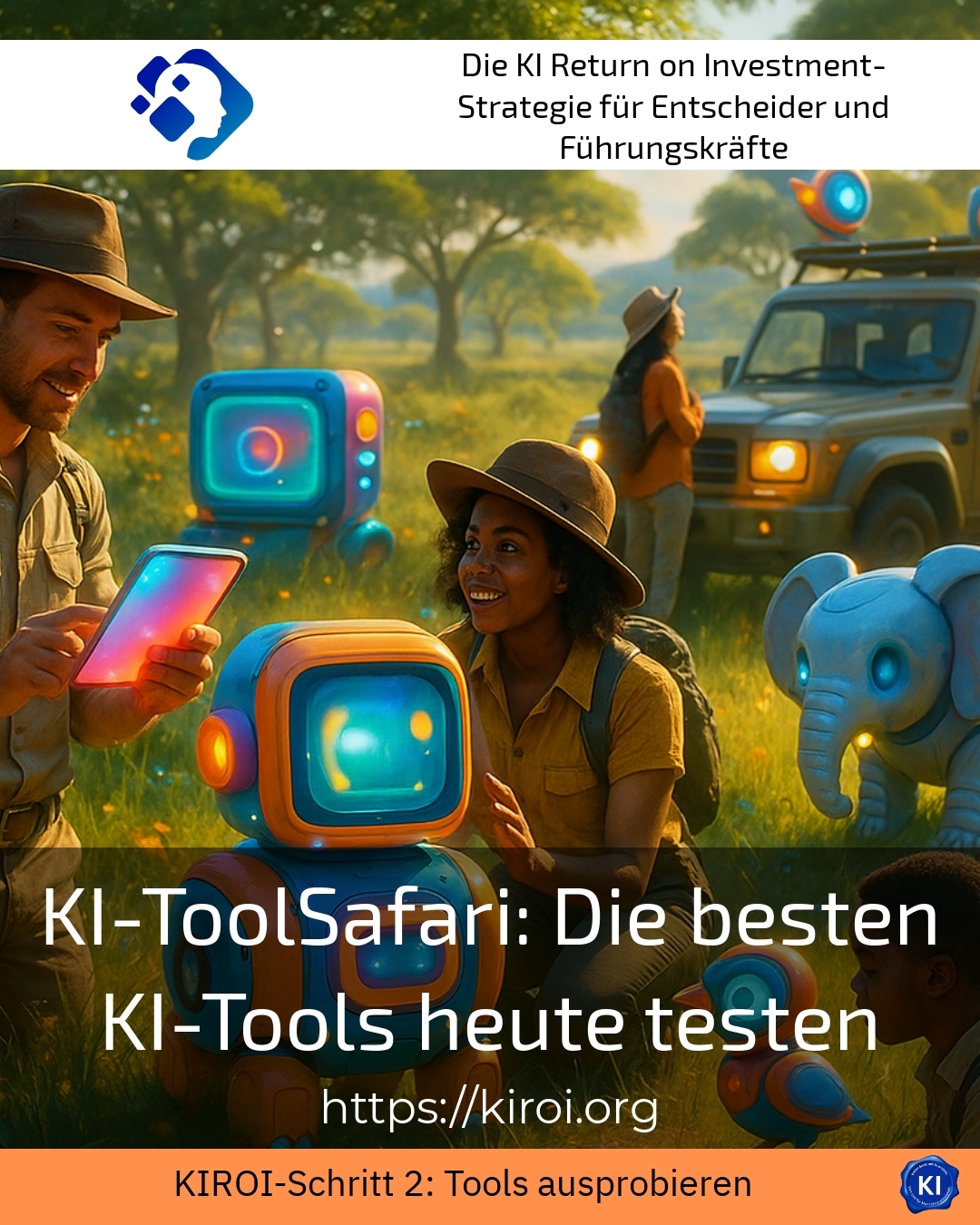
Imagine you could roam through a digital jungle full of innovative solutions in a single day and discover precisely the tools that will transform your business. That is precisely what a AI Tool Safari, where you can systematically explore the most promising applications of artificial intelligence and test them directly in your working environment. This expedition into the world of intelligent systems opens up perspectives that were considered science fiction only a few years ago, but are tangible reality today. At a time when digital transformation is no longer optional, but determines competitiveness, the targeted exploration of new technologies becomes a strategic imperative for any forward-looking company.
Why a structured AI tool safari is becoming essential for businesses
The landscape of intelligent applications is evolving at a breathtaking pace. New solutions emerge almost daily. These promise efficiency gains in a wide variety of business areas. Without a structured approach, however, decision-makers quickly get lost in the abundance of options. Clients frequently report feeling overwhelmed by the sheer volume of available tools. A methodical safari through this jungle therefore provides valuable orientation. It helps to distinguish relevant applications from irrelevant ones.
In the field of automated text generation, for example, there are systems such as Claude, ChatGPT and Jasper, each bringing different strengths [1]. Marketing teams use these tools to create advertising copy. Legal departments employ them for drafting contracts. Customer service departments use them to automate standard inquiries. At the same time, image generators like Midjourney, DALL-E and Stable Diffusion are revolutionising visual communication in businesses [2]. Designers use them to create conceptual visualisations in minutes instead of hours. Product developers generate prototype images for initial market research. Social media teams produce unique content without an external graphics budget.
Furthermore, analytical tools like Tableau with integrated artificial intelligence are transforming the evaluation of complex data sets [3]. Sales managers receive automatically generated insights from sales figures. Financial controllers identify anomalies in accounting data without manual checks. Logistics managers optimise supply chains based on real-time forecasts. These three categories represent only the tip of an iceberg. Therefore, a systematic exploration of all relevant fields of application is recommended.
Best practice with a AIROI customer
A medium-sized manufacturing enterprise faced the challenge of making its processes more efficient while simultaneously increasing employee satisfaction. As part of a guided safari through available intelligent solutions, the team initially identified three core areas with the greatest potential for optimisation. Quality control formed the first focal point because this traditionally involved a great deal of manual work. Subsequently, the focus turned to production planning with its complex dependencies. Finally, the team looked at internal communication between different departments. During the structured exploration phase, those responsible tested a total of twelve different applications under real-life conditions. In doing so, they carefully documented the pros and cons of every single solution. The transruption guidance helped to develop objective evaluation criteria and avoid emotional decisions. After eight weeks of intensive testing, the company chose three core tools. These integrated seamlessly into existing systems and were well received by employees. Today, those involved report noticeable improvements in all three target areas. The systematic approach proved to be a decisive success factor for the sustainable implementation.
Practical implementation of an AI tool safari in a corporate context
Successfully conducting an exploratory tour of intelligent tools requires thoughtful preparation. First, teams should clearly define their specific challenges and goals. This is the only way to prevent technical possibilities from overshadowing actual needs. In the second step, the formation of an interdisciplinary evaluation team is recommended. This should include representatives from various departments. In this way, different perspectives are incorporated into the assessment.
Specifically, many companies begin their safari with process automation tools such as UiPath or Automation Anywhere [4]. These platforms combine intelligent decision-making with robotic process automation. For example, a financial services provider could use this to accelerate credit checks. An insurance company automates claims processing. A retail company optimises invoice processing without manual intervention. At the same time, advanced teams are exploring tools for intelligent document processing. Systems such as ABBYY or Kofax extract relevant information from unstructured texts [5]. Human resources departments use this for CV screening. Legal departments use it to search contract archives in seconds. Procurement departments analyse supplier bids automatically and comparatively.
A particularly exciting area includes predictive analytics tools. Platforms such as DataRobot or H2O.ai enable predictions without deep programming knowledge [6]. Retailers use them to forecast demand fluctuations more precisely. Energy suppliers optimise their generation capacities based on consumption forecasts. Maintenance teams identify impending machine failures before they occur. These diverse applications underline the value of a comprehensive exploration.
Setting evaluation criteria correctly during the AI tool safari
When evaluating tested tools, various factors play a crucial role. User-friendliness is often paramount. After all, even the most powerful system is of little use without acceptance by users. At the same time, integration capability deserves special attention. New solutions must be able to fit into existing IT landscapes. Isolated silo solutions often create more problems than they solve.
Furthermore, teams should carefully examine the data protection compliance of every application. Especially for European companies, GDPR compliance plays a central role. Many American providers do not fully meet these requirements. Therefore, involving data protection officers in the evaluation process is recommended. The long-term cost structure also deserves attention. Some tools lure users with low entry prices and then significantly increase costs as usage grows. Transparent pricing models should therefore be preferred.
Scalability forms another important criterion for forward-looking decisions. A tool that works for a small team today must also be able to keep pace as the business grows. Cloud-based solutions often offer advantages here compared to on-premise installations. In addition, vendor support deserves attention during the evaluation. High-quality documentation and accessible support teams significantly ease the implementation phase.
Typical challenges in exploring smart tools
Many clients report recurring difficulties during their technology expeditions. A common challenge relates to dealing with exaggerated expectations. Vendors' marketing promises often generate unrealistic ideas about the capabilities of individual tools. Here, neutral guidance helps to develop realistic assessments. External impulses assist in objectively categorising actual performance.
Another typical hurdle arises from a lack of internal coordination between business departments and IT. While business departments often expect quick results, IT teams emphasise security and integration aspects. Without moderation, these differing priorities lead to conflicts. As part of transruption coaching, we accompany teams in developing common goals and resolving conflicts of interest constructively. This creates viable solutions that are supported by all participants.
Best practice with a AIROI customer
A service company with several hundred employees wanted to improve its customer interactions through intelligent systems and turned to us for a guided exploration journey. The initial situation was characterised by fragmented approaches to solutions in various departments. The marketing team had already carried out initial experiments with text generators without involving the IT department. At the same time, customer service was testing its own chatbot solutions at a local level. These parallel structures led to inefficiencies and security concerns on the part of the company management. As part of the support process, we initially established a common governance framework for all technology experiments. We then held structured evaluation workshops in which all stakeholders could contribute their requirements. The safari through available tools was then carried out in a coordinated and documented manner. In the process, the team identified surprising synergies between different departments. A unified platform was ultimately able to replace several individual solutions while reducing costs. The joint journey through the technology landscape also strengthened cross-departmental understanding and improved collaboration for the long term. Today, this experience serves as a blueprint for further digitalisation projects within the company.
Sustainable knowledge transfer after the safari
The value of a technology expedition only becomes clear through the sustainable anchoring of the insights gained. Many companies neglect this important aspect and lose valuable knowledge. A structured documentation of the test results therefore forms an indispensable conclusion to every safari. Alongside technical details, this should also include the practical experiences of the testers. Only in this way can later decision-makers benefit from the findings.
Additionally, it is recommended to establish internal experts for selected tools. These multipliers disseminate knowledge within their departments and are available as points of contact. Training formats such as lunch-and-learn sessions also promote informal knowledge exchange. Regular updates of insights take into account the rapid evolution of the technology landscape. Given the speed of innovation, a one-off safari is not sufficient. Rather, companies should establish a continuous exploration process.
Practical tools for knowledge documentation include Notion for collaborative knowledge bases or Confluence for technical documentation [7]. Some teams also use video documentation of their testing experiences. These convey nuances that are often lost in written reports. Building an internal knowledge base on intelligent tools pays off in the long run. New employees benefit from the accumulated wealth of experience just as much as existing teams.
My AIROI Analysis
The systematic exploration of intelligent tools is developing into a core competency for future-proof organisations. Companies that regularly navigate the landscape of available technologies gain decisive competitive advantages. They identify trends earlier than their competitors and can react faster. The AI Tool Safari has established itself as a particularly effective format in the process. It combines systematic exploration with practical testing under real-world conditions.
Our experience from numerous accompaniment projects reveals clear success patterns. Teams that start the exploration phase with clear goals and an open mindset achieve the best results. Interdisciplinary composition fosters innovative approaches and prevents operational blindness. The inclusion of external perspectives through transruption coaching further accelerates the insight process. At the same time, professional guidance significantly reduces typical pitfalls in tool selection.
Exciting developments are on the horizon for the coming months. The integration of various smart tools into unified platforms is progressing. Companies are benefiting from fewer interface issues and simplified administration. At the same time, no-code and low-code approaches are democratising access to advanced functionalities. Staff without programming skills are increasingly able to develop their own automation solutions. However, this democratisation requires clear governance structures. This is where AIROI-based consultancy helps strike a balance between innovation and control.
Finally, I would like to emphasise that successful technology adoption always remains a human-centred process. The best tools only unfold their impact in the hands of motivated and empowered users. Therefore, supporting people through technological change is at the core of our work. We look forward to accompanying your company too on its next exploratory journey through the fascinating world of intelligent tools.
Further links from the text above:
[1] Anthropic Claude – Intelligent text generation
[2] Midjourney – AI-powered image generation
[3] Tableau AI – Intelligent data analysis
[4] UiPath – Robotic Process Automation Platform
[5] ABBYY – Intelligent Document Processing
[6] DataRobot – Automated Machine Learning
[7] Notion – Collaborative Knowledge Base
For more information and if you have any questions, please contact Contact us or read more blog posts on the topic Artificial intelligence here.









 Deutsch
  English (UK)