
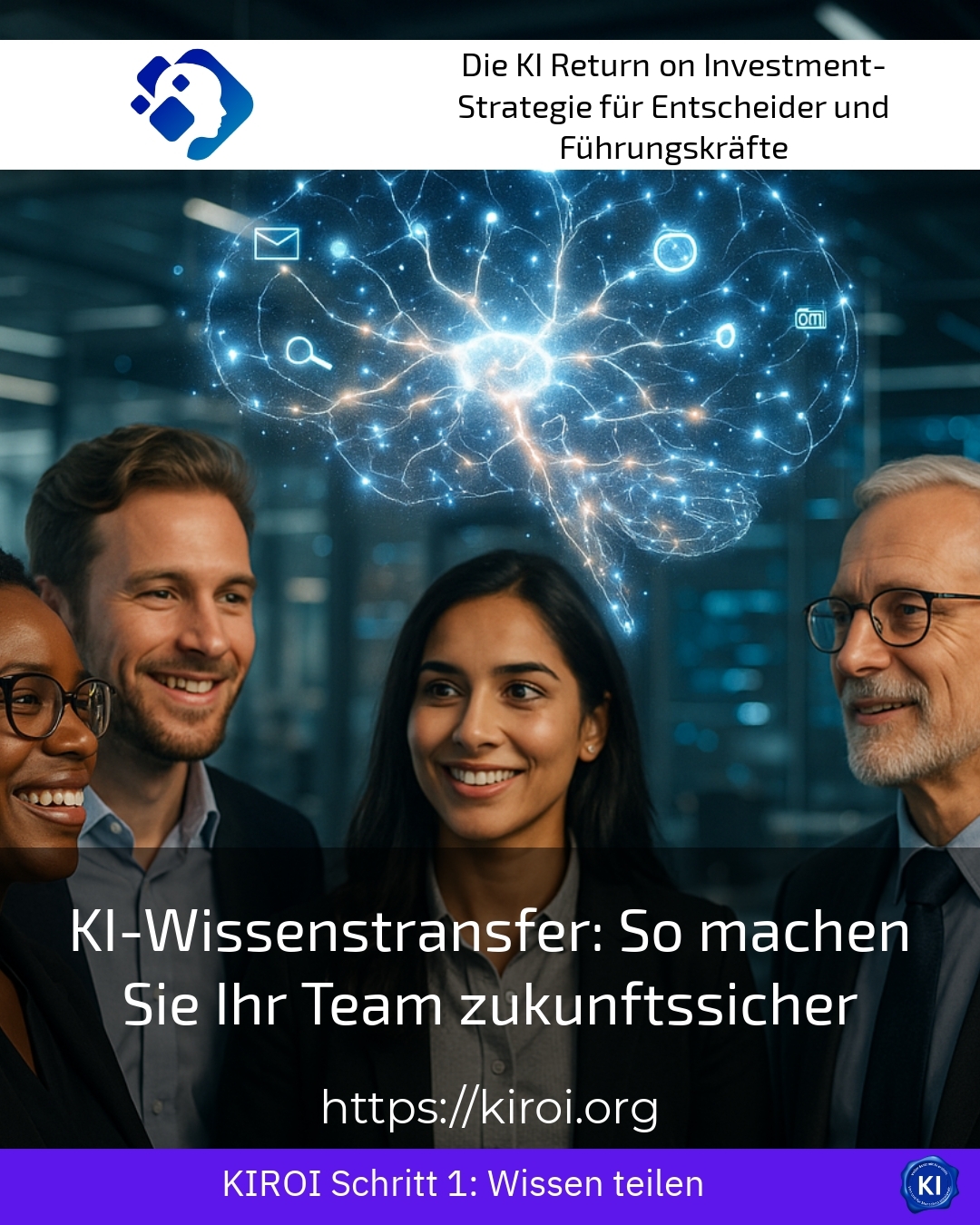
The world of work is changing rapidly, and many companies are facing a crucial challenge. Knowledge that has been built up over years threatens to be lost. At the same time, new technologies are opening up unprecedented possibilities. The AI knowledge transfer thereby developing into a central success factor for teams that want to remain competitive in the future. But how can you succeed in preserving experiential knowledge while simultaneously building innovative competencies? This article shows you concrete ways in which you can optimally prepare and support your employees.
Why AI knowledge transfer has become indispensable today
Organisations are in the middle of a profound transformation. Traditional ways of working are reaching their limits. New demands arise almost daily. This is not just about technical skills. Rather, teams must learn to combine human expertise with intelligent systems.
Clients frequently report uncertainties when dealing with this transformation. They wonder which competencies will be relevant in the future. Others worry that proven expertise will lose its significance. These concerns are understandable and deserve serious engagement. Transruption coaching can help to gain clarity and develop concrete steps for action.
For example, a medium-sized consultancy faced the challenge of securing many years of industry knowledge. Several experienced consultants were approaching retirement. At the same time, new analysis tools were to be introduced. The solution was to combine structured handover processes with digital learning formats. Another example shows an agency that redefined its creative processes. The employees learned to use intelligent tools as a source of inspiration. As a result, they gained time for strategic tasks. A financial services provider also benefited considerably from this approach. The compliance department integrated automated checks into its workflows [1].
Establishing the foundations for successful knowledge transfer
Before concrete measures can take effect, a solid basis is needed. First of all, an honest stocktaking of the existing competencies is recommended. What knowledge already exists within the team? Where do strengths lie, and where are there development needs? This analysis forms the foundation for all further steps.
Furthermore, corporate culture plays a crucial role in this process. Openness to new ideas and appreciation for experience must go hand in hand. Only when employees feel secure will they willingly share their knowledge. Transruption coaching helps teams to develop and consolidate such cultures.
For example, an audit firm realised that informal knowledge often remained locked in the heads of individual experts. It introduced regular knowledge-sharing sessions where experiences were systematically documented. A logistics company, in turn, used mentoring programmes to introduce younger employees to complex planning tasks. The older colleagues felt valued and were happy to pass on their knowledge. A third example comes from the healthcare sector, where nursing staff were to familiarise themselves with digital assistance systems. Here, a step-by-step approach with regular feedback loops proved successful [2].
Best practice with a AIROI customer
An internationally active trading company approached us with a complex challenge. The workforce had been unsettled by numerous changes in recent years. At the same time, a comprehensive digitalisation project was to be implemented. The management recognised that technical training alone would not be enough. Rather, what was needed was holistic support that took both professional and emotional aspects into account. Together, we developed a multi-stage programme that combined various learning formats. Experienced employees were trained as internal ambassadors and received specialised coaching. They learned to pass on their knowledge in an understandable way while remaining open to new impulses. Younger team members contributed their digital skills and benefited from the wealth of experience of the older ones. This mutual enrichment created a completely new dynamic within the company. Employees reported increased motivation and greater confidence in their abilities. After six months, acceptance of the new systems had increased significantly. Staff turnover fell measurably, and cooperation between the generations improved noticeably.
Practical strategies for sustainable AI knowledge transfer within the team
The transition to new ways of working is best achieved gradually and with support. Various approaches have proven particularly effective in this regard. A central element here is formed by mixed learning groups, in which different levels of experience come together. This creates a fruitful exchange on an equal footing.
Furthermore, the setting up of experimental spaces where new tools can be tried out is recommended. Mistakes are expressly permitted there and even encouraged. This atmosphere fosters creativity and removes the fear of the unknown.
For example, an architectural practice established weekly innovation hours. Employees explored new visualisation possibilities together and exchanged views on their discoveries. A publishing house used similar formats to familiarise the editorial team with automated research tools. The editors quickly recognised that these tools could enrich their journalistic work. A pharmaceutical company also benefited from structured learning sessions in which researchers got to know new analysis methods [3].
Understanding and constructively dealing with resistance
Changes frequently trigger resistance that may at first seem obstructive. Upon closer inspection, however, it becomes apparent that these reactions contain valuable insights. They show where uncertainties exist and which needs have not yet been sufficiently taken into account.
Clients often come with the concern of no longer being needed or not being up to the demands. Taking these fears seriously is the first step towards a solution. Transruption coaching offers a safe environment to work through such issues.
For example, an insurance company initially experienced significant reservations among administrative staff. The employees feared being replaced by automated systems. Open discussions and transparent communication helped to alleviate these fears. A mechanical engineering company encountered similar challenges when introducing predictive maintenance systems. Initially, the technicians felt their expertise was being called into question. Through targeted involvement in the system development, their attitude changed fundamentally. A tourism company addressed the resistance from its travel consultants with a special approach by deliberately placing their expertise centre stage [4].
Secure long-term development through continuous AI knowledge transfer
One-off training sessions are not enough to bring about lasting change. Rather, what is needed are continuous learning processes that are firmly embedded in daily work routines. This requires a rethink in the way further education and training is organised.
In doing so, transruption coaching supports organisations in designing and implementing bespoke development programmes. The focus is on practical relevance and the immediate applicability of what has been learned. This creates a positive cycle of learning, applying and improving.
For example, an energy supplier established a system of regular learning impulses that were integrated into the workflow. Employees received short weekly prompts that they could implement immediately. A retail chain pursued a similar approach for its branch managers. These learned to interpret sales data better and derive recommended actions from it. A media company, in turn, relied on peer-learning groups in which employees coached each other [5].
Best practice with a AIROI customer
An established manufacturing company faced the task of fundamentally modernising its production planning. The challenge lay in combining decades of accumulated empirical knowledge with new planning systems. The long-standing dispatchers possessed invaluable tacit knowledge that was not recorded in any manual. Together, we developed a structured process to make this knowledge explicit and document it. In doing so, we used a combination of one-to-one interviews, observations and joint workshops. The dispatchers felt valued as experts and actively contributed. At the same time, younger employees who brought technical know-how were intensively involved. This collaboration led to a significantly improved planning system that united both perspectives. The company reported a noticeable increase in planning quality and shorter lead times. Particularly noteworthy was the positive impact on the working atmosphere and intergenerational cooperation. The employees developed a new understanding of one another and appreciated the respective strengths of their colleagues.
The role of leaders in the transformation process
Leaders hold a key position when it comes to successful change processes. They significantly shape the culture and set important signals. Their own attitude towards innovations influences the entire team.
Therefore, it is important that leaders themselves also continuously learn and develop. They do not need to know everything, but they must show a willingness to learn. Transruption Coaching offers special programmes for leaders in phases of transformation.
For example, a telecommunications company recognised that its managers first had to gain confidence themselves. Only then could they credibly lead their teams through change. A management consultancy relied on regular reflection sessions for management. There, the partners shared their experiences and uncertainties. A family-owned business firmly integrated leadership development into its strategic planning and made it a central success factor [6].
My AIROI Analysis
Accompanying numerous organisations through transformation projects has brought to light important insights. The decisive success factor does not lie in the technology itself, but in how people are dealt with. Teams that feel secure and valued show a significantly higher willingness to change. In this regard, the right balance between demand and support is crucial.
The AIROI methodology has proved particularly effective because it takes both aspects into account. It combines structured approaches with individual support, thereby facilitating sustainable development. Organisations that adopt this approach report faster progress and higher staff satisfaction.
At the same time, it becomes clear that patience and perseverance are essential for success. Real change takes time, and setbacks are part of the process. It is important to view these as learning opportunities rather than interpreting them as failure. Transruption coaching helps to develop and maintain this constructive perspective.
In conclusion, it can be stated that the AI knowledge transfer is far more than a technical issue. It touches upon fundamental questions of collaboration, learning and corporate culture. Organisations that take this dimension seriously create the conditions for long-term success. They not only become future-proof, but also more attractive to talented employees.
Further links from the text above:
[1] McKinsey Digital Insights on the economic potential of intelligent systems
[2] Harvard Business Review on organisational learning
[3] World Economic Forum contributions on intelligent technologies
[4] Gartner Research on Change Management
[5] Forbes Technology Council on digital transformation
[6] MIT Sloan Management Review on intelligent systems
For more information and if you have any questions, please contact Contact us or read more blog posts on the topic Artificial intelligence here.







 Deutsch
  English (UK)