
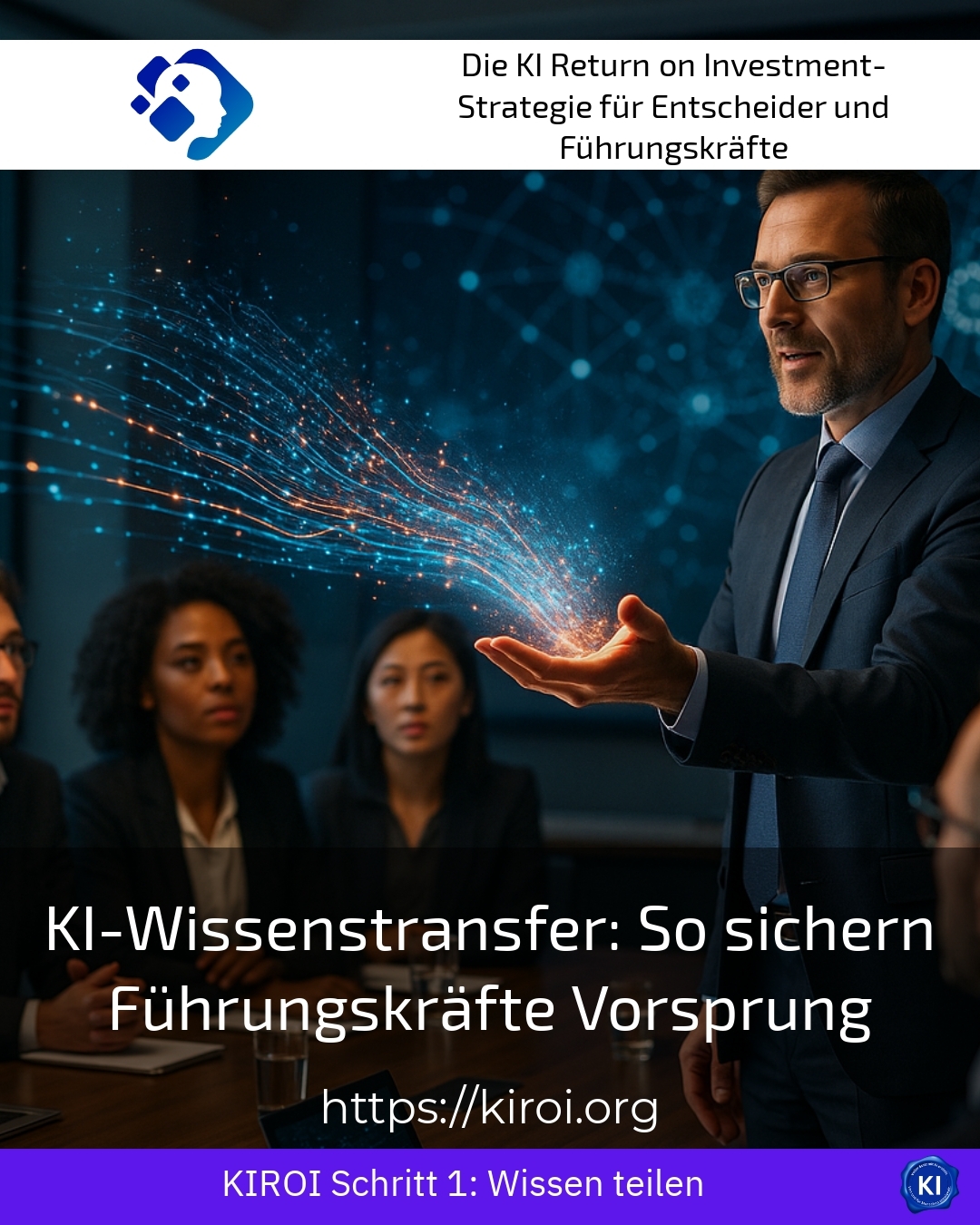
Imagine your most valuable corporate asset disappearing unnoticed through the back door. Every day, experienced employees leave organisations, taking decades of accumulated expertise with them. At the same time, new insights are being generated at a rapid pace, rarely being captured systematically. This is precisely where the AI knowledge transfer and offers leaders a unique opportunity to secure decisive advantages. The integration of intelligent systems into operational knowledge management fundamentally changes how organisations learn and develop. But how can these technologies be deployed profitably in practice?
Why strategic knowledge management has become essential today
Demographic change is presenting companies with massive challenges. Experienced professionals are retiring. Their implicit knowledge, built up over decades, threatens to be irretrievably lost. A medium-sized mechanical engineering company from southern Germany was facing precisely this problem. The chief engineer, who had known all critical production processes for thirty years, announced his retirement. Only then did the management realise how little had been documented. They looked for solutions and found them in modern technological approaches. This issue is also particularly evident in the healthcare sector. Hospitals regularly lose experienced nursing staff who possess irreplaceable practical knowledge. A pharmaceutical company from the Rhineland reported similarly concerning developments. Long-standing researchers left the company and took valuable insights about failed experiments with them [1].
Market dynamics are further exacerbating this situation. Products and services are changing in increasingly short cycles. What applied yesterday may already be obsolete today. A financial services provider in Frankfurt discovered that regulatory knowledge within its company was scattered decentrally. Compliance experts hoarded information in personal folders. During audits, systematic access was lacking. An insurance company from Munich had similar experiences. Claims knowledge existed mainly in the minds of long-standing case handlers. New employees required years to achieve a similar quality of decision-making. An energy supplier from North Rhine-Westphalia recognised that technical plant knowledge was only passed on verbally. During shift handovers, critical information was regularly lost.
AI knowledge transfer as a strategic lever for sustainable competitive advantages
Intelligent systems today offer possibilities that seemed unthinkable just a few years ago. They can recognise patterns in large amounts of data and uncover hidden connections. An automotive supplier from Baden-Württemberg uses such technologies for quality assurance. The system analyses historical inspection reports and identifies potential sources of error at an early stage. Experiential knowledge is thus digitally preserved and made generally accessible. A chemical group from Ludwigshafen goes a step further. There, laboratory reports are automatically evaluated and compared with previous experiments. Researchers receive hints about similar tests and thus avoid redundant work. A logistics company in Hamburg uses comparable approaches in fleet management. The route knowledge of experienced drivers is systematically recorded and prepared for newcomers [2].
The real added value lies in the democratisation of expert knowledge. Previously privileged information is becoming accessible to a wider circle of employees. A telecommunications provider from Düsseldorf reports remarkable results. The average onboarding time for new customer service staff has been significantly reduced. Customer enquiries are answered more quickly and precisely. Customer satisfaction has improved measurably. A retail company from Cologne made similar observations. Product knowledge that previously only experienced salespeople possessed is now available to everyone. Quality of advice and sales figures have developed positively. A construction company from Berlin is using these approaches for project documentation. Experience from completed construction projects is automatically incorporated into new planning.
Best practice with a AIROI customer
An international industrial company with several thousand employees was facing a critical situation. Within the next five years, more than thirty per cent of its technical specialists would reach retirement age. The management commissioned a comprehensive transformation project aimed at safeguarding knowledge. AIROI’s ‘transruptions’ coaching supported this process from conception through to implementation. First, the key knowledge holders were identified and their expertise systematically recorded. Interviews were conducted and work processes documented. In the second stage, the team developed a bespoke technological solution. This solution analysed the collected information and organised it by topic. New staff can now access this practical knowledge via an intuitive interface. The ability to ask context-specific questions proved particularly valuable. The system provides relevant answers based on the documented expert knowledge. The induction period for new technical staff was reduced by around forty per cent. The error rate in critical production processes also fell significantly. The company reports a marked improvement in its overall knowledge culture. Staff now share their knowledge more actively because they experience the immediate benefits.
Practical implementation steps for AI knowledge transfer
The successful introduction of such systems requires a well-thought-out strategy. Leaders face the task of considering technical and human factors alike. A first step consists of identifying critical knowledge domains. Where are the greatest risks of knowledge loss in your organisation? A medical technology company from Tuttlingen began with a systematic knowledge map. This visualised which expertise was concentrated in which employees. Critical dependencies immediately became visible. A management consultancy from Stuttgart carried out similar analyses for several clients. The results often surprised even experienced leaders. A medium-sized plant engineering company from the Ruhr area realised that fifty percent of its core technical knowledge lay with just three employees [3].
The technical implementation forms the second important building block. This is not about introducing as many tools as possible. The decisive factor is the careful selection of suitable solutions for specific requirements. A food manufacturer from Lower Saxony chose a step-by-step approach. First, a pilot project was launched in quality assurance. The experience gained fed into the further rollout. A textile company from southern Germany focused on product development. Design decisions and the reasons behind them are now systematically documented. New designers can draw on decades of experience. A tool manufacturer from the Black Forest focused on technical customer service. Service technicians receive mobile support with access to on-site expert knowledge.
Do not underestimate the human dimension in AI knowledge transfer
Technology alone does not solve organisational challenges. Cultural change often proves more demanding than technical implementation. Employees need to understand why knowledge sharing is important. They need incentives and positive experiences. A software company from Karlsruhe invested heavily in communication and training. The managers modelled the desired knowledge culture. They demonstrably shared their own knowledge and publicly acknowledged contributions from others. A bank from Frankfurt created financial incentives for knowledge documentation. Employees receive bonuses for high-quality contributions to the knowledge base. An energy company from Munich integrated knowledge sharing into performance appraisals. The willingness to cooperate feeds into career decisions.
Leaders play a crucial role in this cultural shift. Their attitude significantly influences the behaviour of their teams. Skepticism towards new technologies is understandable and should be taken seriously. Concerns deserve to be heard and addressed constructively. An electronics manufacturer from Bavaria created spaces for open dialogue. Employees were able to voice their fears and received transparent answers. This built trust and significantly increased acceptance. A mechanical engineering company from Hesse trained internal ambassadors for the new system. These multipliers supported their colleagues in getting accustomed to it. A chemical company from the Rhineland relied on intensive support from external coaches. The transruption coaching helped to deal with resistance constructively [4].
Measurable successes through systematic knowledge transfer
Investment in modern knowledge management is proven to pay off. Companies report measurable improvements in various metrics. An automotive manufacturer from Lower Saxony documented a fifteen percent reduction in defect costs. The faster availability of relevant information accelerated problem-solving. A pharmaceutical company from Hesse significantly shortened development times for new products. Researchers avoid duplication of effort and build on existing knowledge. A retail company from North Rhine-Westphalia increased customer service productivity by twenty percent. Employees find suitable answers to complex customer queries more quickly.
Alongside quantitative improvements, qualitative effects are also apparent. Employee satisfaction often increases measurably. People appreciate it when their expertise is valued and preserved. A financial services provider from Munich reported an improved atmosphere in experienced teams. Long-standing employees felt taken seriously and were happy to leave a legacy. A technology company in Berlin recorded lower staff turnover in critical areas. New employees feel better supported and integrated more quickly. An industrial company from Baden-Württemberg observed increased cross-departmental collaboration. Knowledge now flows more easily across organisational boundaries.
Best practice with a AIROI customer
A leading company in the consumer goods sector approached AIROI with a specific concern. Product development was suffering from a lack of continuity in design decisions. Previous developments were not systematically taken into account, and similar mistakes were being repeated. The transruptions coaching programme supported a structured transformation process over several months. As a first step, all historical product development projects were analysed and categorised. Both success factors and failures were documented and evaluated. The team then developed a solution that provides designers with context-specific information. For new projects, relevant past decisions and their consequences are automatically displayed. Designers receive warnings about potential pitfalls based on historical experience. The integration of customer feedback from past product launches proved particularly valuable. New designs now systematically take market experience into account. The time to market was reduced by around thirty per cent in the first pilot projects. The number of subsequent design changes fell significantly, thereby reducing development costs. The company now plans to extend this approach to other business areas and locations.
Future prospects for intelligent knowledge management
Technological capabilities continue to evolve rapidly. New generations of systems are becoming even more powerful and user-friendly. Leaders should monitor these developments closely and identify relevant trends at an early stage. A technology consultant from Frankfurt predicts an increase in the personalisation of knowledge systems. Every employee will receive individually tailored information based on their role and level of experience. A research institute in Munich is working on context-aware assistants for knowledge-intensive activities. These recognise what someone is currently working on and proactively offer relevant support. An industry association from Stuttgart sees a growing importance of cross-company knowledge platforms [5].
For leaders, this gives rise to important strategic implications. Those who today lay the foundations for effective AI knowledge transfer lays, secures sustainable advantages. The ability to preserve and utilise organisational knowledge is becoming a critical success factor. Companies with mature knowledge management systems can respond more quickly to changes. They integrate new employees more efficiently and lose less when staff leave. A consulting firm from Düsseldorf refers to this as „organisational resilience“. A business association from Berlin emphasises the growing importance for Germany as a location for innovation. A futures institute from Vienna sees systematic knowledge management as a key to mastering complex challenges.
My AIROI Analysis
The systematic integration of human expertise and intelligent technologies opens up remarkable opportunities for leaders to secure organisational competitive advantages. My analysis of numerous real-world examples clearly shows that successful implementations always feature three key success factors. Firstly, a clear strategic vision is required, one that is actively supported and communicated by senior management. Secondly, the change requires significant investment in cultural transformation, which is often underestimated. Thirdly, a step-by-step approach involving pilot projects prior to a wider roll-out has proven effective. Transruptions coaching has proved to be a valuable tool in my work with numerous organisations. It helps to take technical and human aspects into account in equal measure and to avoid typical pitfalls. Managers who come to me with such issues often describe similar starting points. They recognise the need for action but feel overwhelmed by the complexity. The structured approach of the AIROI framework offers valuable guidance here and provides practical insights. I believe it is particularly important to realise that there is no one-size-fits-all solution. Every organisation must find its own path that suits its culture and specific requirements. The examples presented can provide inspiration and guidance, but must be adapted to individual circumstances. Those who set the right course today will position their organisation for sustainable success in an increasingly knowledge-based economy.
Further links from the text above:
[1] McKinsey: Knowledge Management – The Human Touch
[2] Harvard Business Review: How AI is Transforming Knowledge Management
[3] Gartner: Insights into Knowledge Management
[4] Deloitte: Knowledge Management and Artificial Intelligence
[5] Forbes: The Future of Knowledge Management in the Age of AI
For more information and if you have any questions, please contact Contact us or read more blog posts on the topic Artificial intelligence here.






 Deutsch
  English (UK)